Three moods, and only one of them has no past tense
Spanish organizes its verbs under three moods: indicative, subjunctive, and imperative. According to the Real Academia Española, the indicative carries more tense distinctions than the other two. The subjunctive marks fewer, splitting mainly into present, present perfect, imperfect, and pluperfect in everyday use, since the future subjunctive has all but dropped out of speech and survives mostly in legal writing today. The imperative sits apart from both: RAE's own grammar notes that it doesn't take part in the usual tense oppositions at all. It has only a present, no past or future forms, and no compound tenses built with haber.
That leaves a short list of forms that actually carries a normal Spanish conversation: five indicative tenses, the present subjunctive, and the imperative. The chart below conjugates the regular verb hablar ("to speak") across the first six, side by side, so the endings can be compared at a glance instead of hunted down across six separate tables. The imperative isn't part of that grid, since (per the RAE point above) it has no past or future to sit next to; it gets its own note further down instead.
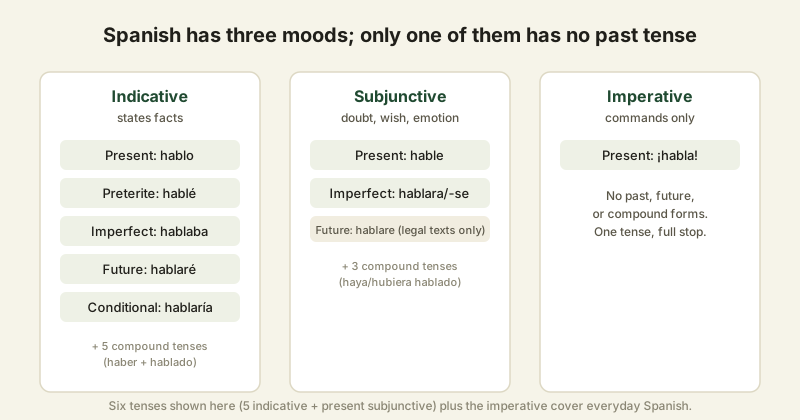
The chart: hablar across six tenses
Hablar is a fully regular -ar verb, which makes it the cleanest example: every form below comes from stripping -ar off the infinitive and attaching a standard ending, with no stem changes or exceptions involved. Regular -er and -ir verbs follow the same logic with their own ending sets. Comer ("to eat") becomes como, comí, comía, comeré, comería, coma; vivir ("to live") becomes vivo, viví, vivía, viviré, viviría, viva. Once the pattern below is familiar, applying it to any other regular verb is mostly a matter of swapping the stem.
Notice that nosotros stays identical in the present and preterite (hablamos, both times); the rest of the sentence is what tells them apart, not the verb form itself. These forms come from the same Wiktionary-checked conjugation generator this site uses for every regular verb on it, not typed in by hand.
What each tense is actually for
Present (hablo, hablas, habla...) covers habitual actions, general truths, and often the near future in casual speech: Hablo español ("I speak Spanish"), Salgo mañana ("I'm leaving tomorrow," present standing in for a planned future event).
Preterite (hablé, hablaste, habló...) and imperfect (hablaba, hablabas, hablaba...) split Spanish's simple past between a completed action viewed as a whole and an ongoing or habitual one viewed from the inside. Hablé con ella ayer ("I talked to her yesterday") reports a finished event; Hablaba con ella todos los días ("I used to talk to her every day") describes a repeated pattern with no marked start or end. This distinction trips up almost every English speaker learning Spanish, since English uses one past tense for both; the full preterite-versus-imperfect breakdown works through more pairs like this one.
Future (hablaré, hablarás, hablará...) states what will happen, though Spanish speakers reach for it less often in casual speech than the chart might suggest; ir a + infinitive (voy a hablar, "I'm going to talk") covers a lot of the same ground. The full future tense guide covers both.
Conditional (hablaría, hablarías, hablaría...) is Spanish's "would" form, used for hypotheticals and polite requests alike: Hablaría contigo si tuviera tiempo ("I would talk to you if I had time"). The conditional tense guide covers the polite-request use and other angles that go beyond a plain "would" translation.
Present subjunctive (hable, hables, hable...) shows up after expressions of doubt, wish, emotion, or influence over someone else's actions, rather than being tied to a particular point in time: Espero que hables con ella ("I hope you talk to her"). It's a mood shift as much as a tense, which the full subjunctive guide explains in more depth.
Imperative (¡habla!, an informal command) is the one form RAE describes as sitting outside the normal tense system entirely: just a present, no compound forms. Negative commands don't even use the imperative; Spanish borrows the present subjunctive for those instead (no hables, not a negated habla). The Spanish commands guide covers why affirmative and negative commands end up looking so different from each other.
The tenses this chart leaves out
Six tenses cover the forms in daily use, but a complete Spanish verb paradigm runs longer than that. Every simple tense above has a compound counterpart built from a conjugated haber plus an unchanging past participle: he hablado (present perfect), había hablado (pluperfect), habré hablado (future perfect), and so on. Learn haber's own conjugation once and all of those compounds follow automatically, since the participle itself never changes form.
The subjunctive adds two tenses beyond the present shown here: an imperfect (hablara or hablase, both correct and interchangeable) and, in formal or legal writing, an all-but-extinct future subjunctive (hablare) that RAE itself notes has narrowed almost entirely to legal texts today. For a verb with every one of these paradigms laid out and sourced, including the compound and rare forms, the full ser conjugation shows what the complete picture looks like for one (highly irregular) verb.