Five families, and three of them share their forms
French splits pronouns into five separate jobs rather than one all-purpose list, and per the Office québécois de la langue française's own reference on personal pronouns, several of the forms do double duty across those jobs instead of each family getting its own unique set of words. Subject pronouns (je, tu, il/elle/on, nous, vous, ils/elles) trigger the verb's conjugation and never do anything else. Direct object pronouns (me, te, le/la, nous, vous, les) stand in for whatever the verb acts on with no preposition in between: Je vois Marc becomes Je le vois. Indirect object pronouns (me, te, lui, nous, vous, leur) take over the same slot when the noun is attached to the verb by à: Je parle à Marc becomes Je lui parle.
Line those two object rows up and the overlap is obvious: me, te, nous, and vous are identical whether the object is direct or indirect. Only the third person actually splits, le/la against lui, and les against leur, which means most of the real learning curve in this system sits in one grammatical person, not across all six. Which pronoun family a verb takes in the first place comes down to its preposition, and French prepositions don't map onto English ones any more predictably than these pronoun families do: à, en, and dans can all translate as English "in," which is exactly the kind of mismatch that makes memorizing a verb's preposition, not its English translation, the only reliable way to pick the right pronoun family too.
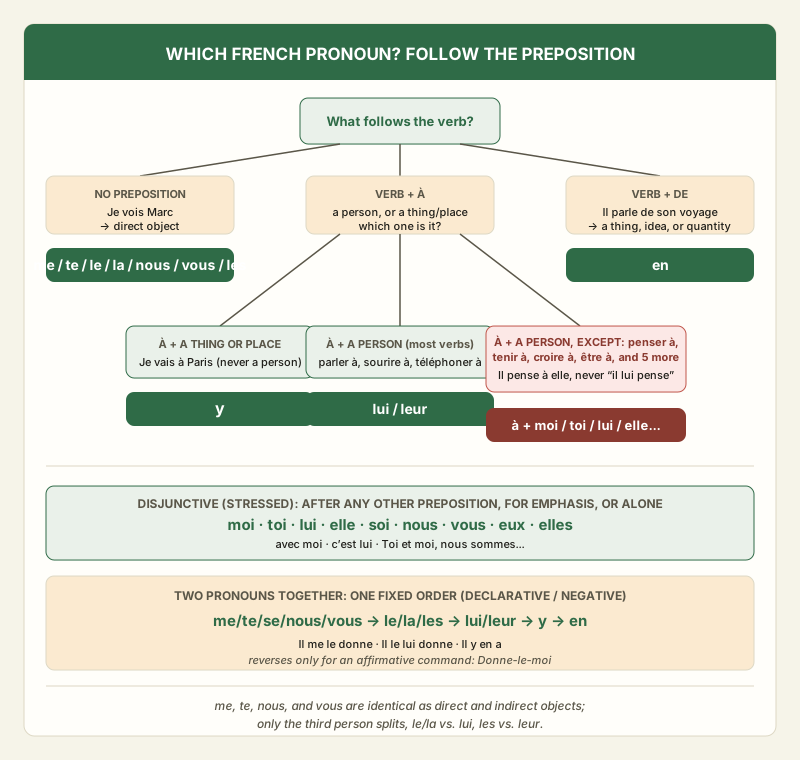
No preposition, à, or de: the test that actually decides it
The preposition a verb takes decides which family its object belongs to, not what the pronoun means in English and not whether the noun it replaces happens to be a person or a thing. Three tests cover almost every ordinary verb.
No preposition at all. The object attaches straight to the verb, so it takes a direct object pronoun: J'écoute la radio becomes Je l'écoute; Il connaît mes parents becomes Il les connaît.
Verb + à + a person, for most verbs. That calls for lui or leur: Je téléphone à ma sœur becomes Je lui téléphone; Il sourit aux enfants becomes Il leur sourit. Per a French pronoun reference published by Concordia University's Université ouverte des humanités, this is the ordinary pattern for verbs like parler à, sourire à, plaire à, appartenir à, ressembler à, nuire à, succéder à, and téléphoner à.
Verb + à + a thing or place. That calls for y instead, and y never stands for a person: Il répond à la question becomes Il y répond; Je vais à Paris becomes J'y vais.
Nine verbs that refuse lui and leur for a person
A short, fixed list of verbs breaks the "à + person = lui/leur" rule above. Per the same Université ouverte des humanités reference, verbs including penser à, songer à, croire à, tenir à, renoncer à, recourir à, être à, faire attention à, and rêver à route a personal object to à plus a disjunctive pronoun instead, even though the object is a person: Il pense à Marie becomes Il pense à elle, never the ordinary-looking Il lui pense. Elle tient à ses amis becomes Elle tient à eux. The same source adds a further set of pronominal verbs that follow the identical pattern: s'adresser à, s'attacher à, s'intéresser à, se plaindre à, se fier à, se joindre à, se rendre à, and s'opposer à all take à plus a disjunctive pronoun for a person, never lui or leur.
The two verb lists sit right next to each other in form and pull in opposite directions in practice: téléphoner à and penser à both take à plus a person, but only téléphoner hands that person over to lui. There's no shortcut for telling the two groups apart beyond that reference's own lists; the verb's meaning doesn't predict which side it falls on, which is exactly why generic language-learning guides tend to skip this exception rather than name the verbs it covers.
En replaces de-phrases, and it can stand for a person too
En stands in for a complement introduced by de, the same way y stands in for one introduced by à: J'ai besoin de ce livre becomes J'en ai besoin; Il parle de son voyage becomes Il en parle. It also carries French's expressions of quantity, standing in for de plus a number or an amount: J'ai deux frères becomes J'en ai deux.
Per the OQLF's own reference on the pronoun en, it most often stands for a thing or an animal, but it is explicitly accepted for a person too, and that accepted use isn't limited to counting: Mes deux enfants, j'en suis très fier ("My two children, I'm very proud of them") replaces the whole de mes deux enfants complement, not just a number attached to it. Where French still tends to reach for a disjunctive pronoun instead is a single, specific person named as the sentence's sole focus: Je parle de Pierre more often becomes Je parle de lui than J'en parle, though this choice isn't as rigid a fork as the à-side exception verbs from the previous section.
Disjunctive pronouns: after prepositions, for emphasis, and standing alone
Disjunctive pronouns, moi, toi, lui, elle, soi, nous, vous, eux, elles, are the pronouns French reaches for whenever a personal pronoun has to stand on its own rather than attach directly to a conjugated verb. Per the OQLF's reference on the disjunctive pronoun, that covers several distinct situations: after any preposition other than the à that routes to lui, leur, or y (avec moi, chez eux, pour toi), for emphasis or contrast (Moi, je pense que...), inside a compound subject or object (Toi et moi, nous sommes de bons amis), standing completely alone or right after c'est (C'est moi), and the exception-verb pattern from the previous section (penser à elle).
Soi is the odd one out on that list: it pairs with an indefinite or generic subject rather than a specific person, as in chacun pour soi or on doit avoir confiance en soi, and it never substitutes for a named il or elle the way the other eight forms do.
Stack two pronouns and they lock into one order, except in a command
When a sentence needs two object pronouns at once, French doesn't let them fall in whatever order feels natural. In an ordinary declarative or negative sentence, they line up in a fixed sequence: me/te/se/nous/vous, then le/la/les, then lui/leur, then y, then en. Il me le donne (me before le), Il le lui donne (le before lui, since both are third person and lui drops behind), Il nous y emmène (nous before y), Il y en a (y before en, the fixed phrase "there is/are").
That order only reverses in one place: an affirmative command, where the direct object moves ahead of the indirect one instead (Donne-le-moi, not Donne-moi-le), a rule covered in full, including the hyphenation and the negative-command reversal back to ordinary order, in the French imperative guide. Spanish double object pronouns enforce an equally strict order of their own, but for a different reason: Spanish blocks le or les from sitting directly in front of lo, la, los, or las and substitutes se instead (se lo doy, never le lo doy), while French makes no such substitution; it just lines le/la/les up ahead of lui/leur in sequence, as two separate words, the same way it does for every other pronoun pair.