Why two pronouns end up in one sentence
Spanish routinely names both the thing being given, shown, or told and the person receiving it, and each half is what direct and indirect object pronouns individually replace. Le doy el libro a María (I give María the book) already uses one: le stands in for a María. Drop the noun phrase for the book too, and Spanish swaps in a second, direct object pronoun instead: lo, for el libro. Put both pronouns in the same sentence, in the order Spanish requires, and le doy el libro becomes se lo doy, never le lo doy, a combination that doesn't actually occur in Spanish, for the reason covered below.
Any clause that answers both "what" and "to/for whom" in pronoun form ends up carrying a pair like this: me lo, te la, nos los, os las, se lo. Every one of them follows the same two rules: a fixed order, and a mandatory substitution whenever le or les would otherwise land in front of a third-person direct object pronoun.
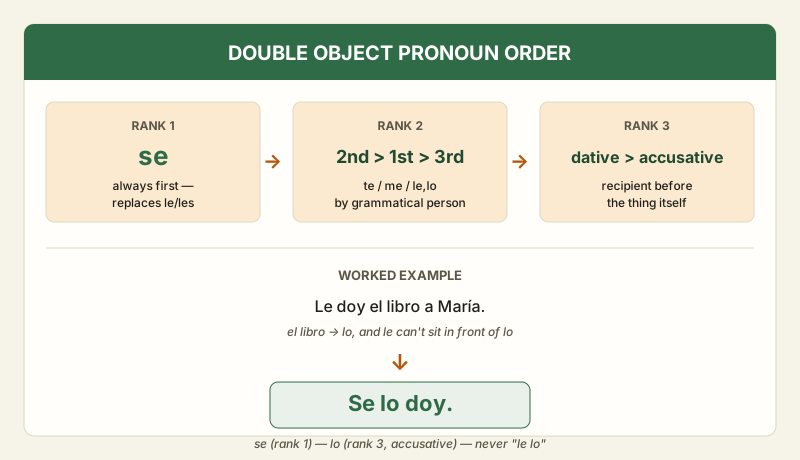
The order rule: se first, then person, then role
The Real Academia Española's Nueva gramática básica lays out the sequence for combined atonic pronouns as a strict hierarchy, each condition outranking the ones that follow it. Se always comes first, ahead of every other pronoun. Among what's left, second person outranks first, which outranks third: te before me, me before le/les/lo/la. And within a single person, the dative pronoun (the recipient, "to/for" someone) precedes the accusative pronoun, the thing itself.
That hierarchy is why me lo dan (they give it to me) and te lo doy (I give it to you) put the person pronoun first and the thing pronoun second, never the reverse: lo me dan isn't a sentence Spanish produces. Nos lo enseñan (they teach it to us) and os la mandamos (we send it to you all) follow the identical pattern across every person, not only the third. The RAE's own grammar gives the same dative-before-accusative pattern in a single worked example: "Te lo enviaron."
Why "le" and "les" become "se"
The one pairing Spanish blocks outright is le or les sitting directly in front of lo, la, los, or las; that specific sequence doesn't exist as a spoken form. Whenever it would occur, le/les is replaced by se, a substitution that applies mechanically every time, regardless of what the underlying le was standing in for. Le doy el libro a María becomes, once el libro is also pronominalized, Se lo doy, never Le lo doy.
Se itself carries no gender or number marking, which makes it genuinely ambiguous on its own: se lo mostró could mean "showed it to him," "to her," "to you (formal)," or "to them," with nothing in the pronoun itself to settle which. When context doesn't make it clear, Spanish adds the same kind of clarifying phrase used with a single indirect object pronoun (se lo mostró a ella, se lo mostró a ellos), spelling out who se refers to without changing the pronoun.
Where the pair goes: before the verb, or fused onto it
Double object pronouns follow the same placement pattern as a single object or reflexive pronoun: they go immediately in front of a conjugated verb (Te lo doy. No me lo digas.) and shift to attaching after the verb, fused into a single written word, with infinitives, gerunds, and affirmative commands: Voy a dártelo (or Te lo voy a dar, both correct), Estoy explicándoselo, Dámelo, Dénmelas.
Fusing two pronouns onto a verb form almost always pushes the stress back far enough that Spanish's ordinary accent rules require a written accent to keep the pronunciation unchanged. The RAE's orthography guide gives dámelo, dénmelas, and pedírsela as exactly this case: words that become esdrújulas (stressed on the third-to-last syllable) once both pronouns attach, which is why they carry a tilde the bare verb form doesn't need. Negative commands break the fusion pattern entirely and send both pronouns back in front of the verb: No me lo des, No se lo digas, never No dámelo or No díselo. The RAE's own grammar walks through this exact alternation in one string of examples: "Se lo daré; Traigo esto para dárselo; Dáselo; No se lo des." That progression is proclitic before a conjugated verb, then enclitic fused onto an infinitive, then enclitic fused onto an affirmative command, then back to proclitic the moment the command turns negative.
Common mistakes with double object pronouns
The order slip is the most frequent: putting the thing before the person, as in lo me dan instead of me lo dan, reverses the RAE's person-before-role hierarchy and reads as a beginner error rather than a regional variant. The second is forgetting the se substitution and producing le lo doy, a sequence that simply doesn't occur in Spanish, however logical it looks to an English speaker mentally translating "to him" plus "it" word for word.
The third is leaving one pronoun behind when attaching to an infinitive or gerund, splitting them instead of moving both together as a single fused unit: the correct form is voy a dártelo, not two separate pieces. The fourth is dropping the written accent that two fused pronouns almost always require, writing damelo instead of dámelo, a missing tilde that doesn't change the meaning in isolation, but is the kind of small, checkable error native readers notice immediately.