Three points on a line, not two
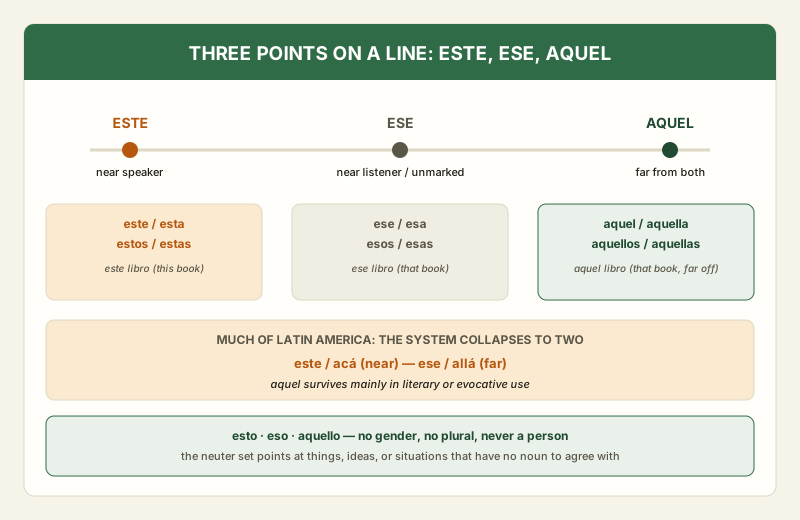
English gets by with two demonstratives, "this" for what's near and "that" for everything else. Spanish keeps a third position: este/esta/estos/estas marks what's near the speaker, ese/esa/esos/esas marks what's near the listener, and aquel/aquella/aquellos/aquellas marks what's far from both. The RAE's grammatical glossary classifies all three as determinantes demostrativos, the adjective-like set that sits in front of a noun and narrows it down by position, not by ownership, the job Spanish's possessive forms handle instead.
Este libro ("this book," in the speaker's hands), ese libro ("that book," over by the listener), and aquel libro ("that book," across the room or further) can describe the exact same object depending on where the speaker imagines it relative to each person in the conversation. English speakers default to treating ese and aquel as interchangeable synonyms for "that," and for a lot of everyday speech the mix-up goes unnoticed, but the three-way system is real, and the sections below cover where it actually changes meaning.
Ese isn't really "medium distance": it's the unmarked term
Most English-language explanations describe the three-way system as near / medium / far, as if ese always meant "medium distance" the way "medium" sits between "small" and "large." The RAE's Nueva gramática de la lengua española, in its entry on the classes of demonstratives, notes a more recent analysis that treats the real opposition as binary rather than three equal steps: este marks closeness to the speaker, aquel marks distance from both speaker and listener, and ese is the unmarked term, carrying no fixed distance value of its own and able to lean toward either reading depending on where the listener is standing and what the speaker wants to emphasize.
That's why ese so often gets used for something that isn't literally halfway between the speaker and something far off. Ese problema ("that problem") doesn't place the problem at a measured midpoint; it just declines to claim the speaker's own space (este) or push the thing conspicuously far away (aquel). Treating ese as a fixed middle distance is the kind of rule that sounds tidy in a table and falls apart the first time it meets real usage.
In much of Latin America, the system collapses to two
The three-way split isn't universal across the Spanish-speaking world. The same RAE grammar entry describes a binary system active in parts of Latin America, where este pairs with the adverb acá to mark closeness to the speaker, and ese pairs with allá to mark distance, leaving aquel largely reserved for literary writing and for what the Academia calls deixis evocadora: pointing back at something remembered or emotionally distant, not physically far away, closer to English "in those days" than to a spatial "over there."
A learner who only studies the three-way peninsular system can walk away thinking aquel is a routine, everyday word across the Spanish-speaking world; in practice, its frequency in ordinary conversation varies a lot by region, and hearing it less often in Latin American speech isn't a sign of nonstandard Spanish, it's the binary system doing its job.
Este and aquel do a different job inside a written sentence
Beyond pointing at physical objects, demonstratives also do anaphoric work, referring back to something already mentioned in a text, and here este and aquel split a different way. When a sentence has already named two things, aquel typically refers back to whichever one was mentioned first (the more distant, in text-position terms), while este refers back to whichever was mentioned second (the nearer one). Juan y Pedro discutieron: este defendía su idea, aquel la suya ("Juan and Pedro argued: the latter defended his idea, the former defended his own") uses este for Pedro, the more recently named of the two, and aquel for Juan, the one named first. English states "the former... the latter" in the same order the two people were introduced, former for whoever came first, then latter for whoever came second. Spanish reverses that word order: este comes first in the sentence even though it points to the second-named person, and aquel comes second even though it points back to the first-named one.
This usage shows up mostly in formal or literary writing rather than casual conversation, but it explains a pattern that otherwise looks backwards to an English speaker: aquel referring to what's textually "closer" to the start of the sentence, not to what's physically far away.
The exception nobody expects: "esta águila," not "este águila"
Spanish famously uses the masculine article el in front of feminine singular nouns that start with a stressed a- sound (el águila, el agua, el hacha), purely to avoid two a-sounds colliding, even though águila, agua, and hacha stay grammatically feminine (las águilas, agua fría, not agua frío). Learners who've internalized that rule often extend it by analogy to demonstratives, producing este águila or ese agua on the assumption that the same euphonic fix applies.
The RAE's Nueva gramática is explicit that this analogy is wrong. The masculine-looking este, ese, and aquel before these nouns has become common in speech and writing, but the Academia recommends the feminine forms instead (esta águila, esa águila, aquella agua), because demonstratives, unlike the article el, don't carry the specific phonological shape that motivated the article's exception in the first place. It's a genuine trap precisely because it runs opposite to a rule learners were taught correctly for articles just one lesson earlier.
Esto, eso, aquello: the neuter set with no noun to modify
Alongside the twelve gendered, numbered forms above, Spanish has a separate three-word neuter set: esto, eso, and aquello. The RAE's grammar treats these as exclusively pronominal. They never precede a noun, never change for number, and never take a written accent, unlike their gendered counterparts, which historically could carry one as pronouns before the 2010 spelling reform dropped that requirement.
Esto, eso, and aquello point at things that don't have a grammatical gender to agree with: an idea, a situation, an action, something gestured at without being named. ¿Qué es esto? ("What is this?") can gesture at an object whose name the speaker doesn't know or hasn't decided on yet. The RAE is specific that these forms are meant for non-personal referents, and using esto or eso to identify a person (Esto, más que un muchacho, parece un espantapájaros, "This, more than a boy, looks like a scarecrow") reads as offensive, not simply informal. There's one carve-out: in an attributive sentence built with ser, the same neuter form can flip to praise instead of insult, as in Esto es un jugador de verdad ("Now this is a real player"), where the construction singles the person out for admiration rather than stripping them of ordinary gendered reference.