Two parts, one sandwich, and the half that vanishes in speech
French negation is built from two separate pieces that only work as a pair. The adverb ne (n' before a vowel sound) comes first, and a second negative word closes the sandwich around the conjugated verb: Je ne sais pas ("I don't know"), Elle ne mange jamais de viande ("She never eats meat"), Nous n'avons rien vu ("We saw nothing"). English gets by with a single negative marker; per the OQLF's own syntax reference on negation, French routinely needs both an adverb (ne) and a second negative element, which can be another adverb (pas, plus, jamais, guère), a pronoun (personne, rien, aucun), or a determiner (aucun, nul) standing in front of a noun.
That first half is also the one careful writing can't drop but relaxed speech drops constantly. Per Larousse's own dictionary entry on ne, the particle disappears routinely in casual spoken French, and the dictionary's own illustrative examples show exactly what that looks like: j'irai pas, il veut jamais, c'est pas moi, next to the written-French versions of the same three sentences, je n'irai pas, il ne veut jamais, ce n'est pas moi. A learner who only studies textbook French can be caught off guard the first time a native speaker says J'sais pas instead of Je ne sais pas; it isn't sloppiness, it's the normal register split Larousse itself documents.
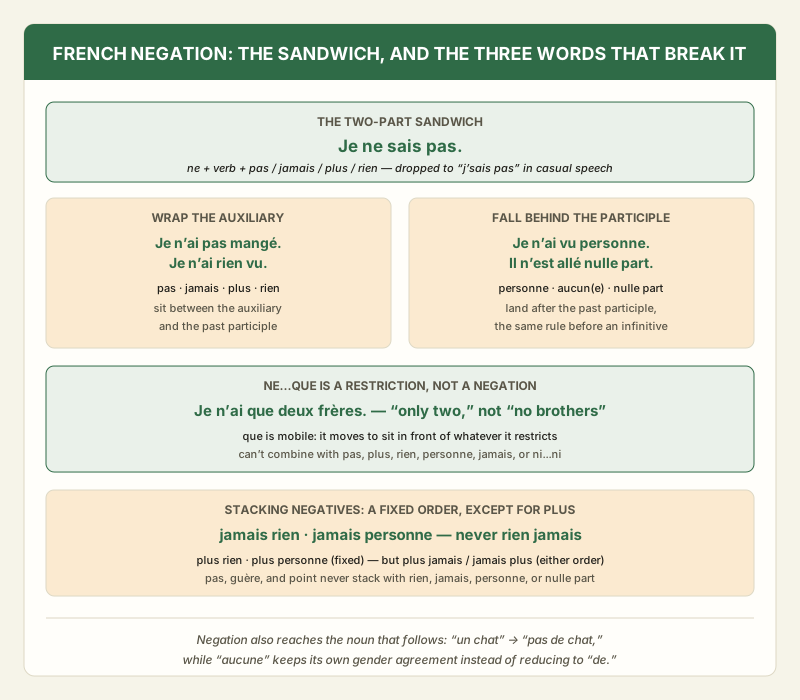
In compound tenses, three words refuse to hug the auxiliary
In a simple tense, the sandwich just wraps the one verb. In a compound tense like the passé composé, there are two verb parts, an auxiliary (avoir or être) plus a past participle, and most negative words squeeze into the gap between them, exactly where pas sits: Je n'ai pas mangé, Je n'ai jamais visité Lyon, Je n'ai plus vu Marc depuis ce jour-là, Je n'ai rien vu. Pas, jamais, plus, and rien all take that same slot, immediately after the auxiliary and before the participle.
Personne, aucun, and nulle part refuse to sit there. Per the OQLF's own reference page on personne as an indefinite pronoun, which gives Je n'y ai trouvé personne as its own worked example, personne moves past the participle entirely instead of wedging in front of it: Je n'ai vu personne, not the pas-style Je n'ai personne vu. Nulle part follows the identical rule, landing after the participle: Il n'est allé nulle part. Aucun (or aucune, since it agrees in gender with the noun it stands in for) does the same: Elle n'a fait aucune faute, not aucune wedged before the participle the way rien would be. Three words, one shared behavior that sets them apart from every other negative in the language: they land after the participle, not between the two verb parts. That three-word exception list is small by design: French confines almost all of its structural unpredictability, this kind included, to a closed set of cases, the same closed-set logic that keeps French's genuinely irregular verbs down to just four members that don't reduce to a shared family rule.
The same three words fall behind an infinitive, too
Negating an infinitive, after il faut, pour, afin de, avant de, or décider de, keeps both halves of the negation together as a single block sitting in front of the infinitive, in the order ne + [negative word] + infinitive: Il a décidé de ne pas venir ("He decided not to come"), J'essaie de ne jamais mentir ("I try never to lie"), Elle préfère ne rien dire ("She prefers to say nothing"). Pas, jamais, and rien front-load the infinitive the same way they front-load an auxiliary.
Personne and nulle part break from the group again, and in the same direction as before: both trail behind the infinitive instead of standing in front of it. Préférer ne voir personne ("to prefer to see nobody") puts personne after voir, not before it, mirroring exactly how it falls after a past participle rather than in front of one. The two contexts, compound tenses and infinitives, are really the same underlying rule showing up twice: whatever construction has a second verb form for the negative word to attach around, personne and nulle part attach to the far side of it rather than the near side.
Ne...que isn't negation at all, and que refuses to sit still
Ne...que looks like it belongs on the same list as ne...pas or ne...rien, but it functions as a restriction meaning "only" rather than a true negation: Je n'ai que deux frères doesn't deny having brothers, it limits the count to exactly two, functionally equivalent to Je n'ai seulement deux frères. Because it restricts rather than negates, ne...que can't be combined with pas, plus, rien, personne, jamais, or ni...ni to build one coherent sentence; que has to work alone against ne, the way any single true negative word does.
Que also refuses to sit in the fixed slot pas, jamais, plus, and rien all share. It's mobile, moving to sit directly in front of whichever element of the sentence it's actually restricting, rather than staying anchored right after the verb: Il n'a mangé que la moitié du gâteau (restricting the quantity eaten) reads differently from Il n'a mangé que le matin (restricting when the eating happened), with que sliding to whichever phrase carries the restriction. In compound tenses, que still can't move in front of the auxiliary the way ne does; ne stays anchored before avoir or être, and que floats somewhere after the past participle, wherever the restricted element sits.
Stacking negatives: jamais outranks rien and personne, but plus can go either way
French allows more than one negative word in a single clause without them canceling each other out the way a double negative would in standard English. Ils ne vont jamais rien perdre ("They will never lose anything") stacks jamais and rien in one sentence, and the order between them isn't arbitrary: jamais consistently comes before rien, personne, or nulle part when they combine, so jamais rien is the pattern, not rien jamais.
Plus is the one flexible piece. Combined with jamais, either order is accepted: Je ne ferai plus jamais ça and Je ne ferai jamais plus ça both mean "I will never do that again," with no meaning difference between the two orderings. Combined with rien, personne, or nulle part instead, plus takes the first slot every time: plus rien, plus personne, plus nulle part, never the reverse. What plus won't do is combine with pas, guère, or point; those three don't stack with rien, jamais, personne, or nulle part either, which keeps the two negation systems, the "pas family" and the "jamais/rien/personne family," from mixing into the same sentence.
One more thing negation changes: the article on the noun that follows
Negating a verb doesn't just add ne and a second word, it can reach into the noun phrase that follows and change the article, too. J'ai un chat becomes Je n'ai pas de chat, with the indefinite article un collapsing down to a bare de. That reduction, including its three real exceptions (a linking être, an implicit contrast, and the restrictive ne...que construction covered above, which keeps the article unchanged because nothing is actually being denied), is covered in full in the French articles guide; it's the same negation system this article covers, just reaching one step further into the sentence.
Aucun works differently from that de-reduction, even though the two land on similar-sounding English translations. Je n'ai pas de sœur strips the article down to bare de, but Je n'ai aucune sœur keeps aucune standing directly in the article's own slot, agreeing in gender with sœur the way an article would, rather than reducing to an invariant particle. Aucun also stays grammatically singular no matter what it's negating, even for nouns that are normally plural-only (aucunes vacances doesn't exist; aucune vacance does), because it's asserting a count of zero, and zero is inherently singular. Commands built on any of this negation machinery, and the pronoun-order reversal that comes with a negative command specifically, are covered separately in the French imperative guide, including why dis-le-moi flips to ne me le dis pas the moment the command turns negative.