Regular endings first, because irregularity means a different stem, not different endings
Regular preterite verbs attach one of two endings sets to the infinitive stem: -ar verbs take -é, -aste, -ó, -amos, -asteis, -aron (hablé, hablaste, habló...), and -er/-ir verbs share -í, -iste, -ió, -imos, -isteis, -ieron (comí, comiste, comió... vivi, viviste, vivió...). Most Spanish "irregular preterite" lists throw dozens of verbs at you with no explanation of what they actually have in common, which makes the whole tense feel like arbitrary memorization.
It isn't, for the majority of the common ones. What actually happens with most irregular preterites is that the verb keeps a version of the -er/-ir ending set, but swaps in a completely different stem, and drops the written accents that mark regular yo and él/ella forms. Once you see that the endings barely change and only the stem does, the list stops looking random and starts looking like a small number of families, each built around one new stem. (For where the preterite sits among Spanish's other core tenses, see the six-tense overview chart.)
The u-stem family: one new stem, one set of endings
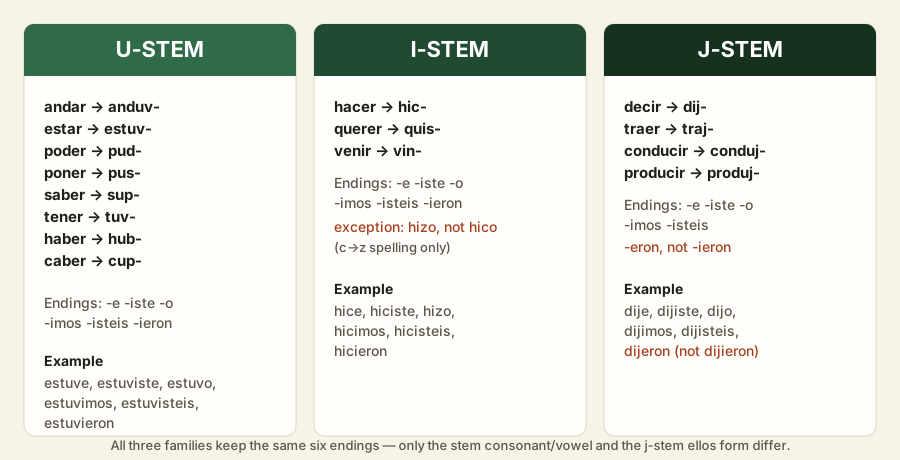
Eight common verbs replace their stem with one containing -u- in the preterite, then all take the same endings: -e, -iste, -o, -imos, -isteis, -ieron, with no written accents anywhere in the paradigm. The verbs: andar → anduv-, estar → estuv-, poder → pud-, poner → pus-, saber → sup-, tener → tuv-, haber → hub-, caber → cup-.
Take estar as the model: estuve, estuviste, estuvo, estuvimos, estuvisteis, estuvieron. Swap in any of the other seven stems and the endings don't change at all. Estuve en Madrid la semana pasada ("I was in Madrid last week"). Tuve que salir temprano ("I had to leave early"). No pudimos terminar a tiempo ("We couldn't finish on time").
Notice there's no accent on estuve or estuvo, unlike a regular -ar preterite like hablé or habló. That's consistent across every irregular preterite stem covered on this page: the accent marks that distinguish regular yo/él forms (hablé vs. hable, the present subjunctive) simply don't apply once the stem itself is irregular, because there's no longer a regular form to distinguish from. The endings themselves, for every one of these irregular stems, are still the same six-form set that regular preterite verbs use; what makes a verb irregular here is only ever the stem, never a different ending list.
The i-stem and j-stem families
Three verbs form an i-stem group with the same six endings as the u-stem family: hacer → hic- (hice, hiciste, hizo, hicimos, hicisteis, hicieron), querer → quis- (quise, quisiste, quiso...), venir → vin- (vine, viniste, vino...). The one spelling wrinkle is hacer's third-person singular: it's written hizo, not hico, because Spanish spelling always writes the "s" sound before o with z rather than c in this position. The sound is completely regular; only the letter changes.
A separate j-stem group covers decir → dij-, traer → traj-, and every verb ending in -ducir (conducir → conduj-, traducir → traduj-, producir → produj-, reducir → reduj-). These take the same endings as the u-stem and i-stem groups, with one exception: the ellos/ellas/ustedes form drops the i before -eron. So it's dijeron, trajeron, condujeron, never dijieron, trajieron, condujieron. Le dije la verdad ("I told him the truth"). Trajeron comida para todos ("They brought food for everyone"). El gobierno redujo los impuestos ("The government reduced taxes").
All three families (u-stem, i-stem, j-stem) exist for the same underlying reason: these verbs descend from Latin forms that already had irregular perfect-tense stems, so the irregularity isn't a modern quirk, it's inherited. That's also why the pattern holds across the whole family, not verb-by-verb: once a verb belongs to one of these stem classes, every person of the preterite follows the same rule.
Two verbs that don't fit any family: dar and ver
Dar is an -ar verb, so by the regular pattern it should take -é, -aste, -ó, -amos, -asteis, -aron. It doesn't. Instead, dar borrows the -er/-ir ending set with the accents removed: di, diste, dio, dimos, disteis, dieron. Me dio su número de teléfono ("She gave me her phone number"). There's no stem change here (the stem is just d-), only a borrowed ending set, which makes dar irregular for a different reason than the u/i/j-stem verbs above.
Ver keeps the regular -er endings, but drops every written accent because its stem is just a single vowel: vi, viste, vio, vimos, visteis, vieron. Compare that to a regular -er verb like comer (comí, comió, with accents on the í and ió) and the missing accents on vi and vio stand out immediately. Vi la película ayer ("I saw the movie yesterday").
Both dar and ver used to be written with accents on their third-person singular forms, dió and vió, before a 1959 Real Academia Española spelling reform removed accent marks from one-syllable words as a general rule, with only a small set of diacritical exceptions (like sí "yes" versus si "if") kept for meaning. Dió and vió are now considered misspellings, but they still turn up in older books and in writing by people who learned the pre-reform convention.
Ir and ser share one preterite, literally
Ir ("to go") and ser ("to be") are two completely unrelated verbs in the present tense (voy vs. soy), but in the preterite they collapse into one identical paradigm: fui, fuiste, fue, fuimos, fuisteis, fueron. There is no spelling or accent difference between the ir-preterite and the ser-preterite at all; only the sentence around the verb tells you which one is meant.
Fui a la tienda only makes sense as ir ("I went to the store"), since ser can't take a destination. Fui estudiante en esa universidad only makes sense as ser ("I was a student at that university"), since ir can't take a noun complement like that. Most sentences disambiguate this easily and natively; the overlap causes confusion mainly for learners who haven't yet built the instinct to check what kind of complement follows fui. For the rest of ser's (very irregular) paradigm across every tense, see the full ser conjugation table.
Spelling changes aren't the same thing as true irregularity
A large group of preterite forms that get labeled "irregular" are actually just regular verbs with a spelling adjustment to preserve pronunciation, not a different underlying stem. Verbs ending in -car, -gar, and -zar change their spelling only in the yo form: buscar → busqué (not buscé, which would sound like "boo-SEH," not "boo-SKEH"), llegar → llegué (not llegé), empezar → empecé (not empezé). Every other person of these verbs is completely regular: buscaste, buscó, buscamos are unaffected.
A second spelling-only group covers -eer, -oír, and -uir verbs, where an unstressed i between two vowels becomes y in the third-person forms, and the surviving í in the other forms picks up a written accent it wouldn't otherwise need: leer → leí, leíste, leyó, leímos, leísteis, leyeron; oír → oí, oíste, oyó, oímos, oísteis, oyeron; construir → construí, construiste, construyó, construimos, construisteis, construyeron. This is the same underlying spelling rule in both directions (i between vowels becomes y; a stressed i next to another vowel gets an accent), and neither the stem nor the meaning is doing anything irregular.
The distinction matters for a practical reason: the u-stem, i-stem, and j-stem verbs above have to be memorized verb by verb, because the stem itself changed. The -car/-gar/-zar and -eer/-oír/-uir groups don't; once you know the one spelling rule, it applies automatically to every verb in that class, including ones you've never seen conjugated before.
Stem-changing -ir verbs: only the third person moves
Present-tense stem-changing verbs that end in -ar or -er (pensar, volver, and similar verbs) are completely regular in the preterite; their stem change is a present-tense-only phenomenon and doesn't carry over. Stem-changing -ir verbs are different: they do carry a change into the preterite, but only in the third-person singular and plural, never in yo, tú, nosotros, or vosotros.
The e → i pattern covers verbs like pedir, sentir, servir, seguir, repetir, and preferir: pedí, pediste, pidió, pedimos, pedisteis, pidieron. Only pidió and pidieron carry the change; the other four forms are entirely regular. The o → u pattern is rarer, limited mainly to dormir and morir: dormí, dormiste, durmió, dormimos, dormisteis, durmieron.
This third-person-only pattern is a genuinely different mechanism from the u-stem, i-stem, and j-stem families covered earlier, where the entire paradigm shares the new stem. Here, four of the six forms stay completely regular, and only the two third-person forms shift, which is why grouping this pattern in with "irregular verbs" in general can be misleading: it's closer to a narrow, rule-governed exception than to genuine stem irregularity.
Three mistakes that come from mixing up these groups
Dijieron is wrong; dijeron is right. This is a common error with the j-stem group, caused by treating decir like an i-stem verb (which would take -ieron) instead of a j-stem verb (which drops the i).
Pedió is wrong for the third person singular; pidió is right. Learners who've memorized "pedir is regular except for the stem change" sometimes forget the change is required, not optional, in the third person, and default to the plain infinitive stem instead.
Dió and vió, with accents, are outdated spellings rather than acceptable variants; current usage is dio and vio, with no accent, following the 1959 reform covered above. This one shows up most often in older textbooks or in writing influenced by them, not from an obvious grammar rule to mix up.