Two endings sets, and -er and -ir stop splitting
Every regular Spanish verb in the imperfect drops its infinitive ending (-ar, -er, or -ir) and adds one of exactly two endings sets, decided only by whether the infinitive ended in -ar or in something else. There's no third pattern to learn and no verb-by-verb variation among regular verbs: once a verb is regular, its imperfect forms are fully predictable from its infinitive alone.
That's a real simplification compared to most other Spanish tenses, where -er and -ir verbs share most endings but still split in a couple of spots. In the present tense, for example, -er and -ir verbs match everywhere except the nosotros and vosotros forms: comemos/coméis (-er) versus vivimos/vivís (-ir). The imperfect drops that split entirely. -Er and -ir verbs take the identical six endings, with no exceptions anywhere in the paradigm.
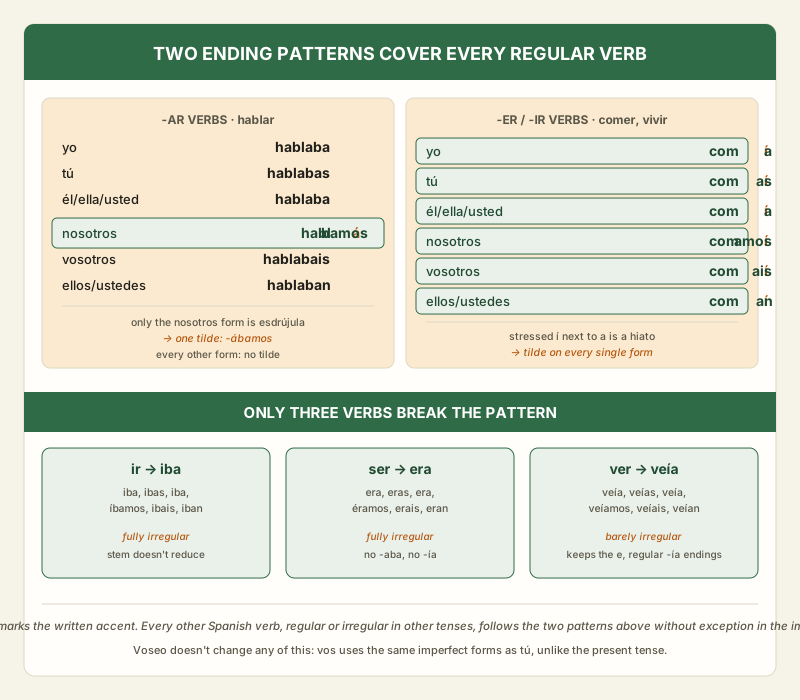
The -ar pattern: one accent, and only in one spot
-Ar verbs take -aba, -abas, -aba, -ábamos, -abais, -aban. Worked through with hablar: hablaba, hablabas, hablaba, hablábamos, hablabais, hablaban. Hablaba español en casa ("I used to speak Spanish at home"). Trabajábamos juntos todos los veranos ("We used to work together every summer").
Exactly one of those six forms carries a written accent: hablábamos. That's not arbitrary. Spanish's general stress rules require a written accent on any word stressed on the third-to-last syllable, a class called esdrújula, with no exceptions. Hablábamos breaks down as ha-BLÁ-ba-mos, stressed on the third syllable from the end, which makes it esdrújula and forces the accent. Every other form in the set (hablaba, hablabas, hablabais, hablaban) is stressed on the second-to-last syllable and ends in a vowel or -n, which is exactly the pattern that normally takes no written accent at all.
The -er/-ir pattern: an accent on every single form
-Er and -ir verbs both take -ía, -ías, -ía, -íamos, -íais, -ían. Worked through with comer and vivir: comía, comías, comía, comíamos, comíais, comían; vivía, vivías, vivía, vivíamos, vivíais, vivían. Vivíamos en Bogotá cuando era niño ("We used to live in Bogotá when I was a kid").
Here every single form carries a written accent, on the í, and that's a different rule from the one that puts the accent on hablábamos. Real Academia Española's orthography guide states that a stressed closed vowel (i or u) next to an open vowel (a, e, o) always takes a written accent, overriding the general stress rules entirely, and lists sabíais, an imperfect form, as one of its own examples of the rule. That combination, a stressed í touching an a, is called a hiato: without the accent, ia would tend to collapse into a single glide syllable, and the accent is what keeps the í as its own syllable and marks it as the stressed one. Every person of the -ía set has that same í-next-to-a shape, which is why the accent shows up in all six forms instead of just one.
Only three verbs break the pattern, and one barely counts
Ir and ser are the only two fully irregular verbs in the entire Spanish imperfect. Ir takes iba, ibas, iba, íbamos, ibais, iban, forms with no visible connection to the infinitive stem at all. Ser takes era, eras, era, éramos, erais, eran, equally unconnected to ser itself. Neither one reduces to a stem plus a regular ending; both simply have to be memorized as their own six-form sets.
Ver is the third verb usually listed as irregular, but it barely qualifies. It takes the completely regular -ía endings, veía, veías, veía, veíamos, veíais, veían, and the only irregularity is that the stem keeps its e instead of dropping to nothing the way a normal -er verb's single-letter stem would. Compare it to a genuinely irregular verb like ir, which doesn't follow either endings pattern at all, and ver's "irregularity" is really just one letter of stem, not a different set of endings. That distinction matters for the same reason it matters in the irregular preterite verbs: the preterite has whole families of verbs that swap in a new stem and still share one endings set, while the imperfect has almost none of that. Ir and ser are the exceptions, not the start of a pattern, and ver isn't really an exception to the endings at all.