One form, but "will" is only one of its jobs
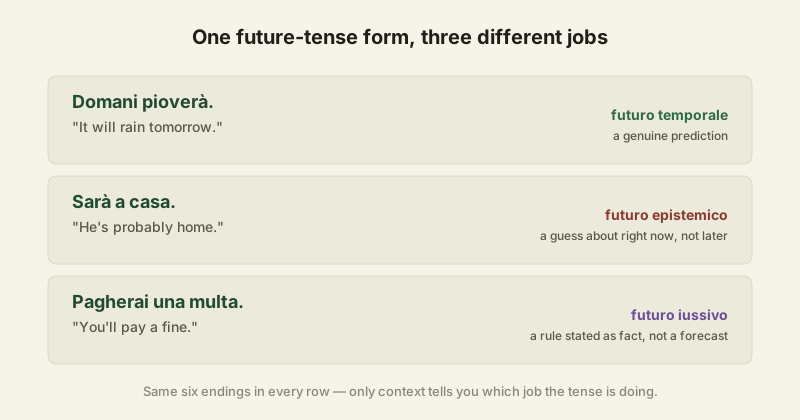
Domani pioverà a Milano ("It will rain tomorrow in Milan") is the future tense doing exactly what an English speaker expects: pointing at something that hasn't happened yet. Mio marito non è tornato: avrà perso il treno uses the identical grammatical form, avrà, in a sentence that isn't about the future at all. It means "He's probably missed the train," a guess about something that may already be true right now, not a prediction about later.
Treccani's Enciclopedia dell'Italiano groups prediction, intention, softened claims, and commands together as usi deittici: uses that still nominally point at a future moment, however loosely that's stretched. Only two functions fall outside that grouping entirely, guessing about the present and marking which of two events comes first, and both share the identical conjugation with every deittico use. Even inside the "points at the future" label, the tense covers plenty a learner who memorizes "future tense = will" would never predict.
Building it: one set of endings, no split by conjugation class
Regular formation is mechanical, and unlike the present tense or the passato remoto, it doesn't split into three separate patterns for -are, -ere, and -ire verbs. Drop the infinitive's final -e, then add one of six endings that are identical across every conjugation class: -ò, -ai, -à, -emo, -ete, -anno. Credere becomes crederò, crederai, crederà, crederemo, crederete, crederanno; partire becomes partirò, partirai, partirà, partiremo, partirete, partiranno.
The one adjustment applies only to -are verbs: they swap their characteristic -a- for -e- before the ending goes on, matching the -ere and -ire stem vowel exactly. Parlare doesn't become parlarò; it becomes parlerò. Mangiare becomes mangerò, not mangiarò.
Two spelling adjustments exist purely to keep pronunciation intact, not to mark anything grammatical. -care and -gare verbs insert an h before the ending: giocare becomes giocherò, not giocerò, which would soften the hard c [k] into the ch sound [tʃ]. Conversely, -ciare and -giare verbs drop their silent i, since it existed only to soften the c/g in the infinitive and the following e already does that job on its own: cominciare becomes comincerò, not comincierò.
Sixteen verbs that shorten instead of just adding endings
Sixteen common verbs keep the same six endings but attach them to a shortened stem instead of the full infinitive: andare → andr-, avere → avr-, bere → berr-, dare → dar-, dire → dir-, dovere → dovr-, essere → sar-, fare → far-, potere → potr-, rimanere → rimarr-, sapere → sapr-, stare → star-, vedere → vedr-, venire → verr-, vivere → vivr-, volere → vorr-. Once the stem is settled, the endings attached to it are the same regular six every other verb uses: avere becomes avrò, avrai, avrà, avremo, avrete, avranno.
Most of these come from the same mechanism: an unstressed vowel dropping out of the stem, sometimes followed by the resulting consonant cluster smoothing into a doubled r. Treccani traces two specific cases directly: vedere loses its unstressed e (vederò becomes vedrò), while venire both loses the vowel and then has its n assimilate into the following r (venirò becomes ∗venrò, which becomes verrò). Bere, rimanere, and volere end up with the same -rr- shape through the same kind of vowel loss and assimilation.
Two of the sixteen break that pattern in the opposite direction: dare and stare keep their -a- instead of losing it, giving darò and starò rather than a shortened stem. Treccani offers this as the likely explanation rather than a settled one: the -a- probably survives here by analogy with those two verbs' own present-tense forms, do and sto.
Where a "regular" ending like -ò actually comes from
Classical Latin already had its own synthetic future, but sound changes had quietly blurred its endings into the present and imperfect until the three tenses became hard to tell apart by ear. Vulgar Latin worked around the confusion by building a new future out of the infinitive plus the present tense of habere ("to have"). That periphrasis didn't start out meaning "future" at all: Treccani traces its earliest use, in Cicero's own prose, as a statement of obligation, closer to "I have a duty to sing" than "I will sing." Centuries of use in contexts where duty and forward-looking time overlapped let the obligation sense fade until only the future meaning was left, and the two words gradually contracted into one: cantare habeo narrowed step by step into cantarò.
That contraction didn't land the same way everywhere. Old regional dialects built their own future endings out of local variants of avere's present tense: Old Lombard produced farai ("farò"), Old Paduan anderè ("andrò"). It wasn't until the eighteenth century that the Tuscan-based endings standard Italian uses today spread widely enough to displace them, and the older regional endings held on well past that in parts of Piedmont and in Istrian and Dolomitic Ladin dialects.
"Sarà" doesn't always mean "will be": the epistemic guess
One of the future tense's most common real-world jobs has nothing to do with time at all. Treccani calls this the uso epistemico: using the future to express an inference or a guess about something happening right now, rather than a claim about what happens later. The literal translation of Non vedo Marco da un'ora: sarà uscito a fare una passeggiata would be "I haven't seen Marco in an hour: he will have gone out for a walk," a future-tense claim. What the sentence actually communicates is a present-tense guess, "he's probably gone out for a walk."
The tell is almost always context, not grammar: there's no future time marker in the sentence, and the situation being described is something the speaker is uncertain about right now, not later. Asked what time it is with no clock visible, Saranno le tre means "It's probably three," not any statement about a future three o'clock.
Softening a claim, or stating a rule: the attenuativo and iussivo uses
The future can also soften a statement rather than time it. Treccani's futuro attenuativo places a claim at a psychological distance from the speaker to make it land more gently, a courtesy device that shows up especially in argumentative or literary prose: Ammetterai che la tua proposta aveva qualche difetto reads less like a prediction and more like a polite way of saying "you'll admit," softening what could otherwise be a blunt accusation.
At the opposite extreme, the same tense can carry real force. The futuro iussivo uses future-tense grammar to issue an order or state a binding rule as though it were simply a fact, a pattern so old it survives in the second of the Ten Commandments (non avrai altro Dio all'infuori di me, "you shall have no other god before me") and remains common today in legal and administrative Italian. I trasgressori pagheranno una multa reads grammatically like a forecast that violators will eventually pay a fine, but functionally it states the penalty as a rule, closer in force to "violators are fined" than to any prediction.
Futuro anteriore: the same trick, one step further back
The futuro anteriore (future perfect) is a compound tense: the future of avere or essere, plus the main verb's past participle. Its core job is sequencing two future events, marking which one finishes first: Quando avrò finito il lavoro, ti chiamerò ("When I've finished the work, I'll call you") places the finishing before the calling, even though both are still ahead of the present moment.
Like the futuro semplice, it also carries a suppositive sense, only aimed at the past instead of the present: Se Marco non ha risposto al messaggio, avrà avuto un buon motivo means "If Marco hasn't answered the message, he probably had a good reason," not any statement about the future. And unlike Latin, which required the sequencing tense in this situation, Italian doesn't strictly enforce it: per Treccani, everyday and even literary Italian frequently uses the plain futuro semplice in both clauses instead (Quando arriverà il pacco, ti manderò un messaggio, "When the package arrives, I'll send you a message," with neither verb marked as happening first), and casual spoken Italian often reaches for the passato prossimo in its place (Ti chiamo quando ho mangiato, "I'll call you when I've eaten").
Where this future tense is losing ground
Italian isn't alone in watching its inherited future tense get squeezed by something newer. Spanish faces a comparable shift, with the periphrasis ir a + infinitive edging into territory its own future tense once held largely to itself. Italian's version of that pressure shows up in a different construction: for a plan someone has already settled on, everyday speech increasingly reaches for the plain present tense instead of the futuro semplice. Domani parto and Domani partirò both mean "I'm leaving tomorrow," and the present-tense version is now the more common choice in casual conversation.
What the futuro semplice keeps for itself, per Treccani, are the jobs a present tense genuinely can't do: real uncertainty about later, formal and written statements, and the modal functions covered above, guessing about right now, softening a claim, or stating a rule as though it were simply a fact.