Se + verb: what Larousse means by "pronominal"
Per Larousse's own encyclopedia entry, a verbe pronominal is one "qui se conjugue avec un pronom personnel réfléchi de la même personne que le sujet": a verb conjugated with a reflexive personal pronoun matching the subject's person. The pronoun set is small and reused across every pronominal verb in French: me, te, se, nous, vous, se. Four of those six forms, me, te, nous, and vous, double as the ordinary direct- and indirect-object pronouns used everywhere else in French; only se is unique to the pronominal form, since it covers every third-person subject regardless of gender or number. The OQLF illustrates the pattern with Je me réjouis de cette bonne nouvelle, Nous nous excusons pour ce retard, and Dimitri et Julie se marient.
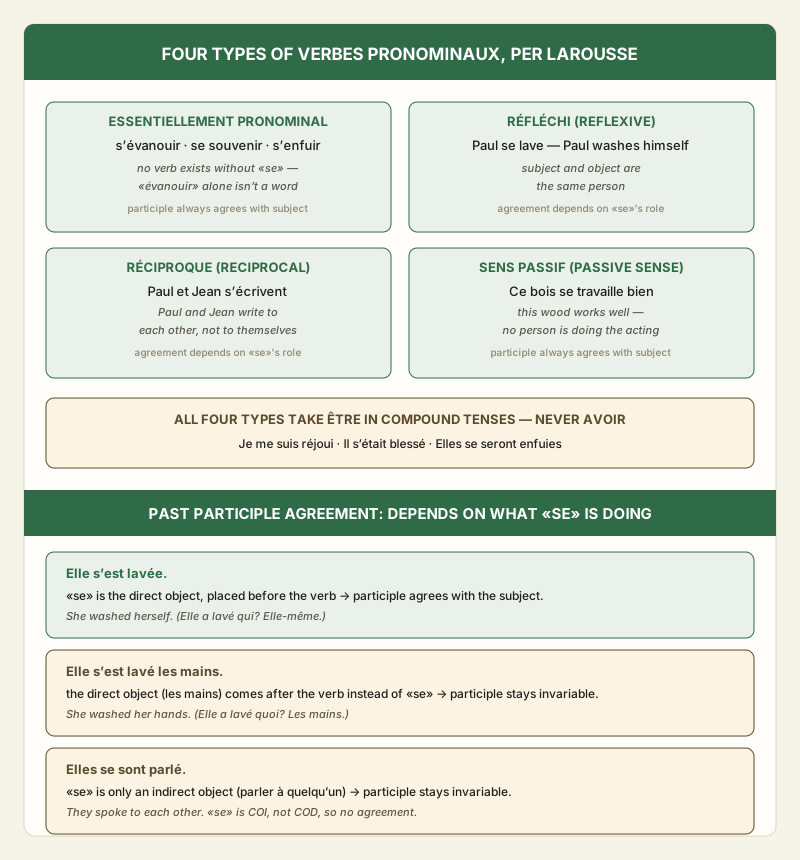
Larousse then splits pronominal verbs into four distinct types. Essentiellement pronominal verbs, like s'évanouir ("to faint") and se repentir ("to repent"), are lexicalized only in the pronominal form and have no ordinary verb sitting underneath them. Réfléchi verbs, the textbook case, have the subject acting on itself: Paul se lave, "Paul washes himself." Réciproque verbs have two or more subjects acting on each other instead: Paul et Jean s'écrivent, "Paul and Jean write to each other." And pronominal verbs with a sens passif drop the acting subject from the sentence entirely: Ce bois se travaille bien, "this wood works well," where nobody is doing any working to the wood; the sentence just states a property of the wood itself.
Réfléchi vs. réciproque: the same form, two different meanings
A plural subject doesn't automatically make a pronominal verb reciprocal. Per the OQLF's own entry on verbes pronominaux de sens réciproque, Mes deux frères ne se rasent jamais la fin de semaine ("my two brothers never shave on the weekend") is réfléchi despite its plural subject, because chacun des sujets agit sur lui-même et non sur l'autre: each brother shaves himself, not his brother. Paul et France s'observent sans dire un mot ("Paul and France watch each other without saying a word") is réciproque instead, because Paul observe France et France observe Paul.
When a sentence is ambiguous between the two readings, or a writer wants to remove any doubt, French can spell out the mutual reading explicitly. The OQLF gives Hélène et Martine s'aident mutuellement dans leur travail ("Hélène and Martine help each other in their work") as its own example: adding mutuellement, l'un l'autre, or réciproquement locks in the reciprocal reading the way eux-mêmes or elles-mêmes would lock in a reflexive one.
Common réfléchi verbs for daily routines
The réfléchi type clusters heavily around routines performed on one's own body, which is why so many French courses open with a morning-routine list: se lever ("to get up"), se laver ("to wash oneself"), se doucher ("to shower"), s'habiller ("to get dressed"), se raser ("to shave"), se maquiller ("to put on makeup"), se brosser les dents ("to brush one's teeth"), se coucher ("to go to bed"). Je me lève, je me douche, je m'habille et je me brosse les dents avant de partir ("I get up, shower, get dressed, and brush my teeth before leaving") strings several of them together the way they actually get used.
Every "me" in that sentence stands for "myself," which is the test that separates a true réfléchi verb from the essentiellement pronominal verbs covered next: swap in the English reflexive pronoun, and if the sentence still means the same thing, it's réfléchi.
Essentiellement pronominal: verbs that don't exist without "se"
Per the OQLF's entry on verbes essentiellement pronominaux, this type "ne peut être employé qu'à la forme pronominale," meaning the bare verb, stripped of se, simply doesn't exist as a word. The OQLF's own examples make the point directly: se méfier ("le verbe méfier n'existe pas"), s'enquérir ("le verbe enquérir n'existe pas"), se souvenir ("le verbe souvenir n'existe pas"), and s'enfuir ("le verbe enfuir n'existe pas"). In each case, the pronoun ne représente rien dans la phrase: it isn't standing in for the subject, an object, or anyone else, so it has no syntactic function to analyze at all.
That's a different failure mode than an ordinary réfléchi or réciproque verb simply not being used pronominally in a given sentence. Reconnaître works fine on its own (Elle a reconnu son erreur, "she recognized her mistake"), so Maya et Édouard se sont reconnus is an ordinary réciproque use with a working non-pronominal counterpart sitting right behind it. Évanouir has no such counterpart; s'évanouir is the only form the verb has ever had.
Sens passif: when nobody is doing the acting
This fourth Larousse type tends to get the lightest treatment in language-learning material, likely because it has no reflexive-pronoun choice to drill and no participle-agreement puzzle attached to it: it always agrees with the subject, the same as an essentiellement pronominal verb. But sens passif constructions show up constantly in everyday descriptions of a general property, not just in the ce bois se travaille bien example above: ça se mange froid ("it's eaten cold"), ce livre se lit facilement ("this book reads easily"), ce vin se boit frais ("this wine is drunk chilled"). Each one states something the subject generally allows or invites, with the agent left unnamed.
The real trap: être in compound tenses, never avoir
Per the OQLF's entry on l'emploi de la forme pronominale, "le verbe pronominal conjugué à un temps composé se construit toujours avec l'auxiliaire être": a pronominal verb in a compound tense always takes être, with no exceptions across any of the four types above. The OQLF's own examples span all four: Je me suis réjoui de cette bonne nouvelle (réfléchi), Il s'était blessé en taillant ses rosiers (réfléchi), Dimitri et Julie se seraient mariés (réciproque), Elles se seront enfuies (essentiellement pronominal).
That's a structural break from the rest of French verb conjugation, where avoir is the default auxiliary and être is reserved for a short, memorized list of motion and state verbs (aller, venir, naître, mourir, and the rest of the so-called "maison d'être" set). Every pronominal verb sits outside that memorized list entirely; the pronominal form itself is what decides the auxiliary, regardless of which of the four types the verb belongs to or what auxiliary the same verb would take in its non-pronominal use.
Past participle agreement: it depends on what "se" is doing, not just who the subject is
Essentiellement pronominal and sens passif verbs skip any real analysis: their participle always agrees in gender and number with the subject, no exceptions. Rachel s'est évanouie à cause de la chaleur agrees because évanouir has no other possible construction to check against.
Réfléchi and réciproque verbs are different, and this is where most of the real difficulty sits. Per the OQLF's entry on verbes occasionnellement pronominaux, the rule is the same one that governs any participle used with avoir: agreement follows the direct object, and only when that direct object comes before the verb. Elle s'est lavée agrees, because se is itself the direct object (elle a lavé qui? elle-même) and it sits before the verb. Elle s'est lavé les mains doesn't agree, because the direct object shifts to les mains (elle a lavé quoi? les mains), which follows the verb instead of se; the OQLF lists Ils se sont acheté une nouvelle voiture and Rachel s'est préparé une bonne tasse de thé as the same pattern.
A third outcome shows up whenever se isn't a direct object at all. Marie et Ludvick se sont téléphoné tous les jours stays invariable, per the OQLF's réciproque entry, because téléphoner takes à (Marie téléphone à qui? À Ludvick), which makes se an indirect object rather than a direct one; the occasionnellement pronominal entry gives the identical pattern for Elles se sont parlé, since parler works the same way. Three sentences, three different outcomes, and none of them can be predicted just by looking at the subject.