Two ways to point at the future, and they're not interchangeable
Spanish has two everyday ways to talk about something that hasn't happened yet. Voy a llamar a mi hermana esta noche ("I'm going to call my sister tonight") uses the periphrasis ir + a + infinitive. Llamaré a mi hermana esta noche ("I will call my sister tonight") uses the simple future tense, built by adding endings straight onto the infinitive. Plenty of English-language grammar guides present these as a casual-versus-formal pair, the Spanish equivalent of "I'm gonna call" against "I will call." That's close, but it understates what's actually going on.
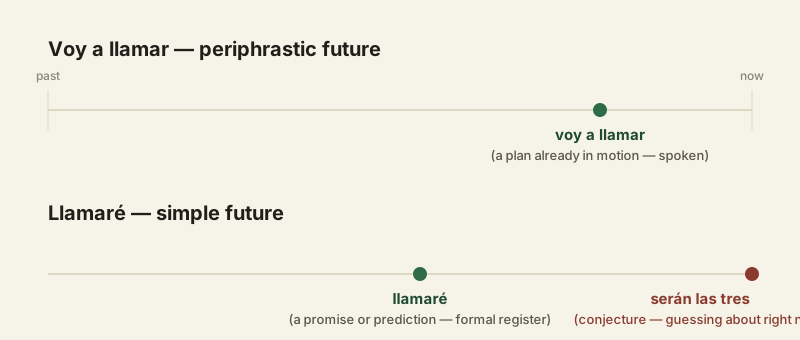
The Real Academia Española's own description of the periphrasis is more precise: ir a + infinitive expresses posterioridad (futurity) and constantly competes with the future indicative and the conditional to do that job, but the periphrasis shows up far more often in spoken language than in writing, and some formal registers avoid it as inappropriate. That's a statement about frequency and register, not about which form is "more correct." Both are standard Spanish, and (as the sections below cover) the simple future carries at least two jobs the periphrasis can't do at all.
Building the periphrastic future
The formation is mechanical: conjugate ir in the present tense (voy, vas, va, vamos, vais, van), add a, then add any infinitive unchanged. Va a llover. (It's going to rain.) Vamos a comer. (We're going to eat.) Nothing about the main verb changes; all the conjugating happens on ir.
When the main verb takes a reflexive or object pronoun, Spanish allows it in two positions: attached to the end of the infinitive, or moved in front of the conjugated ir. Voy a levantarme temprano and Me voy a levantar temprano both mean "I'm going to get up early," with no difference in meaning. This is the same either-or placement Spanish uses whenever a conjugated verb is directly followed by an infinitive; it isn't specific to the future.
Building the simple future: one set of endings for every verb
The simple future is unusual among Spanish tenses because it doesn't split into three separate ending patterns for -ar, -er, and -ir verbs. Every regular verb, regardless of conjugation class, takes the exact same six endings (-é, -ás, -á, -emos, -éis, -án) attached to the full infinitive, not a shortened stem: hablar → hablaré, comer → comeré, vivir → viviré. Compare that to the present or preterite, where -ar verbs and -er/-ir verbs use noticeably different endings, and the future's uniformity stands out.
There's a historical reason the endings look less like typical verb endings and more like a separate word tacked on. That's covered further down, after the irregular verbs.
The twelve verbs that don't just tack endings onto the infinitive
Twelve common verbs keep the same six future endings but attach them to a shortened or altered stem instead of the full infinitive. They fall into three patterns. Five drop the infinitive's final vowel: caber → cabr-, haber → habr-, poder → podr-, querer → querr-, saber → sabr-. Five drop the vowel and insert a -d-: poner → pondr-, salir → saldr-, tener → tendr-, valer → valdr-, venir → vendr-. Two don't fit either pattern and just have to be memorized: decir → dir-, hacer → har-.
Once the stem is settled, the endings are identical to any regular verb's: tener becomes tendré, tendrás, tendrá, tendremos, tendréis, tendrán. Ser, otherwise one of Spanish's most irregular verbs, isn't on this list at all; its future tense conjugates entirely regularly: seré, serás, será, seremos, seréis, serán.
The simple future used to be a periphrasis too
The reason future endings look bolted onto the infinitive rather than woven into it is that, historically, they were a separate word. Latin had lost its own synthetic future forms, and Vulgar Latin rebuilt one by fusing the infinitive with the present tense of habere ("to have"): cantare habeo, literally "I have to sing," gradually lost its sense of obligation and became a plain future, "I will sing." As the construction fused into a single word, cantar he became cantaré. Before the fusion was complete, Spanish speakers could still insert a pronoun between the two pieces, as in cantar lo he ("I will sing it"), a possibility that disappeared once cantar he solidified into one word.
The same process is playing out again, in real time, with ir a + infinitive. Spanish built its current simple future by grammaticalizing a periphrasis centuries ago, and today's periphrastic future is doing the equivalent job while it slowly displaces the simple future in everyday speech, a cycle documented in RAE's own account of futuros sintéticos y analíticos.
The real trap: future tense that isn't about the future
The simple future has two uses that have nothing to do with predicting what happens later, and both trip up learners because a literal translation misses them entirely. The first is the futuro de conjetura: using the future tense to guess about something happening right now. Asked "¿Dónde está Juan?", a Spanish speaker might answer "Estará en casa": not "He will be at home," but "He's probably at home." Asked the time with no clock in sight, "Serán las tres" means "It's probably three," not any statement about a future three o'clock. RAE gives its own example of the same value: "Ahora mismo serán las ocho" ("It's probably eight right now"). Italian's future has the same job, which is why sarà often isn't about the future at all.
The second is modal: a future-tense statement addressed to someone else can function as an order, a warning, or a threat rather than a prediction. RAE's own examples cover all three: "Comprarás el más barato" ("You will buy the cheapest one," functioning as an instruction), "Te caerás" ("You'll fall," functioning as a warning), and "Me las pagarás" ("You'll pay for this," functioning as a threat). None of these are claims about the future; the future tense is doing the work English would hand to a modal verb or a different sentence altogether.
So which one do you actually reach for?
For a plan someone has already decided on and is about to act on, ir a + infinitive is the default in spoken Spanish, especially across Latin America. RAE notes that the synthetic (simple) future tends to be replaced by the periphrastic future in American Spanish, while remaining common with the conjecture value and in formal registers such as literary, judicial, and administrative Spanish. Voy a estudiar medicina reads as a plan already in motion; Estudiaré medicina reads more like a vow or a prediction, and turns up more often in writing, formal speech, or Spain than in casual conversation elsewhere.
Reach for the simple future specifically when the sentence is a promise, a prediction about something uncertain, a formal or written statement, or a guess about what's true right now. Everywhere else, ir a + infinitive is the safer, more natural default, and it's the one native speakers reach for first.