What "reflexive" technically means
The RAE's own definition is precise: a reflexive pronoun agrees with an antecedent within the same clause, and in a true reflexive use, the pronoun and its antecedent are coarguments of the same verb, meaning the subject and the object are the same entity. Their example is Roberto se peinaba con gomina: the antecedent of se is Roberto, the subject of peinar, and se is also the object of that same verb. Roberto is combing Roberto.
That's the narrow, textbook sense of "reflexive," and it covers plenty of everyday verbs: Me lavo (I wash myself), Se viste (She dresses herself), Nos miramos en el espejo (We look at ourselves in the mirror). In every one of these, swapping in "myself/yourself/herself" produces a sentence that actually means the same thing as the Spanish.
The pronouns and where they go
The reflexive pronouns are me, te, se, nos, os, se: the same atonic clitic set used for direct and indirect objects, with one simplification. Unlike lo/la versus le, the third-person reflexive is always se, for singular or plural, masculine or feminine. There's no gender-marked reflexive form to choose between.
Placement follows the same rule as direct and indirect object pronouns: the pronoun goes immediately before a conjugated verb (Me levanto), and attaches to the end of an infinitive, a gerund, or an affirmative command (Voy a levantarme, Estoy levantándome, ¡Levántate!), with a written accent added where needed to keep the original stress. Negative commands put it back in front: No te levantes, never No levántate.
Reciprocal "se": a different meaning hiding in the same form
Plural reflexive pronouns can also mean "each other" rather than "themselves," and Spanish doesn't mark the difference with a separate word. Se conocen is ambiguous out of context: it can mean "they know themselves" (each person individually knows who they are, an unusual thing to say) or "they know each other" (reciprocal, by far the more common reading).
When the ambiguity matters or a speaker wants to underline the reciprocity, Spanish adds el uno al otro (or la una a la otra, los unos a los otros, matched to the group's gender and number): Se conocen el uno al otro. That phrase doesn't add reciprocal meaning that wasn't already there (se conocen already carries it); it just removes any doubt.
The real trap: verbs where "se" doesn't mean "yourself" at all
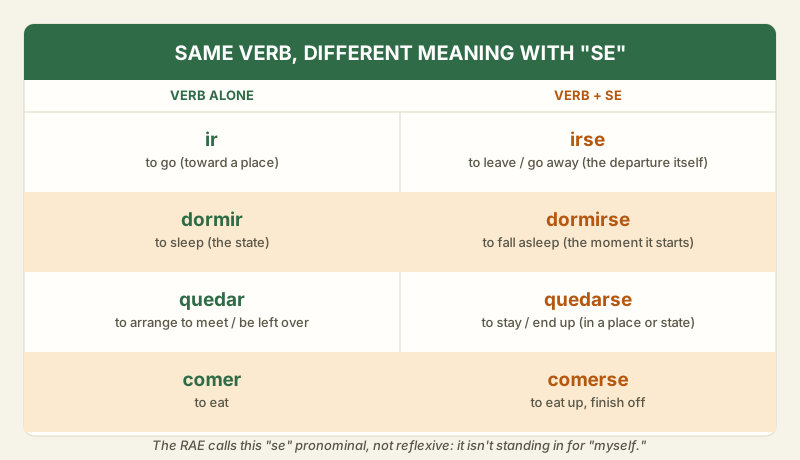
A large group of common Spanish verbs is built with the same me/te/se/nos/os/se pronouns but doesn't fit the "acting on yourself" definition at all. The RAE explicitly recommends against calling these verbs reflexivos, because that label can't distinguish a genuine reflexive reading from one where the pronoun isn't functioning as an argument of the verb at all. Their own contrast: Me mojé a mí mismo is reflexive (I got myself wet, on purpose, targeting myself), while Empezó a llover y me mojé is not (I got wet because it started raining). Same verb form, mojarse, completely different relationship between the subject and the pronoun. The RAE's term for this second category is verbo pronominal.
Dormir means to sleep, the ongoing state; dormirse means to fall asleep, the moment sleep starts. Nobody is sleeping themselves. Ir means to go, usually toward a stated destination; irse means to leave or go away, shifting the focus to the act of departing rather than the destination: Voy al cine (I'm going to the movies) versus Me voy al cine (I'm off to the movies / I'm leaving for the movies). Quedar means to arrange to meet up or to be left over; quedarse means to stay, remain, or end up in some state: Quedamos a las ocho (We're meeting at eight) versus Me quedo en casa (I'm staying home). Comer means to eat; comerse means to eat up or finish off, adding a sense of completion: Comí la sopa (I ate the soup) versus Me comí la sopa (I ate up the soup, all of it).
None of these four pairs can be translated by inserting "myself" into the English sentence. That's the practical test: if adding "myself/yourself/himself" to the English translation doesn't produce a sentence that means the same thing as the Spanish, the "se" isn't doing reflexive work, whatever a textbook chapter titled "Reflexive Verbs" might call it.
Common true reflexive verbs for daily routines
The verbs that actually are reflexive in the strict sense cluster heavily around routines a person performs on their own body, which is exactly why so many Spanish courses introduce reflexives through a morning-routine list. Levantarse (to get up), ducharse (to shower), lavarse (to wash oneself, or a specific body part: me lavo las manos), vestirse (to get dressed), peinarse (to comb one's hair), cepillarse los dientes (to brush one's teeth), acostarse (to go to bed), maquillarse (to put on makeup): in each case, the subject is doing something to their own body, which is exactly the coargument relationship the RAE's definition describes.
Me levanto a las siete, me ducho, me visto y me cepillo los dientes antes de salir. (I get up at seven, shower, get dressed, and brush my teeth before leaving.) Every "me" in that sentence stands for "myself": swap in the English reflexive pronoun and the meaning holds, which is the same test that fails for dormirse, irse, quedarse, and comerse above.