The frame is the same in both languages
Reference grammars describe English and Spanish the same way. The unmarked order of an affirmative statement in both is subject, then verb, then object. Wikipedia's overview of Spanish grammar states it directly, that Spanish unmarked word order for affirmative declarative sentences is subject-verb-object, and adds the qualification that matters more in practice: word order is variable, with topicalization and focus deciding which alternative gets used. Verb-subject-object, verb-object-subject and object-verb-subject all appear in ordinary Spanish, while English reserves its own reordering for a much narrower set of cases.
This is why the two languages can feel further apart than their grammars are. A learner braced for a different skeleton will spend a long time hunting for a difference that is not there. Both languages build the same plain statement the same way: mi hermana lee un libro is my sister reads a book, slot for slot. The trouble starts once pronouns and adjectives enter the sentence, because those pieces are what Spanish moves.
Five sentence types, side by side
Setting the two languages out by sentence type makes the pattern visible. The frame holds in every row; a different small word moves in each.
| Sentence type | English order | Spanish order | What moves |
|---|---|---|---|
| Statement, noun object | Subject, verb, object: My sister reads a book. | Subject, verb, object: Mi hermana lee un libro. | Nothing. The subject can shift to the end of the sentence for emphasis. |
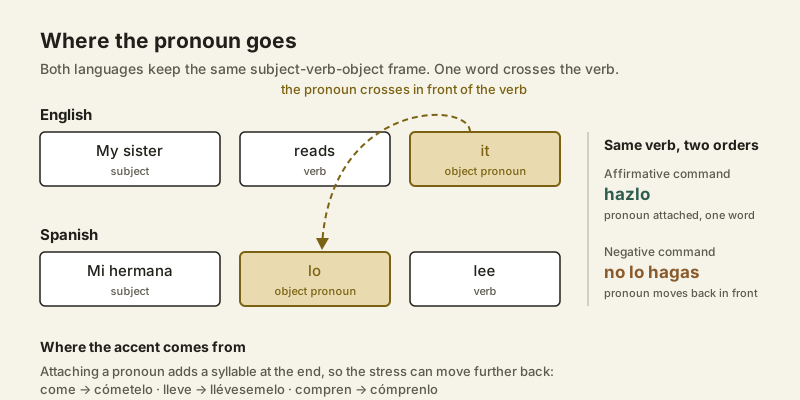
| Statement, pronoun object | Subject, verb, pronoun: My sister reads it. | Subject, pronoun, verb: Mi hermana lo lee. | The object pronoun crosses to the front of the verb. |
| Negation | Subject, auxiliary, not, verb: My sister does not read it. | Subject, no, pronoun, verb: Mi hermana no lo lee. | No auxiliary. No goes in front of the pronoun cluster. |
| Yes or no question | Auxiliary, subject, verb: Does my sister read it? | Verb, subject, pronoun: ¿Lo lee mi hermana? | No auxiliary, and an opening ¿. The subject often drops entirely. |
| Information question | Question word, auxiliary, subject, verb: What does my sister read? | Question word, verb, subject: ¿Qué lee mi hermana? | The verb follows the question word with nothing between them. |
Two of those rows account for most of what people mean when they say Spanish word order is different, and both involve a pronoun. English leaves an object pronoun exactly where the noun it replaced used to sit. Spanish picks that pronoun up and sets it down before the verb, which is where the front-loaded look of Spanish sentences comes from. The guide to Spanish pronouns maps the seven pronoun families, only some of which can occupy that slot, and direct and indirect object pronouns covers what happens when two of them stack up and the indirect one turns into se.
Why the subject can disappear in Spanish
One asymmetry runs the other way and shows up early. English insists on a subject in every finite clause, and Spanish does not. Wikipedia notes, checked 16 October 2026, that because subject pronouns are often dropped, a Spanish sentence routinely turns up with a verb and a direct object and no stated subject at all.
The reason is in the verb ending. Leo is a complete clause on its own and means I read; lee means he reads or she reads, and the sentence is still complete without either pronoun in front. English verb forms are far less distinctive, so a bare reads leaves the reader guessing who is doing it, which is why the pronoun is not optional there. The endings carry the information in Spanish, so the pronoun would only repeat what the verb already said.
Leaving the pronoun out is the default, not a casual habit. When a Spanish speaker does say yo leo, the pronoun is doing a job, usually marking a contrast, as in yo leo, tú escribes. A learner who keeps the pronoun in every sentence produces something that reads as emphatic from beginning to end.
Where the object pronoun goes
This part is rule-governed rather than a matter of feel, and the rule is short enough to apply by hand. The Royal Spanish Academy's usage guide describes the unaccented pronouns as leaning phonetically on the neighbouring verb, and splits them by which side they land on. Those that come first are proclitic and are written as separate words; those that follow are enclitic and are written joined to the verb.
The placement test runs in one direction. In current Spanish, the guide says, these pronouns go after the verb when they attach to infinitives, to gerunds, and to affirmative imperatives, and before it for every other verb form. Its own examples run comprarlo, comprándolo, compradlo and cómprenlo on the attached side, against Lo compró, Se fue and No se lo digas on the separated side. The Academy's dictionary of doubts adds the constraint behind the pattern: these pronouns cannot follow a finite verb form that is negative, which is why the negative command comes back as no lo hagas and not as a single joined word. A negated infinitive is a different case and still takes the pronoun attached, as in prefiero no hacerlo.
Joining the pronoun also changes the spelling. Because the written accent has to follow the stress, a word that gains a syllable at the end can gain an accent as well. The Academy's dictionary gives the working examples: déselo, cuéntame and entiéndannos carry a written accent because they became stressed on the third syllable from the end, and the dictionary states the wider rule by stress position rather than by length: words stressed there or further back siempre llevan tilde, always carry the tilde, which its examples cómetelo and llévesemelo show.
Two reductions are worth knowing by name because they look like typos otherwise. Adding nos to a first-person plural subjunctive used as a command drops the s of the verb: dejemos plus nos is written dejémonos. Adding se to a verb already ending in -s collapses the two: pongamos plus se plus lo is written pongámoselo.
One corner stays flexible. When an infinitive or a gerund sits inside a verbal periphrasis, or when the infinitive depends on another verb, the Academy notes that there is some freedom in where the pronoun goes, so both orders turn up in edited prose.
Negation and questions
Both of these are easier in Spanish than in English, because neither one needs an auxiliary. English has to recruit do to carry the negative or to open a question, which is what produces does not read and does she read. Spanish sends the verb straight to work. Negation is no in front of the verb, and since the pronouns sit between the two, the order is no first and then the pronoun cluster. A question is the verb with an opening ¿ and a closing ?, as in ¿Lo lee mi hermana?.
That difference is why translating an English question word for word produces something that reads as a statement. Does my sister read it carries its question marking on the auxiliary that Spanish does not have, so the Spanish version marks the question at the edges instead, with the punctuation, and with the subject usually pushed behind the verb or left out. The guide to Spanish question words covers the accent that separates qué and cuál from their plain relatives.
Adjectives follow the noun
This is the last piece that makes an English-shaped sentence sound translated. Wikipedia's summary of Spanish adjectives puts the default first: in Spanish, adjectives usually go after the noun they modify, and the exception is when the speaker or writer is being emphatic or even poetic about a quality. The difference is not decorative. Mi casa roja identifies the red house among houses; mi roja casa stresses how red the house is. English fixes the order and pushes the emphasis into the voice, so the same contrast is not available.
The same reference adds a second behaviour worth keeping in mind at the end of a sentence: a Spanish adjective can stand in for a noun on its own, so los altos means the tall ones, with no hint of rudeness attached to the shorthand.
What this means when you build a sentence
Start at the verb. If the verb is a simple conjugated form and there is a pronoun object anywhere after it, the pronoun is almost certainly in the wrong place; move it in front. If the verb is an infinitive, a gerund or an affirmative command, check the opposite way, and then check whether the joined form needs an accent or a doubled consonant somewhere.
Then look at the subject. If it is a personal pronoun that the verb ending already identifies, delete it. Yo leo is grammatical but marked, reserved for contrast, and an unbroken run of yo, tú, él at the start of Spanish sentences is a reliable sign that the writer is thinking in English.
Finally, check the nouns. Any adjective sitting in front of its noun is making a claim about emphasis, and if that was not the intention, it belongs behind. When two languages differ this little in structure, these three places are where a sentence built on English tends to go wrong.