One English verb, two Spanish jobs
English "to know" stretches to cover two very different mental acts: knowing that something is true (I know his phone number), and being acquainted with someone or something (I know his sister). Spanish keeps those apart with two separate verbs, saber and conocer, and, unlike some pairs where the wrong choice is just an accent mistake, using the wrong one here produces a sentence a native speaker will notice immediately, because it claims something different than what you meant.
The quickest sorting test: if you could rephrase the English sentence with "know how to," "know that," or "know a fact about," reach for saber. If you could rephrase it with "am familiar with" or "have met," reach for conocer. That test holds for almost every case; the exceptions are worth knowing on their own, and they show up further down.
Saber: facts, information, and how to do things
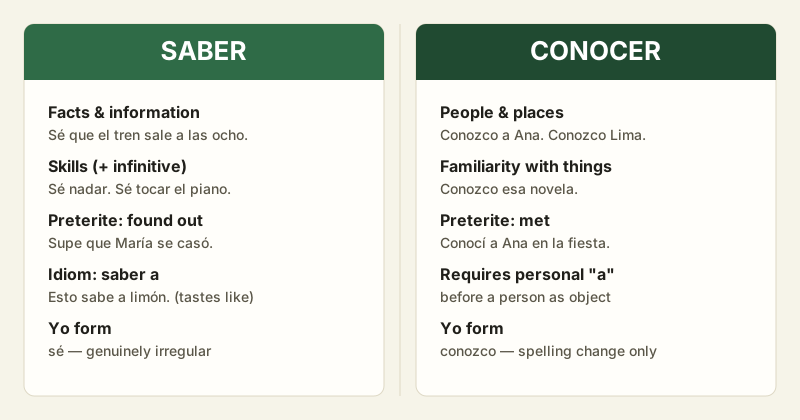
Facts and information. Sé que el tren sale a las ocho. (I know the train leaves at eight.) No sé su número. (I don't know his number.) Saber takes a fact, a piece of data, or a que-clause as its object, something you could, in principle, write down.
Skills, with an infinitive. Sé nadar. Sé tocar el piano. Sé hablar español. (I know how to swim. I know how to play piano. I know how to speak Spanish.) This is the construction English speakers most often get wrong by reaching for conocer instead, because "I know how to" sounds closer to "familiarity" in English than it does in Spanish grammar.
Saber and poder both get translated as "can" in English, and that overlap causes a second, separate mix-up. Sé nadar claims a skill: you learned to swim at some point and haven't forgotten how. Puedo nadar claims present ability, for reasons that have nothing to do with skill: the pool is open, nobody's stopping you, your arm isn't in a cast. A strong swimmer with a broken arm can honestly say sé nadar, pero no puedo nadar ahora ("I know how to swim, but I can't swim right now") without any contradiction.
Saber is also one of the genuinely irregular verbs in Spanish rather than just an orthographic one: the yo form is sé (not sabo), the preterite stem is sup- (supe, supiste, supo...), and the future is built on sabr- (sabré) rather than the infinitive stem. None of those follow a predictable spelling rule the way conocer's does. They have to be learned as their own forms.
Conocer: familiarity with people, places, and things
People. Conozco a Ana desde hace diez años. (I've known Ana for ten years.) Note the a: when the direct object of conocer is a specific person, Spanish requires the "personal a" before it, so it's conozco a Ana, never conozco Ana. Leaving it out is one of the most common non-native errors with this verb, distinct from the saber/conocer choice itself.
Places. Conozco Lima, pero nunca he estado en Cusco. (I know Lima, but I've never been to Cusco.) Here conocer means "have been to / am familiar with," which is why it doesn't take the personal a: a city isn't a person.
Things: books, films, ideas. Conozco esa novela; la leí el año pasado. (I know that novel; I read it last year.) You aren't reciting facts about the novel here, you're claiming acquaintance with it as a whole, and that's what puts it on conocer's side rather than saber's.
Conocer also has a common reflexive form, conocerse, and it splits into two different meanings depending on who's doing the knowing. Nos conocimos en la universidad means "We met each other in college," the moment a mutual acquaintance began. Me conozco bien means "I know myself well," turning the same reflexive back on the speaker rather than between two people. Only the context (a plural subject meeting someone else, versus a subject examining themselves) tells you which reading applies.
Conocer's yo form is conozco, not conoco, but that's a spelling adjustment shared by a whole family of Spanish verbs ending in -acer, -ecer, -ocer, and -ucir (parecer → parezco, conducir → conduzco), not an irregularity unique to this verb the way saber's forms are.
Where the split gets sharper: the preterite
Most saber/conocer explanations stop at "facts vs. people," but the distinction actually tightens rather than loosens once you move into the preterite. In the preterite, saber and conocer do more than change endings: each one names a different kind of event.
Supe que María se casó means "I found out that María got married," not "I knew": the preterite marks the moment the fact entered your head, rather than an ongoing state of possessing it. Conocí a Ana en la fiesta works the same way, meaning "I met Ana at the party," naming the moment acquaintance began rather than a state of already knowing her.
This isn't a quirk unique to these two verbs. Saber and conocer belong to a small group of Spanish verbs, alongside poder ("was able to" becomes "managed to") and querer ("wanted to" becomes "tried to," in the affirmative, or "refused to" in the negative), where the preterite reports the specific instant a state began or resolved rather than simply placing a known state in the past. Learners who've already sorted out the broader preterite-versus-imperfect split still trip on this group specifically, because the meaning shift is larger than "completed vs. ongoing." It's closer to two different English verbs mapping onto the same Spanish root.
Two more places they aren't quite parallel
"Saber a" means "to taste like," not "to know." Esto sabe a limón. (This tastes like lemon.) It's an idiomatic extension of saber's "have knowledge of" sense (you could think of it as the dish "knowing of" lemon), but it has to be memorized as its own construction rather than derived from the facts-vs-people rule.
"Conocer de" exists, but "saber de" is usually the better choice. Spanish speakers sometimes say conoce de carpintería under the influence of saber, but the more standard and preferred phrasing is sabe de carpintería ("he knows about carpentry") or, for a specific instance, sabía de casos así ("I knew of cases like that") over conocía de casos así. If you're choosing between the two for a "know about X" construction, saber de is the safer default.
One more contrast worth having next to this one: ser and estar split English "to be" the way saber/conocer splits "to know," and the underlying move for both pairs is the same: stop translating the English word, and ask what kind of claim the sentence is actually making.
Three common mistakes, corrected
Seeing the wrong choice next to the right one tends to stick better than the rule alone. Three mix-ups account for most of the errors English speakers make with this pair.
Yo conozco que ella vive en Lima is wrong; yo sé que ella vive en Lima is right. A fact introduced by que always takes saber, even though conozco can feel like the safer, more general-sounding verb.
Yo sé a tu profesor is wrong; yo conozco a tu profesor is right. A person always takes conocer, and the personal a travels with conocer, never with saber.
Sé Madrid muy bien is wrong; conozco Madrid muy bien is right. A place is a matter of familiarity, something you've been to and walked around in, not information you could recite, so it stays on conocer's side even though "I know Madrid well" sounds like a fact in English.