English "would" points at two different Spanish tenses
English "would" is genuinely ambiguous, and that ambiguity is exactly what trips up learners translating into Spanish. "She would visit every summer" describes a repeated habit in the past (no hypothesis involved, nothing conditional about it), and that sentence takes the Spanish imperfect: visitaba cada verano. "She would visit if she had the time" is a real conditional, contingent on something that isn't true, and that one takes the conditional: visitaría si tuviera tiempo. Reach for the conditional (cantaría, visitaría, comería) only for the second kind. For the first, plain habitual "would," Spanish wants the imperfect instead. Using the conditional there is a real error, not just a stylistic mismatch, because it wrongly implies the visiting depends on some unstated condition.
Whether the conditional itself is a tense of the indicative mood or a mood of its own has actually been argued over in Spanish grammar. The Real Academia Española notes the question has traditionally been controversial, but settles it: the conditional (cantaría) is treated today as an indicative tense, mainly because it shows up in the same syntactic environments the indicative selects and is excluded from environments that select the subjunctive. That classification matters here mostly to head off a common mislabel: the form is called "conditional" because of one of its jobs (marking hypotheticals), not because it's grammatically a mood parallel to the subjunctive.
Building it: the same endings across every conjugation, on the full infinitive
Formation is uniform across -ar, -er, and -ir verbs, which is unusual among Spanish tenses. Every regular verb takes the same six endings (-ía, -ías, -ía, -íamos, -íais, -ían) attached to the complete infinitive: hablar → hablaría, comer → comería, vivir → viviría. Nothing about the ending changes depending on conjugation class, the same trait the simple future tense has.
Those endings look familiar for a reason: they're identical in form to the regular imperfect endings that -er and -ir verbs already use (comía, vivía...). The difference is what they attach to. Imperfect endings attach to a shortened stem: tener → ten- → tenía. Conditional endings attach to the full infinitive, or to the same altered stem the future tense uses: tener → tendr- → tendría. Tenía ("I had," or "I used to have") and tendría ("I would have") share an ending and a verb but land in genuinely different places, and mixing them up changes the sentence's meaning, not just its register.
The twelve stems it borrows straight from the future tense
The conditional doesn't have its own separate list of irregular stems. It reuses the exact same twelve verbs and the same three stem patterns as the simple future. Five verbs drop the infinitive's final vowel: caber → cabr-, haber → habr-, poder → podr-, querer → querr-, saber → sabr-. Five drop the vowel and insert a -d-: poner → pondr-, salir → saldr-, tener → tendr-, valer → valdr-, venir → vendr-. Two are simply irregular: decir → dir-, hacer → har-.
Once the stem is set, the regular conditional endings attach exactly as they would to any other verb: tener becomes tendría, tendrías, tendría, tendríamos, tendríais, tendrían. Anyone who has already learned the twelve future-tense irregular stems gets the conditional's irregulars for free: it's the identical list, just paired with a different ending set. Ser, true to form, isn't on the list: its conditional is fully regular, sería, serías, sería..., built straight off the infinitive like any other verb.
Job one: the hypothetical that isn't true
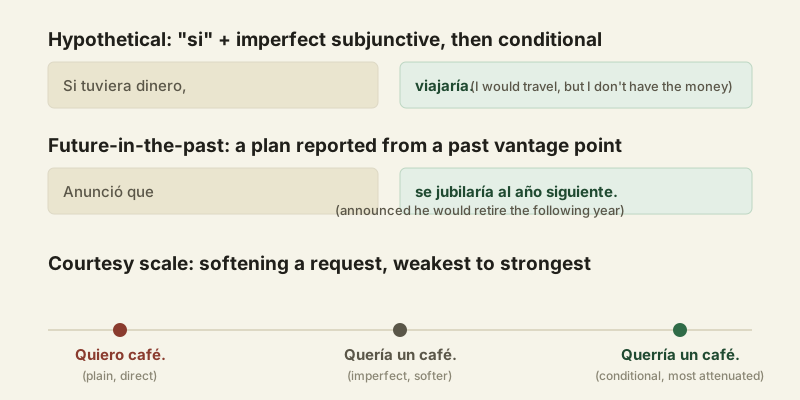
The conditional's best-known job pairs it with the imperfect subjunctive in si-clauses describing situations contrary to fact. The Real Academia Española gives the pattern directly: the si-clause (the protasis) takes the imperfect subjunctive, and the main clause (the apodosis) takes the conditional simple, as in RAE's own examples Si me tocara/tocase la lotería, me compraría un coche ("If I won the lottery, I'd buy a car") and Si yo fuera tú, hablaría directamente con ella ("If I were you, I'd talk to her directly").
This is a fixed pairing, not a free choice: the si-clause cannot take the present subjunctive or the conditional itself when the hypothesis is contrary to present fact, and the main clause cannot take the present or future indicative there either. The imperfect subjunctive on the si side is the same mood the subjunctive uses whenever a clause needs to mark something as unreal or unverified rather than asserted. The conditional in the main clause is simply what completes that unreal framing on the outcome side.
Job two: a future seen from a point in the past
The conditional also reports a future event, but relative to a past moment rather than to right now. RAE's own description of the condicional simple states that it localizes a state of affairs in a non-current situation: either hypothetical, as above, or a situation that is posterior to another situation already in the past, giving the example Anunció que se jubilaría al año siguiente ("He announced he would retire the following year"). At the moment of the announcement, the retirement was still in the future; from the narrator's present-day vantage point telling the story, it's already happened or is otherwise settled. English does exactly the same shift with "would" in reported speech ("she said she would call"), which is part of why this use, unlike the hypothetical one, rarely trips up English speakers.
This is the conditional standing in for the simple future once the reference point moves into the past: dice que llamará ("she says she'll call," future from now) becomes dijo que llamaría ("she said she'd call," future from a past moment) with no other change to the sentence.
Job three: softening a request, on a real graded scale
The third use has nothing to do with hypotheses or reported time. RAE calls it the condicional de cortesía o modestia, used in requests, wishes, and other situations specifically to avoid the bluntness a present-tense verb can carry. RAE's own examples are ¿Podría ponerme agua? ("Could you get me some water?") and Querría hablar con el director ("I'd like to speak with the director"), both markedly softer than the identical requests phrased with puede or quiero.
What most courtesy-conditional explanations skip is that RAE places this on an actual graded scale rather than a simple on/off softener. With modal verbs like querer, the conditional alternates with the imperfect indicative and imperfect subjunctive as different strengths of the same softening move: RAE's own scale runs quería below querría in attenuation, giving the example pair quería / querría un café to show that the conditional reads as noticeably gentler than the already-softened imperfect, which in turn is gentler than the flat present-tense quiero un café.