One search term, six different grammatical jobs
"Spanish pronouns" isn't one grammar topic. It's six, and they don't all work the same way. A subject pronoun (yo, tú) tells you who's performing the verb. An object pronoun (lo, le) tells you who or what is receiving the action. A reflexive pronoun (se) tells you the subject and the object are the same entity. A prepositional pronoun (mí, conmigo) only ever follows a preposition. A possessive pronoun (mío, suyo) stands in for "my [noun]" or "his [noun]" without naming the noun. A demonstrative pronoun (esto, aquello) points at something without naming it at all.
The good news: Spanish reuses the same small set of forms across most of these families. Me, te, nos, and os show up, unchanged, as object pronouns, reflexive pronouns, and (with a preposition in front) prepositional pronouns. The learning curve isn't spread evenly across the whole system. It concentrates almost entirely in the third person, where the families actually diverge from each other, and in a handful of regional splits that change which subject pronoun a whole country uses.
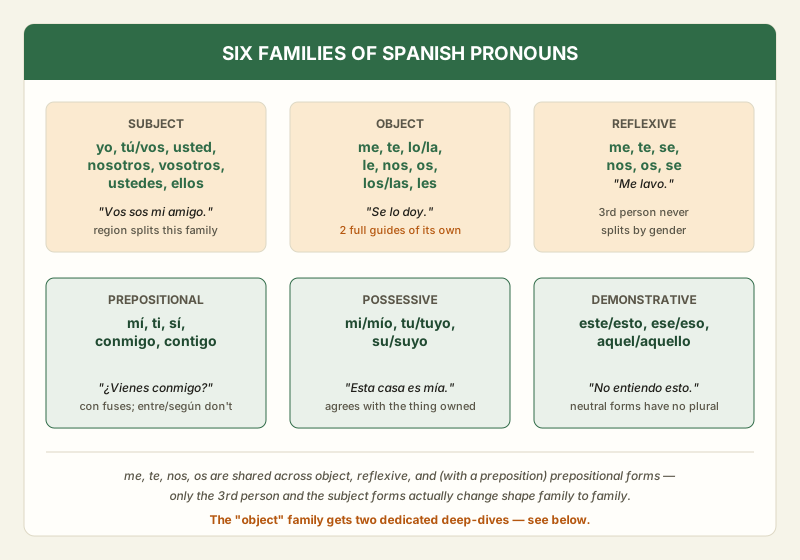
Subject pronouns: often dropped, and split by region
The subject pronouns are yo (I), tú or vos (you, informal singular), usted (you, formal singular), él/ella (he/she), nosotros/nosotras (we), vosotros/vosotras (you all, Spain informal), ustedes (you all), and ellos/ellas (they). Spanish conjugates its verbs to mark person and number, so the subject pronoun is frequently dropped entirely: Hablo español ("I speak Spanish") already tells you who's speaking through the verb ending, and adding yo only makes sense for emphasis or contrast.
Two splits are worth knowing before they cause confusion. First, the plural "you": Spain distinguishes informal vosotros/vosotras from formal ustedes, while Latin American Spanish drops vosotros entirely and uses ustedes for both registers, whether the person on the other end is a lifelong friend or someone just met. Vosotros sois de España only makes sense in Spain; Ustedes son de España works everywhere and is the only option outside Spain.
Second, vos replaces tú as the informal "you" across a wide stretch of the Spanish-speaking world, a usage the RAE's Diccionario panhispánico de dudas now formally accepts as standard, not substandard, Spanish. It fully displaces tú in Argentina and Uruguay, is Paraguay's everyday informal form, and shows up regionally in Costa Rica, Nicaragua, parts of El Salvador, and Colombia's Paisa region around Medellín. It also carries its own present-tense verb endings, stressed on the last syllable rather than following the tú pattern: vos sos (not tú eres), vos tenés (not tú tienes), vos hablás (not tú hablas). Textbooks built around Spain or Mexico often skip vos entirely, which is why it surprises learners the first time they hear Argentine Spanish.
Object pronouns, briefly: the deep dive lives elsewhere
Direct object pronouns (me, te, lo, la, nos, os, los, las) replace whatever receives a verb's action; indirect object pronouns (me, te, le, nos, os, les) replace whoever the action is done to or for. Every person except the third shares identical forms between the two sets, which means nearly all of the real complexity sits in lo/la versus le/les, and in what happens when both show up in the same sentence, as in se lo doy rather than the ungrammatical le lo doy. The indirect set is also what verbs like gustar use for the person, since the thing liked is the grammatical subject.
That third-person split, and the ordering rule for combining two object pronouns, gets a full treatment in two dedicated guides: direct vs. indirect object pronouns and double object pronouns. This overview intentionally doesn't re-derive those rules; read those two if that's specifically what brought you here.
Reflexive pronouns: identical forms, one different rule
Reflexive pronouns (me, te, se, nos, os, se) mark that the subject and the object of a verb are the same entity: Me lavo ("I wash myself"), not "I wash someone else." The forms are identical to the object pronoun set with one simplification: object pronouns split the third person by gender and number (lo/la/los/las for direct, le/les for indirect), but the reflexive third person is always se, with no gender or number marking at all.
Where the pronoun attaches, and what happens with verbs like dormirse and quedarse that use the same forms without a truly reflexive meaning, is covered in full in Spanish reflexive verbs.
Prepositional pronouns: mí, ti, sí, and why "con mí" is wrong
After a preposition, Spanish switches to a distinct set of tonic (stressed) pronouns: mí, ti, sí for first, second, and reflexive third person singular, plus the same subject-pronoun forms (él, ella, usted, nosotros, vosotros, ellos, ustedes) for everything else. Este regalo es para mí ("This gift is for me") uses mí, not yo, because it follows the preposition para.
One preposition forces a written fusion: when con ("with") precedes mí, ti, or sí, Spanish doesn't say them as two separate words. It merges them into conmigo, contigo, consigo. Saying con mí is simply not correct Spanish; the fused form is mandatory. ¿Vienes conmigo? ("Are you coming with me?"), never ¿Vienes con mí?.
A handful of prepositions and conjunction-like particles break the pattern entirely and take ordinary subject-pronoun forms in place of the tonic prepositional set: entre ("between"), según ("according to"), and the exceptive words excepto, salvo, and menos (all roughly "except"). The RAE's own examples show tú and yo surviving unchanged after entre, as in Lo que hablemos será entre tú y yo ("What we talk about will stay between you and me"), where a learner might expect entre mí y ti by analogy with every other preposition. Según tú, somos el enemigo ("According to you, we're the enemy") and Todos llegaron, menos él ("Everyone arrived, except him") follow the same exception.
Possessive pronouns: the same word, two different shapes
Spanish possessives come in two forms that trade off stress and position. The short, unstressed forms (mi, tu, su, nuestro, vuestro, and their plurals) sit before the noun: Mi casa es grande ("My house is big"). The long, stressed forms (mío, tuyo, suyo, nuestro, vuestro, with full gender and number agreement) come after the noun, or stand entirely on their own with ser: un amigo mío ("a friend of mine"), Esta casa es mía ("This house is mine").
Both forms agree in gender and number with the thing owned, never with the owner. Suyo covers "his," "her," "your (formal)," and "their" without changing shape, because Spanish possessives track only the object, not who possesses it. That's exactly why suyo on its own is often ambiguous, and why Spanish speakers add a clarifying phrase (de él, de ella, de usted) when context doesn't settle it. The short prenominal forms get a full breakdown, including why only nuestro and vuestro mark gender, in Spanish possessive adjectives.
Demonstrative pronouns: distance, and a neutral set with nothing to agree with
The demonstrative pronouns track distance in three steps: este/esta/estos/estas (this, near the speaker), ese/esa/esos/esas (that, near the listener), and aquel/aquella/aquellos/aquellas (that, far from both). The RAE's own grammar treats ese as the unmarked term of the three rather than a fixed midpoint, so it doesn't carry a set distance value the way este and aquel do. The full three-way system, its regional variants, and the exceptions that trip learners up are covered in depth separately. Este libro es interesante ("This book is interesting") sits differently on that scale than Aquella montaña es alta ("That mountain over there is tall").
Alongside those gendered forms, Spanish keeps a separate neutral set (esto, eso, aquello) that never takes a gender or a plural, because they don't stand in for any specific noun at all. They point at an idea, a situation, or something unnamed or unidentified: No entiendo esto ("I don't understand this," referring to a whole situation, not one object) and Eso no es verdad ("That's not true," referring to a claim someone just made). Confusing the neutral eso with the masculine ese is a real error, since ese has to agree with a specific noun it's replacing, and the neutral forms exist precisely because sometimes there isn't one.
A seventh, different job: relative pronouns
None of the six families above link two clauses together by referring back to something already named. That's a separate job Spanish assigns to relative pronouns: que (invariable, and by far the most common, covering "that," "which," "who," and "whom" for both people and things), quien/quienes (people only, and required, not optional, after a preposition), el cual/la cual/los cuales/las cuales (agrees in gender and number with its antecedent, and favored in formal or written registers), and cuyo/cuya/cuyos/cuyas ("whose"). The same unaccented spelling that separates cuándo the question word from cuando the connector applies here too: que and cual only carry a written accent when they're asking or exclaiming something, never when they're doing this relative-clause job.
Quien(es) has one rule that trips up even confident speakers: when it stands in for a plural antecedent, it has to become quienes, not stay quien. Per the RAE's Diccionario panhispánico de dudas, a sentence like las personas con quien hablé is now considered incorrect; it has to be las personas con quienes hablé. El cual and its forms carry their own restriction in the other direction: without a preposition, per the RAE's own style guide for legal writing, el cual can only open a nonrestrictive clause set off by commas, and even there the Academia's advice is to reach for a demonstrative and split the sentence instead, precisely because Spanish legal and bureaucratic writing overuses it. Cuyo is the one true outlier: despite meaning "whose," it agrees with the noun that follows it, the thing possessed, not with the antecedent that owns it. La autora cuyo libro leímos keeps cuyo masculine because libro is masculine, even though autora is feminine.