The verb doesn't mean "to like" the way its translation suggests
Every Spanish course translates gustar as "to like," and that gloss is close enough for everyday use, but it hides how differently the sentence is built underneath. In "I like the book," English makes the liker the subject and the thing liked the object. Spanish does the opposite. The Real Academia Española's Diccionario panhispánico de dudas describes the normal construction directly: the subject is the thing causing the pleasure or attraction, and the person who feels it is expressed through an indirect object. Me gusta el libro is closer, mechanically, to "the book pleases me" than to "I like the book," even though the second is how anyone would translate it.
The RAE's own dictionary entry for the verb illustrates this with real examples: "Vos me gustás mucho" and "Le gustaban la buena música y los buenos libros." In both, the liked thing (vos, understood; la buena música y los buenos libros) is what the verb agrees with, and the person doing the liking shows up only as me or le, an indirect object pronoun, never as the subject of the sentence.
That reversal is a common source of errors for English speakers, who instinctively want to make "I" the subject and conjugate the verb to match it, producing the ungrammatical "yo gusto" instead of the correct me gusta.
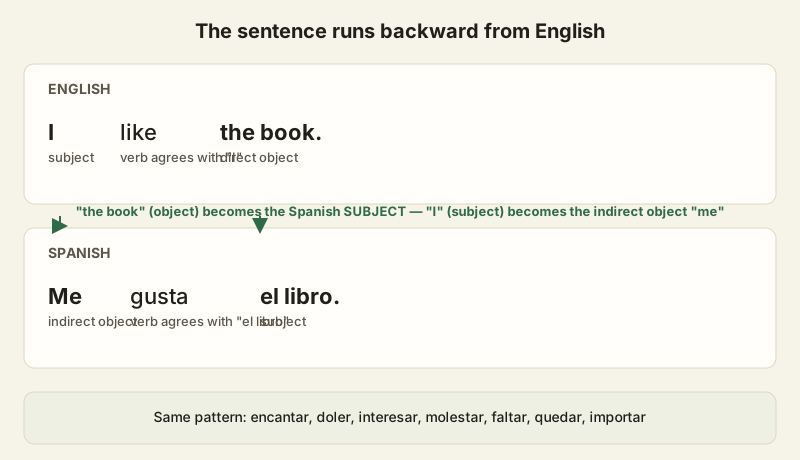
The mechanics: indirect object pronoun + gustar (matching the subject) + the subject
The formula is fixed: an indirect object pronoun (me, te, le, nos, os, les) comes first, then a form of gustar, then the thing being liked, which is the grammatical subject and the thing the verb has to agree with in number. Me gusta el café uses gusta because el café is singular. Me gustan los perros switches to gustan because los perros is plural, not because more than one person is doing the liking.
This is where the reversal trips up learners in a second, more mechanical way, on top of the conceptual one: because the person (me, "I") comes first in the sentence and feels like the subject, it's easy to leave gustar singular even when the thing liked is plural, producing the common error "me gusta los perros" instead of the correct me gustan los perros. The check is always the same: find the noun after the verb, and make gustar agree with that, never with the pronoun in front of it.
When the thing liked is a verb rather than a noun, such as an infinitive or a string of infinitives, gustar stays singular regardless of how many infinitives there are: Me gusta leer y viajar ("I like to read and to travel") keeps gusta, because the RAE treats the infinitive clause as a single, singular notional subject.
Gustar belongs to a defined class of verbs: verbos de afección psíquica
Gustar is not a grammatical oddball; it's the best-known member of a class the RAE's Glosario de términos gramaticales labels verbo psicológico, and which the Academia's grammar elsewhere calls verbos de afección psíquica ("verbs of psychological affection"): verbs that describe a sensation, impression, feeling, or state a person experiences, where the cause of that state is the grammatical subject and the person experiencing it is an indirect object. RAE materials list this group as including aburrir, agradar, alegrar, asombrar, asustar, disgustar, divertir, doler, encantar, entristecer, entusiasmar, impresionar, interesar, irritar, molestar, preocupar, and sorprender, alongside gustar itself.
Every one of those follows the identical indirect-object-first pattern: Me aburre esta película (This movie bores me), Nos encanta la playa (We love the beach), Le duele la cabeza (Her head hurts / She has a headache), Te interesan los idiomas (Languages interest you), Les molesta el ruido (Noise bothers them). Learn the gustar pattern once and every verb in this list works the same way, with the same agreement rule: the verb matches the thing causing the feeling, not the person feeling it.
A separate, wider set of everyday verbs, faltar (to be lacking), quedar (to have left), and importar (to matter), shares the identical word order and agreement rule even though Spanish grammars classify them differently from the affection-verb group above (they describe possession, sufficiency, or relevance rather than a psychological reaction). Me falta dinero (I'm short on money), Nos quedan dos días (We have two days left), and No me importa (It doesn't matter to me) all put the thing that matters, is lacking, or remains as the grammatical subject the verb agrees with, exactly like gustar does.
Clarifying and emphasizing who: a mí, a Juan, a ella
Le and les are genuinely ambiguous on their own: le gusta could mean "he likes it," "she likes it," or "you (formal) like it," since Spanish's pronoun system reuses the same third-person indirect object pronoun for all three. Spanish resolves that ambiguity, and adds emphasis when needed, by adding a prepositional phrase with a alongside the pronoun rather than instead of it: A ella le gusta el fútbol (She likes soccer) keeps le and adds a ella to specify who. The same construction works for names and nouns: A Juan le gusta el fútbol, and for contrast: A mí me gusta el café, pero a ella no le gusta (I like coffee, but she doesn't).
That doubling, the indirect object pronoun and its clarifying a-phrase both present in the same clause, is a normal, required feature of how Spanish's indirect object works with this class of verbs, not redundancy to be trimmed. Dropping le and keeping only a ella, or the reverse when the reference is genuinely ambiguous, are the two most common ways learners accidentally garble who the sentence is actually about.
Two constructions most learners never see: transitive gustar and gustar de
Outside the pattern above, the RAE's dictionary of doubts records two narrower uses of gustar worth knowing so they don't look like exceptions to everything just explained. First, an alternative construction, documented mainly in written and more formal registers, flips the roles: the person who feels the pleasure becomes the subject, and what causes it is expressed with a prepositional phrase using de: Gustaba de reunirse con amigos en su casa (He liked to get together with friends at his house). The RAE specifically flags that de as required, not optional, when the following complement is an infinitive, since dropping it is a documented, frequent error.
Second, gustar also has a rare transitive use meaning "to want" or "to wish," essentially unrelated to the "to like" sense, and it survives today almost exclusively in set courtesy formulas: ¿Gusta usted una cerveza? ("Would you like/care for a beer?"). Outside that kind of fixed, formal offer, this transitive sense doesn't show up in ordinary speech.