"Habrá salido" doesn't mean "she will have left"
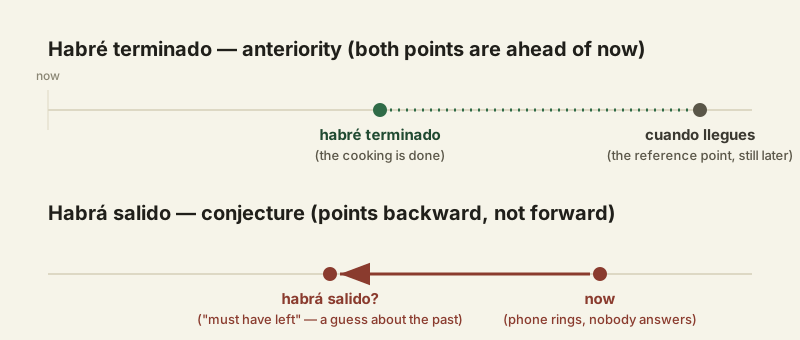
Translated word for word, the Spanish future perfect looks like a strictly future-facing tense: habré terminado becomes "I will have finished," a form English reserves for one job, marking that something is done before a later point. Spanish keeps that job too, further down. But open a real conversation and the far more common use of the tense is a guess about something that has probably already happened. The phone rings, nobody picks up, and a Spanish speaker says "Habrá salido ya": not "she will have left," but "she's probably left already."
The Real Academia Española's own grammar gives essentially the same example with a different verb: "Me habré confundido al anotar el número", which it glosses as roughly "I must have gotten the number wrong when I wrote it down," not any statement about a future mistake. That gap between the literal English translation and the actual meaning is the single biggest trap in this tense, and it mirrors a trap Spanish's simple future tense sets for the exact same reason: both tenses can drop their future meaning entirely and turn into a guess instead.
Building it: haber's own future, plus a participle that never changes
The formation is two pieces. First, conjugate haber in the simple future: habré, habrás, habrá, habremos, habréis, habrán. That stem, habr-, is one of the twelve irregular future stems that swap in for the full infinitive before Spanish verbs add these endings, the same stem-dropping pattern that turns tener into tendré or poder into podré. Second, add the main verb's past participle, and leave it alone: habré hablado, habrás comido, habrá vivido. The participle never changes for gender or number here, no matter who the subject is or what the main verb's participle would do as a plain adjective; habrá terminado is exactly the same whether the subject is él or ella.
Regular participles follow one of two patterns: -ar verbs take -ado (hablado, terminado), -er and -ir verbs take -ido (comido, vivido). Everything below is about the verbs that don't follow either pattern.
Fourteen verbs whose participle isn't just -ado or -ido
A closed set of Spanish participles, the ones the Real Academia Española calls participios fuertes or irregulares, replace the expected -ado/-ido ending with a stressed-root form instead: abierto (abrir), absuelto (absolver), cubierto (cubrir), dicho (decir), disuelto (disolver), escrito (escribir), hecho (hacer), muerto (morir), puesto (poner), resuelto (resolver), roto (romper), satisfecho (satisfacer), visto (ver), and vuelto (volver). Every one of these plugs straight into the future perfect the same way a regular participle would: habrá dicho, habremos hecho, habrán vuelto.
A smaller handful of verbs have two competing participles that both stay in real use, one regular and one irregular: imprimir gives both imprimido and impreso, freír gives both freído and frito, and proveer gives both proveído and provisto. Per RAE, either form works in a compound tense (hemos imprimido veinte ejemplares, habían impreso las copias are both attested), but the split isn't random: the regular form shows up more in present- and future-facing compounds, while the irregular form is more common looking backward, in a pluperfect like había impreso. Reached for as a plain adjective instead of part of a verb phrase, only the irregular form is standard: libros impresos, huevos fritos, never imprimidos or freídos.
The genuinely future use: marking which of two future events finishes first
The straightforward, future-facing use of this tense is anteriority: one action will be complete before a second, later point that is itself still ahead of now. "Para cuando llegues a casa, ya habré terminado de cocinar la cena" ("By the time you get home, I'll have already finished cooking dinner") sets up two future moments, your arrival and the finished dinner, and places the second one before the first. "Habré leído todo el libro para el lunes" ("I'll have read the whole book by Monday") makes the same point with a deadline in place of an event.
This use shows up mostly in planning, writing, and formal or careful speech, the kind of sentence built around a para cuando, cuando, or antes de que clause that fixes the later reference point. It's a real, standard part of the tense, and worth recognizing, but it turns up in ordinary conversation far less often than the conjecture use covered next.
The conjecture use: guessing about the past, not the future
The use that actually dominates spoken Spanish points backward. RAE describes the compound future of conjecture as roughly equivalent to a present perfect plus a modal marker of probability: "Habrá estado enfermo" works out to about "Probablemente ha estado enfermo" ("He's probably been sick"). The tense itself carries the hedge; no separate word for "probably" is required, though Spanish speakers can and do add one anyway for emphasis.
More examples read naturally in everyday contexts: "No contesta el teléfono. Habrá salido ya" ("He's not picking up. He must have already left"), or "Habrán llegado tarde por el tráfico" ("They probably arrived late because of the traffic"). This is the exact same modal trick Spanish's simple future tense uses to guess about right now, just aimed one step further back: it targets something already finished, not something unfolding this very moment. Serán las tres guesses about the present; habrán llegado guesses about the past.
Habrá llegado vs. ha llegado vs. probablemente ha llegado
Three ways of saying roughly the same thing carry different weights of certainty. Ha llegado ("she's arrived") states it as settled fact. Habrá llegado ("she's probably arrived") carries the uncertainty inside the verb form itself, no extra word needed. Probablemente ha llegado says the identical thing by bolting an adverb onto the plain present perfect, with no tense change at all. All three are grammatical, but only the middle one lets the tense itself do the hedging, which is why it's worth learning as its own form, not just as a stylistic variant of the present perfect.
This compound-tense structure, an auxiliary's own tense plus an unchanging participle, isn't unique to Spanish. German's Perfekt builds the same way, a present-tense haben or sein plus an unchanging Partizip II, though the two languages' compound tenses don't line up use-for-use beyond that shared architecture. Spanish's own six-tense everyday core, including where this compound future sits relative to the simple forms, is laid out in full on the site's tense overview.