Keigo has three registers, and they move in different directions
Japanese politeness runs on two systems that get taught as one, and conflating them causes a lot of the confusion. One is the suffix attached to a name: san, sama, kun, chan. It marks social distance and doesn't touch the sentence's grammar at all. The other is keigo (敬語), a set of verb forms that changes depending on whose action is being described. A sentence can pair a plain, suffix-free name with full keigo, or an honorific suffix with completely plain verbs. The two systems layer independently, and native speakers mix them in combinations a suffix-only summary misses entirely.
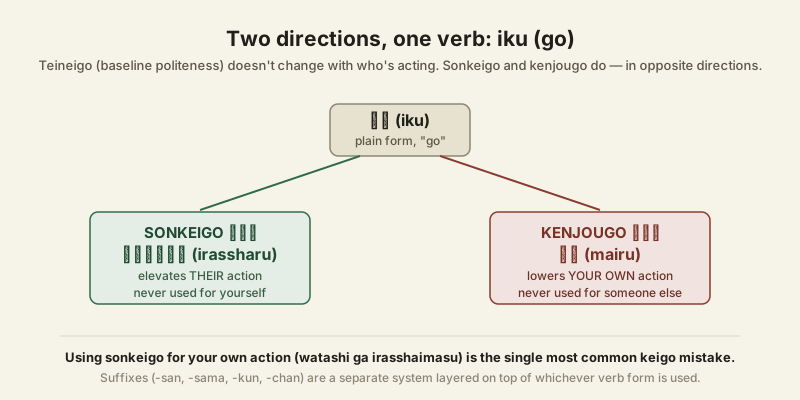
Keigo itself splits into three registers, and only one behaves the way English politeness does. Teineigo (丁寧語), the baseline -masu/-desu ending most learners meet first, marks a sentence as polite without caring who's doing the action: the same ending applies whether the sentence describes your own trip to the store or your boss's trip to Tokyo. Sonkeigo (尊敬語), respectful language, and kenjougo (謙譲語), humble language, both change the verb itself, but they point in opposite directions. Sonkeigo elevates whatever the other person is doing; kenjougo lowers whatever you yourself are doing. Neither gets used the other way around: praising your own action with sonkeigo, or describing someone else's action with kenjougo, sounds off for a specific reason. It inverts who the sentence is supposed to be showing respect to.
The suffixes: san is the safe default, kun tracks rank, not gender
-San is the default, and by far the safest choice when in doubt. It's gender-neutral, works across any age or relationship, and attaches to nearly anyone: a coworker, a stranger, a company name, even a job title. The one place it never goes is your own name. Attaching -san to yourself reads as awkwardly self-important, the way a stranger introducing himself as "Mr. Smith" would in English. -Sama pushes the same idea further up, reserved for customers, deities, and the recipient line of a formal letter (Yamada-sama), where -san would read as too casual for the relationship being marked.
-Kun looks, from a beginner's textbook, like the suffix for boys, and -chan like the one for girls and small children, but that's a side effect of how the suffix actually works, not the rule itself. -Kun marks the person being addressed as junior, or as someone being addressed "downward" in status, regardless of gender. Per a 2025 analysis of the pattern's postwar workplace history, boys ended up with -kun and girls with -san mainly because that was the prevailing gender convention when the habit spread from schools into offices, not because the suffix itself is gender-specific. A senior manager occasionally addressing a young female employee as -kun in a formal workplace is a real, documented use of the same underlying rule: it marks her as junior, nothing more unusual than that. -Chan, by contrast, is about affection and smallness, not rank. Children, pets, close friends, and cute nicknames all take it regardless of gender, and it can attach to a shortened version of a name much like an English nickname would.
-Sensei (先生) tracks expertise, not a job title. Teachers get it, but so do doctors, martial arts instructors, and published authors, because the suffix really marks "someone whose skill puts them in a position to teach me," not "person who works at a school." Senpai, the suffix that's now also an English loanword for someone further along the same path, an upperclassman or a more senior coworker, runs on the same seniority logic as -kun, just aimed up the ladder rather than down it. Two more suffixes exist almost entirely outside spoken conversation, and the last section below covers what they're for.
Nine verbs, three forms each: three of them share one sonkeigo form
The suffix a name carries and the verb form a sentence uses sit on completely separate scales, and the verb scale is where sonkeigo and kenjougo actually live. Most sonkeigo and kenjougo forms just add a prefix or swap an ending, but a short list of common verbs skips that pattern entirely: they replace the whole word with something that shares no root with the plain form at all. This list covers most of what comes up in ordinary polite conversation.
Iku (行く, go), kuru (来る, come), and iru (いる, to be present, for people) collapse into a single sonkeigo form, irassharu (いらっしゃる): three different plain verbs, one honorific verb, told apart only by context. Their kenjougo counterparts split differently. Iku and kuru both become mairu (参る), but iru's humble form is oru (おる), not mairu. Suru (する, do) becomes nasaru (なさる) in sonkeigo and itasu (致す) in kenjougo; go-renraku itashimasu ("I will contact you," humbly) is built on this pair. Iu (言う, say) becomes ossharu (おっしゃる) and mousu (申す). The common self-introduction 田中と申します (Tanaka to moushimasu, "my name is Tanaka") is the humble form doing exactly the self-lowering job kenjougo exists for.
Taberu (食べる, eat) and nomu (飲む, drink) share one sonkeigo form, meshiagaru (召し上がる), and one kenjougo form, itadaku (いただく), the same itadaku that opens every meal in itadakimasu. Miru (見る, see) becomes goran ni naru (ご覧になる) in sonkeigo and haiken suru (拝見する) in kenjougo. Kiku (聞く, hear or ask) has no irregular sonkeigo form; it just takes the regular o-kiki ni naru pattern below, but it does have an irregular kenjougo one, ukagau (伺う), which doubles as the humble form of "visit" as well as "ask." Shiru (知る, know) is one of the few verbs where the sonkeigo form, gozonji (ご存じ), isn't built like a verb at all: it pairs with da or desu and never conjugates on its own, while its kenjougo counterpart, zonjiru (存じる), conjugates normally.
Every other verb that doesn't make this list still gets a sonkeigo or kenjougo form, just built from a predictable pattern, not a separate word. The sonkeigo pattern wraps the verb stem as o-[stem]-ni naru (o-kaeri ni naru, "to go home," respectfully), and the kenjougo pattern wraps it as o-[stem]-suru or o-[stem]-itasu (o-okuri suru, "to send," humbly). The irregular verbs above are irregular precisely because they're common enough that Japanese kept a separate historical word for the honorific version and never let the regular pattern take over, the same reason English still says "went" and not a regularized "goed."
The single most common mistake, and why it survives past the beginner stage
Survey any list of keigo mistakes non-native speakers make and one error dominates: using sonkeigo to describe your own action when kenjougo is what's called for. Watashi ga irasshaimasu, built on the sonkeigo form of "go/come," sounds to a Japanese listener like the speaker is respectfully elevating themselves. The direction runs backward. The correct humble form is watashi ga mairimasu. The fix isn't really about memorizing which of the two lists a verb belongs to; it's about checking, before the sentence leaves your mouth, whose action the verb is describing. Your own action never takes sonkeigo, no matter how polite the situation is.
A second, more subtle error is stacking two honorific layers onto one verb. The regular sonkeigo pattern already marks respect by wrapping the verb as o-[stem]-ni naru. Adding the separate honorific ending -reru/-rareru on top of that, as in o-yomi ni nararemasu, doubles a marker that only needs to appear once. The fix is to pick one mechanism, either the o-...-ni naru wrapper or the -(ra)reru ending, never both on the same verb.
The direction rule gets genuinely harder to apply once a third party enters the conversation, because who counts as "your side" shifts with the audience. Describing your own boss's actions to your team calls for sonkeigo, since your boss outranks you. Describing that same boss's actions to an outside client calls for kenjougo, because relative to an outsider, your boss is now part of your in-group (uchi), and your in-group gets humbled in front of anyone outside it (soto), regardless of the internal hierarchy. The verb changes because the audience changed, not because your boss's rank did.
Dono and shi: honorifics you'll read but rarely hear
Two more honorific suffixes exist mostly on paper. -Dono (殿) once marked a feudal lord's title in the Heian period, then drifted down through the ranks until, by the Kamakura period, -sama had taken over its top-tier role. What survives today is a narrow, formal written use. -Dono shows up in official documents, certificates, and internal memos addressed from a company or institution down to the people below it, and the direction matters, since attaching it to someone equal or senior to the writer reads as backward, the same status-mismatch problem -kun causes when misapplied. It's close to never spoken aloud.
-Shi (氏) is the other written-only suffix, and it solves a different problem: how to refer formally to someone the writer has never actually met. News reports, legal documents, and academic papers reach for -shi when naming a person known only through their public role or publications, and once a full name has been introduced with -shi once, later references can drop to just "shi" alone, functioning almost like a pronoun, as long as only one such person is being discussed. Neither -dono nor -shi is something a learner needs for ordinary conversation, but recognizing them in a document or news broadcast is the difference between reading a sentence correctly and mistaking a formal reference for an unfamiliar name.