Perfekt doesn't map onto English "have done"
German learners usually meet the Perfekt through its literal translation: ich habe gegessen becomes "I have eaten," and it's tempting to treat the two tenses as interchangeable, reserved for the same narrow situations. English present perfect resists a specific past time marker; "I have eaten yesterday" is simply ungrammatical, and "I ate yesterday" is the only correct option. German Perfekt carries no such restriction. Ich habe gestern Pizza gegessen ("I ate pizza yesterday") is completely standard, ordinary spoken German, using the exact tense that would be blocked in English by the word "yesterday."
The mismatch runs deeper than one blocked sentence. In conversation, German speakers reach for Perfekt to report almost anything that happened earlier, regardless of whether it connects to the present the way English present perfect requires. What actually separates German's two past tenses, Perfekt and Präteritum, has far less to do with meaning than a learner coming from English would expect, and far more to do with whether the sentence is spoken or written, a distinction covered in full further down.
Building it: the auxiliary in position 2, the participle at the end
Per the Leibniz-Institut für Deutsche Sprache's Grammis reference, the Perfekt is formed from the present tense of one of two auxiliary verbs, haben or sein, plus the Partizip II (past participle) of the main verb. That much is a direct parallel to English "have" plus a participle. What isn't parallel is where the two pieces end up in the sentence.
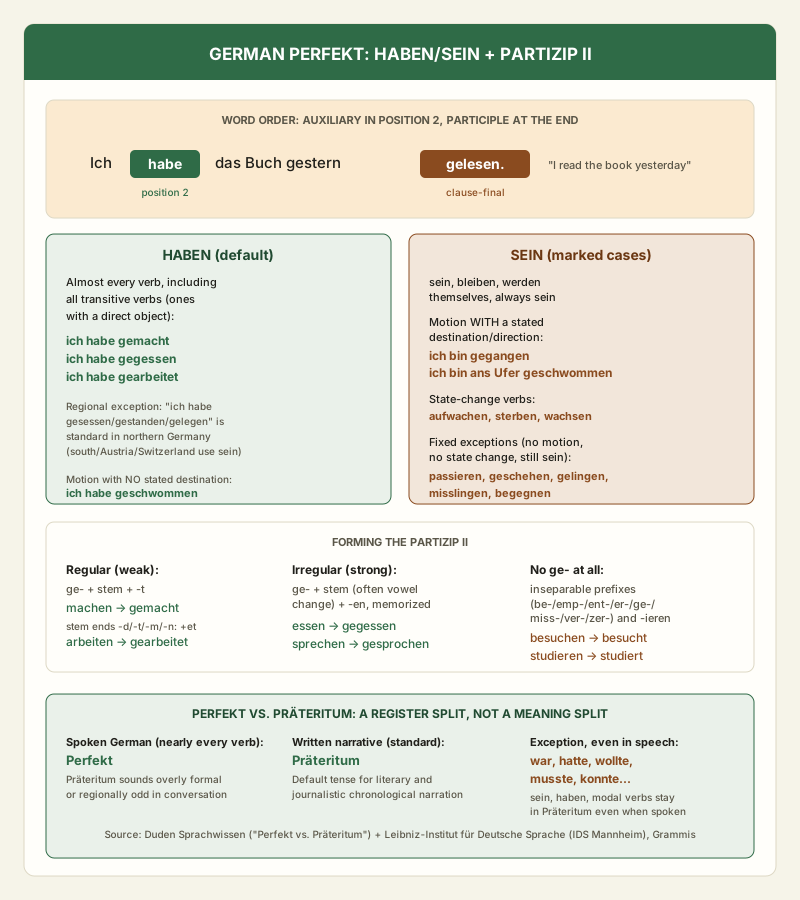
German main clauses put the finite (conjugated) verb in the second position, no matter how many other elements come before or after it. In a Perfekt sentence, that finite slot is filled by the auxiliary, while the participle gets pushed all the way to the end of the clause, forming what's often called the Satzklammer, or "sentence bracket": Ich habe das Buch gestern gelesen ("I read the book yesterday") splits habe and gelesen across the whole sentence, with das Buch gestern sitting between them. English keeps "have" and the participle sitting next to each other; German never does, once anything else is in the clause.
Choosing haben or sein
Haben is the default. It covers the large majority of German verbs, including every transitive verb, meaning any verb that takes a direct object: ich habe das Auto gewaschen, ich habe einen Brief geschrieben. When in doubt, haben is the statistically safe guess.
Sein is reserved for a smaller, more specific set. Per Duden's own reference on the choice, three groups take sein: the verbs sein, bleiben, and werden themselves, always; verbs of movement that carry, or could carry, a directional destination (ich bin gegangen, sie ist über die Straße gesprungen); and intransitive verbs describing a change in the subject's state (er ist aufgewacht, die Blumen sind verblüht). A short list of verbs that fit neither the motion nor the state-change description still take sein by fixed convention: passieren, geschehen, gelingen, misslingen, and begegnen.
The genuinely tricky part, and the one most course-style explanations flatten into a single rule, is that several motion verbs, including schwimmen, fliegen, and laufen, can take either auxiliary depending on whether the sentence states a direction. Per Duden, ich habe geschwommen describes swimming as an activity with no stated destination, while ich bin ans andere Ufer geschwommen ("I swam to the other shore") switches to sein the moment a destination enters the sentence. The verb itself doesn't decide; the presence or absence of a directional phrase does.
One more layer worth knowing before assuming a "wrong" form is a mistake: per Duden and the Leibniz-Institut's Grammis, verbs of rest, sitzen, stehen, and liegen, split by region. Northern German uses haben as the standalone-verb rule would predict: ich habe gesessen, ich habe gestanden. Southern Germany, Austria, and Switzerland instead use sein for the same verbs: ich bin gesessen, ich bin gestanden. Both are correct within their respective regions; neither is a regional error to be corrected toward the other.
Forming the Partizip II
Regular (weak) verbs form the participle by adding the prefix ge- and the ending -t to the verb stem: machen → gemacht, kaufen → gekauft. When the stem itself ends in -d, -t, -m, or -n preceded by a consonant, an -e- is inserted before the -t so the word stays pronounceable: arbeiten → gearbeitet, not gearbtet; regnen → geregnet.
Irregular (strong) verbs take ge- plus the ending -en instead, often with a vowel change in the stem that has to be learned verb by verb rather than derived from a rule: essen → gegessen, sprechen → gesprochen, sehen → gesehen.
Two categories of verbs drop the ge- prefix entirely, regardless of whether they're otherwise regular or irregular. Verbs carrying one of the eight inseparable prefixes, be-, emp-, ent-, er-, ge-, miss-, ver-, and zer-, form their participle without it: besuchen → besucht, verstehen → verstanden, never gebesucht or geverstanden. Verbs ending in -ieren follow the same no-ge- pattern regardless of prefix: studieren → studiert, telefonieren → telefoniert. Separable-prefix verbs behave differently from both: they keep the ge-, but it lands between the separable prefix and the stem rather than at the very front of the word. Aufstehen → aufgestanden, not gaufgestanden.
Perfekt vs. Präteritum: when Germans actually use which
Per Duden's own comparison of the two tenses, the split between Perfekt and Präteritum is primarily one of register, spoken versus written, not one of meaning. In spoken German, narration overwhelmingly happens in Perfekt; Präteritum forms sound regionally unusual or unnecessarily formal in casual conversation. In standard written German, the relationship flips: Präteritum is the default tense for chronological narration in literary texts, reports, and news writing, while Perfekt is comparatively rare outside of dialogue or personal letters.
A small, extremely frequent group of verbs breaks the spoken-Perfekt default even in casual conversation. Sein, haben, and the modal verbs (wollen, müssen, können, dürfen, sollen, mögen) stay in Präteritum in speech: war, hatte, wollte, musste, konnte, durfte, sollte, and mochte are what German speakers actually say, not the grammatically valid but conversationally stilted Perfekt equivalents ist gewesen, hat gehabt, hat gewollt, and so on. Unlike the aspectual choice a Spanish speaker makes between the preterite and imperfect, which tracks whether an action was completed or ongoing, choosing Perfekt or Präteritum in German has almost nothing to do with what actually happened and almost everything to do with whether the sentence is spoken or written, and which specific verb is involved.