How far apart the two varieties actually sit
Puerto Rican Spanish vs Mexican Spanish is a comparison between two ends of the Spanish-speaking Americas. Mexican Spanish belongs to the highland group: its consonants are clipped, its unstressed vowels are often swallowed in fast speech, and the s at the end of a syllable stays a full s. Puerto Rican Spanish belongs to the Caribbean group, alongside Cuban and Dominican Spanish, where consonants weaken at the end of a syllable and the rhythm runs quicker. The two are the same language on paper and clearly different ones in the ear.
The two are not equally familiar to learners. Mexican Spanish is the variety most widely exported through dubbing, television and film, which is why it is often taken for a neutral standard. Puerto Rican Spanish sits at the other end: it is one of the varieties most heavily shaped by contact with English and by Taíno and African vocabulary, and it carries pronunciation habits that a standard textbook never prepares you for. If you learned your Spanish question words from a Mexican course, the Puerto Rican versions will still sound unfamiliar.
The letter s is the clearest line between the two
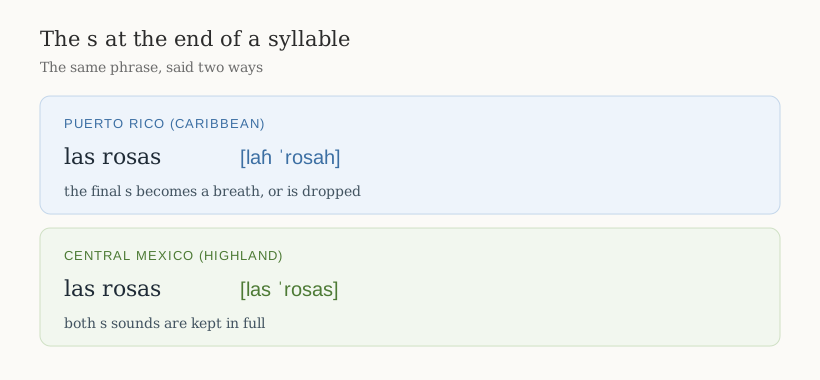
Syllable-final s is the single most reliable way to tell a Caribbean speaker from a Mexican one by ear. In Puerto Rico the s at the end of a syllable is aspirated to a breathy [h] or dropped outright. Las rosas comes out closer to [laɦ ˈrosah] than to [las ˈrosas], and los dos sounds like [loɦ ðoh]. The aspiration is not a marker of casual speech or of low education. It runs across social classes and across the island, in towns and in the countryside alike.
Central Mexican Spanish keeps that s. A speaker from Mexico City or the surrounding highlands pronounces las rosas with both s sounds intact, at the start of the phrase and at the end.
The two varieties do agree on one point that separates them from most of Spain. Both have seseo: the letter z and the soft c before i or e are pronounced as s, so zapato is [saˈpato] and azul is [aˈsul], never with the th sound of peninsular Spanish.
r turns into l, and d falls away
Puerto Rican Spanish reshapes consonants in the middle and at the end of words as well. A syllable-final r becomes an l, which is why the island's own name is often heard as Puelto Rico and arte can come out as alte.
The d between vowels, or at the end of a word, weakens and frequently disappears. Estado reduces to something close to [ehˈtao] and pared to [paˈɾe]. Mexican Spanish weakens some consonants in rapid speech too, but the systematic loss of intervocalic and final d is a Caribbean habit.
The same object, two everyday words
Vocabulary is where the two varieties surprise each other most. None of the words below is slang, and none is a mistake. They are the ordinary words a shopkeeper, a bus driver or a parent would reach for.
The bus is guagua in Puerto Rico and camión in Mexico. The Real Academia Española records guagua as the ordinary word for a vehicle running a fixed urban or interurban route in the Antilles, the Canary Islands, Guatemala and Equatorial Guinea. The Diccionario de americanismos marks camión as the Mexican word for a public-transport bus, distinct from the cargo truck the same word names elsewhere.
A drinking straw is popote in Mexico, a borrowing from Nahuatl popotl, and sorbeto in Puerto Rico, sitting beside the sorbete used in Ecuador, Peru, Argentina and Uruguay. Beans are frijoles in Mexico, the general American Spanish word, and habichuelas in Puerto Rico and the Dominican Republic.
The pattern behind the splits is not random. Mexican Spanish draws a large share of its regional vocabulary from Nahuatl. Puerto Rican Spanish draws on Taíno, on African languages carried through the slave trade, and on English.
¿Qué tú quieres? and the word order question
The sharpest grammatical difference sits in questions. Standard Spanish places the verb before an expressed subject in a wh-question: ¿Qué quieres tú? Puerto Rican Spanish regularly allows the opposite order, with the subject first: ¿Qué tú quieres? Mexican Spanish does not.
This is not a slip. A quantitative study of 882 wh-questions in Puerto Rican conversational speech found subject-verb order in roughly 47% of them against only 4% with the standard verb-subject order. Non-inversion turned up in 14% of all wh-questions, rising to 25% when the question had an overt subject. Cuban and Dominican Spanish show the same tendency.
Linguists have argued about the cause for decades. One proposal ties the fixed order to the loss of word-final s and n in Caribbean speech: with those endings gone, word order takes over part of the work they once did. Other explanations point to the high rate of expressed subject pronouns in these varieties, or to a broader drift from flexible to rigid word order across the Caribbean.
What the two varieties share
The differences above are easy to overstate, because the shared ground is much larger. Both varieties have seseo and both merge ll with y, the change known as yeísmo. Both use tú for the informal singular and ustedes for the plural, with no vos. Both prefer the simple preterite where peninsular Spanish would use the present perfect, so Esta mañana tuve un accidente is normal on both sides of the comparison while Esta mañana he tenido un accidente sounds European.
That shared base is why a Puerto Rican and a Mexican speaker understand each other with almost no friction. The features above mark where someone is from. They rarely block meaning, and a learner who knows one variety is not starting over with the other. The verb system and the core grammar are shared, so two useful places to start are the guides to Spanish prepositions and to the ser and estar distinction.
Where the two varieties trip each other up
The real pitfalls are words that look familiar and mean something else. Guagua is the clearest case. In Puerto Rico it is a bus. In Argentina, Bolivia, Chile, Colombia, Ecuador and Peru the same word means a baby, from Quechua wáwa, and using it for a vehicle there will get a laugh.
The straw and bean splits cut in a milder direction. A Mexican asking for popote in San Juan, or a Puerto Rican asking for habichuelas in Mexico City, will be understood in the end, but not at once, and usually only after a round of pointing.
The word order difference is the one that stands out most. ¿Qué tú quieres? is unremarkable in San Juan and conspicuous in Mexico City, where the standard ¿Qué quieres? is the only form a listener expects. Learners who pick up the Puerto Rican pattern and carry it to Mexico will be understood, but they will sound like they learned their Spanish somewhere specific.