Seven words, one job, two different agreement rules
A Spanish possessive placed in front of a noun (mi hermano, tu casa, su coche) is what the RAE's grammar glossary calls a determinante posesivo, distinct from a possessive that follows the noun (un amigo mío, la casa suya), which the Academia's Nueva gramática treats as behaving like an ordinary postnominal adjective. This guide covers the prenominal set, since that's what "mi casa" and "spanish possessive adjectives" both point at: mi/mis, tu/tus, su/sus, nuestro/nuestra/nuestros/nuestras, and vuestro/vuestra/vuestros/vuestras, seven forms covering six grammatical persons because su does double duty for third-person singular and third-person plural alike.
Two things about that list trip learners up almost immediately. First, only two of the seven forms change shape for gender; the rest stay fixed no matter what they modify. Second, su by itself is ambiguous on its own, not a learner error but an actual gap in the word's information, and Spanish has a fixed, everyday fix for it.
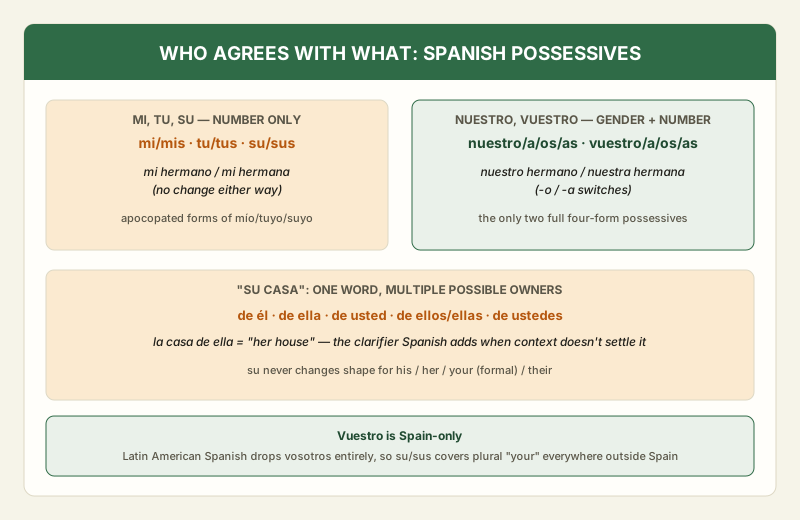
Mi, tu, su: apocopated forms that mark number, never gender
Mi/mis ("my"), tu/tus ("your," informal singular), and su/sus ("his/her/your-formal/their") only ever change for number, and never for the gender of the noun they modify. Mi hermano and mi hermana both take mi, with no -a ending to signal that hermana is feminine; tu perro and tu perra work the same way, and so does su oficina next to su coche. This is unlike Spanish's ordinary adjectives, which almost always flex for gender (rojo/roja, alto/alta), and it's exactly the pattern learners default to expecting, then have to unlearn for this one function word.
The reason is historical rather than arbitrary: mi, tu, and su are apocopated (shortened) forms of the longer possessives mío, tuyo, and suyo, which do carry full gender marking when they appear after a noun or stand alone (la casa es mía, not mío). The written accent matters here too: mi (the possessive) and mí (the stressed pronoun meaning "for me," used after a preposition) are one of the closed set of diacritical tilde pairs, where the accent mark is the only thing telling two identically spelled words apart. The difference isn't only on paper. Mí carries real stress in speech, while mi, like most possessives placed before a noun, doesn't; writing mí hermano instead of mi hermano puts the accent on the wrong word entirely, not just a typo a reader would gloss over. That kind of near-invisible marking has a parallel one tense over: the Spanish present tense is the one tense RAE's own grammar treats as carrying no audible time marker at all, unlike the accent-bearing possessive pair above, where a single written stroke is the entire difference between two words.
Nuestro and vuestro: the only two that agree in gender too
Nuestro/nuestra/nuestros/nuestras ("our") and vuestro/vuestra/vuestros/vuestras ("your," informal plural, Spain) are the two possessives that carry a full four-form paradigm, switching the final vowel for gender the same way an ordinary adjective does. Nuestro hermano and nuestra hermana actually change shape depending on what's being possessed, unlike mi hermano and mi hermana from the section above, which stay identical either way.
That contrast is the single rule that trips up learners who've already internalized mi/tu/su and then assume the whole possessive system behaves the same way. It doesn't: nuestros primos ("our cousins," masculine or mixed group) and nuestras primas ("our [female] cousins") are a real, required distinction, not a stylistic option, per the RAE's classification of possessive forms in the Nueva gramática básica.
Su is ambiguous on its own, and Spanish has a fixed way to clarify it
Sus llaves can mean "his keys," "her keys," "your keys" (formal usted), or "their keys." Su/sus still tracks the number of the thing possessed (llave/llaves), just not who owns it, so the word itself gives no signal which owner is meant. Su oficina, taken on its own with no surrounding context, is ambiguous in four different directions at once, not an artifact of a learner misreading it; a native speaker needs context or a follow-up question to know which owner is intended.
When context alone doesn't settle it, Spanish speakers reach for a fixed clarifying structure: replace the possessive with the noun plus de and the relevant pronoun. La oficina de él ("his office"), la oficina de ella ("her office"), la oficina de usted ("your office," formal), la oficina de ellos or la oficina de ellas ("their office," masculine/mixed or all-feminine group), and la oficina de ustedes ("your office," plural). This is the standard, everyday way Spanish resolves an ambiguity built into the word su itself, not a workaround learners are expected to improvise on the spot.
Vuestro is Spain-only; the rest of the Spanish-speaking world reuses su
Vuestro exists because Spain keeps a real register split in the plural "you": informal vosotros/vosotras against formal ustedes, covered in full for the subject-pronoun side of this same split. The possessive follows that exact line. Vuestro coche ("your car," addressed informally to a group) only makes sense where vosotros is in active use.
Latin American Spanish drops vosotros from everyday speech and uses ustedes for both informal and formal plural "you," collapsing a distinction Spain keeps. Because there's no vosotros in ordinary use to pair a possessive with, there's little everyday occasion for vuestro either: su coche covers "your car" (plural, any register) across the region instead, the same su that already covers "his," "her," and "their." A Latin American speaker will recognize vuestro instantly from a book or a Spanish film, and it can still surface in formal or ceremonial writing paired with ustedes, but it isn't a form most speakers produce in daily conversation.
When the possessive moves after the noun
Every possessive above sits in front of its noun as a determinante posesivo, per the RAE's grammatical glossary, legitimizing the noun phrase the same way an article does, which is why mi and un can't both precede casa at once (mi casa or una casa, never un mi casa). Move the long forms (mío, tuyo, suyo, nuestro, vuestro) after the noun instead, and the RAE's Nueva gramática treats them as ordinary postnominal adjectives: un amigo mío ("a friend of mine") needs no article beyond the un already there, and la casa es suya ("the house is hers") uses the same long form as a predicate, with no noun attached at all.
The two positions aren't interchangeable in feel. Mi amigo is the neutral, default way to say "my friend," with no particular emphasis on the possession itself. Un amigo mío shifts to the long form specifically to draw attention to whose friend this is, often with the sense of "one friend among several," and it's the structure Spanish reaches for when the point is contrast: es idea mía, no tuya ("it's my idea, not yours") needs the postnominal form precisely because it's setting one owner against another.
A third, related use goes further still: when the possessive stands in for the noun entirely rather than modifying it, it crosses into a different grammatical category, a possessive pronoun rather than a possessive adjective, typically requiring the definite article (el mío, la suya) when it isn't simply following ser. That's a separate set of rules from the ones on this page; the full possessive-pronoun paradigm, alongside Spanish's five other pronoun families, covers it in depth.