Habla, but no hables: two different systems, not one
Habla más despacio ("Speak more slowly") and No hables tan rápido ("Don't speak so fast") use the same verb, addressed to the same person, and produce two endings that don't look related at all: habla versus hables. Most learners assume the negative is just the affirmative with no stuck in front, and go looking for the rule that's supposed to explain the vowel change. There isn't one, because habla and hables aren't variants of the same form to begin with.
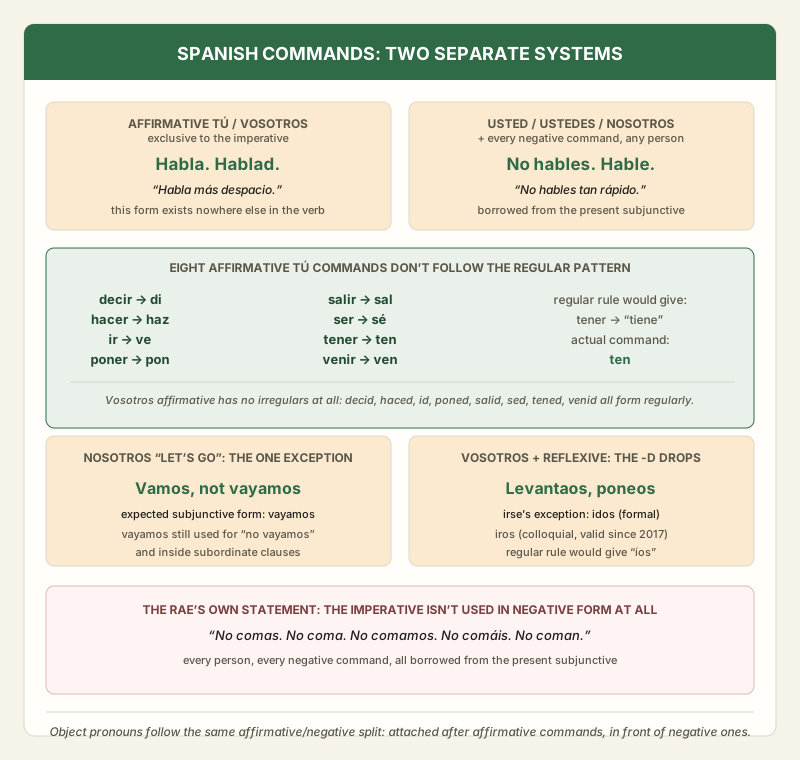
Per the RAE's own glossary entry on modo imperativo, only three grammatical persons have imperative forms that exist exclusively in that mood and nowhere else in the verb's conjugation: tú, vos, and vosotros, and only in the affirmative. Every other command in Spanish, meaning usted, ustedes, and nosotros commands regardless of polarity, plus every single negative command in any person at all, is built by borrowing a form the present subjunctive already has. Habla is one of the imperative's own exclusive forms. Hables, in no hables, is a present-subjunctive form standing in for a negative imperative that Spanish simply doesn't have.
Affirmative tú and vosotros: forms that exist nowhere else
The regular affirmative tú command is identical to the verb's third-person singular present indicative: hablar gives habla (same as él habla), comer gives come, escribir gives escribe. No new form is created; Spanish reuses a shape the verb already has, just aimed at a different person.
Eight common verbs break that pattern outright, with affirmative tú commands that don't match their third-person present indicative at all: decir → di, hacer → haz, ir → ve, poner → pon, salir → sal, ser → sé, tener → ten, venir → ven. Tener's regular pattern would predict tiene; the actual command is ten. These eight are worth memorizing as a fixed set precisely because no rule generates them.
One coincidence worth knowing: ver's regular affirmative tú command is also ve (identical to él ve), which happens to be spelled exactly like ir's irregular ve. Context is the only thing separating ¡Ve la película! ("Watch the movie!") from ¡Ve a casa! ("Go home!").
The affirmative vosotros command follows a separate, completely regular rule that applies to every Spanish verb without exception, including all eight of the tú-irregular verbs above: drop the infinitive's final -r and add -d. Hablar → hablad, comer → comed, escribir → escribid, and even ir → id, decir → decid, tener → tened. There is no irregular vosotros affirmative command in Spanish.
Usted, ustedes, and nosotros: borrowed from the subjunctive by default
Usted and ustedes commands never have a dedicated imperative form at all, affirmative or negative; both polarities use the identical present-subjunctive form. Hable (usted) and hablen (ustedes) serve as both the affirmative and the negative command, with only no separating hable from no hable. That's a real structural difference from tú, where the affirmative (habla) and negative (no hables) are two different forms.
The nosotros ("let's...") command works the same way, borrowed from the present subjunctive: hablemos, comamos, escribamos. One common verb breaks this in the affirmative only: ir's expected subjunctive form is vayamos, but native speakers use vamos for affirmative "let's go" instead. Per the RAE's own dictionary of doubts, vamos historically comes from a contraction of vayamos, though speakers today no longer perceive it as one; vayamos remains the form actually used for the negative (no vayamos, "let's not go") and inside subordinate clauses like quiero que vayamos ("I want us to go").
Negative commands: the imperative mood has no negative form at all
The RAE's own grammar states this directly: the imperative mood is not used in negative sentences at all. Whenever a command is negated, in any person, Spanish substitutes the present subjunctive instead, which is why no hables and no habléis don't resemble habla and hablad even though tú and vosotros do have their own exclusive affirmative forms elsewhere. No comas, no coma, no comamos, no comáis, no coman all follow this same substitution, regardless of which person is being addressed.
This affirmative/negative split also governs pronoun placement, already covered in the reflexive verbs and double object pronoun pieces: object and reflexive pronouns attach to the end of an affirmative command (Siéntate, Dímelo) and move back in front of the verb for a negative one (No te sientes, No me lo digas). Fusing a pronoun onto an affirmative command is also one of the more common sources of the written accents covered in the Spanish accent marks guide, since forms like dímelo and cuéntamelo become esdrújulas that need a tilde to keep their original stress.
Vosotros plus a reflexive pronoun: where the -d disappears
When a reflexive os attaches to an affirmative vosotros command, the -d at the end drops before it: levantad + os becomes levantaos, not levantados; poned + os becomes poneos. This is a regular, exceptionless rule, with one single verb standing outside it.
Irse's expected form by that same rule would be íos (id + os, minus the -d). Spanish kept the -d instead, giving idos. Per the RAE's own explanatory note on the form, íos did exist historically, but its phonetically thin shape led speakers to retain the original -d, and idos remains the Academy's most recommended form in formal writing. In everyday speech, though, a different form, iros, arrived at by shifting that same -d to an -r, has become the dominant colloquial choice, and the RAE accepted it as valid alongside idos in 2017, while still marking idos as the more formal option.