Three degrees of "a noun," not two
English gets by with roughly two article choices: "the" for something specific, "a/an" (or nothing at all) for everything else. French runs a finer grid. Larousse's own dictionary defines the article as a word that precedes a noun and determines it "more or less precisely," while also marking its gender and number. In French, that grid runs three degrees deep, not the two English speakers are used to.
The definite articles (le, la, l', les) mark a noun that's specific and identifiable, or, more surprising to English speakers, an entire category treated as a whole: Le café est bon pour la santé ("Coffee is good for your health") uses le for coffee-in-general, a sentence English states with no article at all. The indefinite articles (un, une, des) mark a countable item that hasn't already been identified: J'ai un chat ("I have a cat," one unspecified cat). The partitive articles (du, de la, de l') mark an unspecified portion of something usually treated as a mass rather than a count of separate items: Je bois de l'eau ("I drink [some] water"), a "some" that English speakers routinely drop by reflex because their own language doesn't require it.
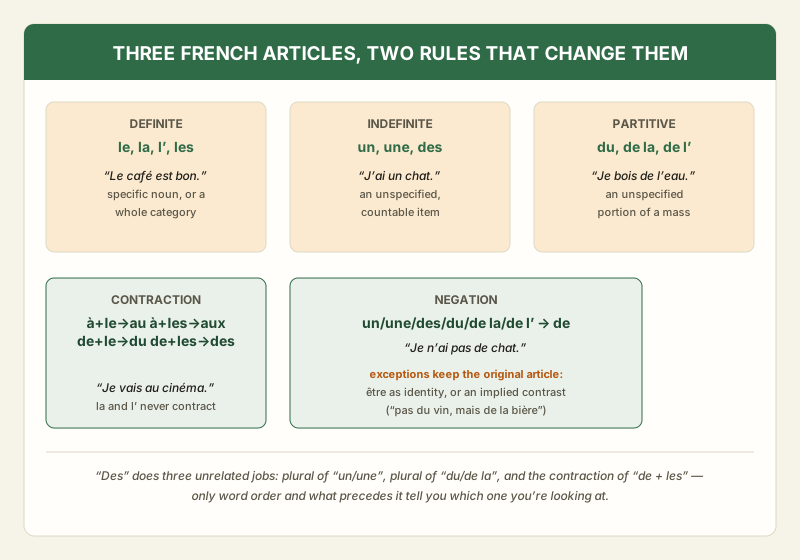
Definite for the specific and the general; indefinite and partitive split by countability
The definite/indefinite choice in French tracks roughly the same logic as English "the" versus "a," with one extra wrinkle: French uses the definite article for a noun considered as a whole category, not just for a noun already mentioned or already known to the listener. J'aime le café ("I like coffee") is definite in French even though the sentence is making a general statement, not pointing at a specific cup.
Once a noun lands in the indefinite camp, not the definite one, French then asks a second question English doesn't grammaticalize the same way: is this something you count, or something you measure? Un chat, deux chats: cats are countable, so the indefinite article (un, une, plural des) applies. Pain, eau, and vin aren't normally counted one by one in ordinary speech, so they take the partitive (du pain, de l'eau, du vin) instead, marking a portion of a mass, not a tally of separate items. Elle mange du pain ("She's eating [some] bread") describes an unspecified amount of bread, not "a bread" as a countable unit; that reading exists in French too (une baguette, un pain), but it requires switching to a noun that names a specific countable shape.
À and de fuse with le and les, never with la or l'
When the prepositions à ("to/at") or de ("of/from") land directly in front of the masculine singular article le or the plural les, French doesn't let the two words sit side by side. It forces a single fused word: à + le becomes au, à + les becomes aux, de + le becomes du, and de + les becomes des. Je vais au cinéma ("I'm going to the movies") is the only correct form; à le cinéma isn't an informal shortcut, it's simply not French. Larousse's own entries for à and for le document the same pattern with parallel examples, including boire au goulot ("to drink from the bottle") for à + le, and s'attendre aux difficultés ("to expect difficulties") for à + les.
The feminine la and the elided l' never take part in this fusion, no matter what precedes them: à la fille, à l'école, de la maison, and de l'université all stay as two separate words. That asymmetry (le and les fuse; la and l' don't) is worth memorizing as a fixed rule rather than a pattern to derive, since nothing about the sound of la or l' explains why they'd resist a contraction that le and les don't.
Negation flips the article to de, with three real exceptions
After a negated verb, French routinely reduces the indefinite and partitive articles down to a single de (or d' before a vowel sound), regardless of the gender or number the article started with. J'ai un chat becomes Je n'ai pas de chat; Elle boit du café becomes Elle ne boit pas de café. The definite article le/la/les doesn't follow this rule at all: Je n'aime pas le café keeps le, because negating "I like coffee" denies a relationship to an already-definite category, not a quantity of coffee.
Three situations keep the original article; it doesn't collapse to de, according to the Office québécois de la langue française's grammar reference. The first is the verb être functioning as a linking verb: Ce n'est pas un problème ("That's not a problem") keeps un rather than shifting to de problème, because être here is asserting or denying an identity, not counting or measuring a quantity of something. The second is a sentence built around an implicit contrast, where the negated noun is being weighed against a different one, not denied outright: Nous n'avons pas des reproches à te faire, mais des éloges ("We don't have criticisms for you, but praise") and Nicole ne boira pas du vin ce soir, mais de la bière ("Nicole won't drink wine tonight, but beer") both keep the original article on the negated side, because the sentence is substituting one thing for another, not claiming zero quantity. The third isn't really negation at all: ne...que restricts a quantity to "only" without denying it, and it generally keeps the article unchanged too, per the same OQLF reference. Nous n'avons que des compliments à te faire ("We only have compliments for you") keeps des without reducing to de, because nothing is actually being denied.
One word, three unrelated jobs: why "des" keeps showing up everywhere
Des is three different grammatical objects wearing the same spelling. It's the plural form of the indefinite un/une (J'ai des amis, "I have [some] friends," an unspecified plural count). It's also the plural form of the partitive du/de la: French doesn't give mass nouns a separate plural partitive shape, so when an ordinarily mass-like noun gets pluralized into countable instances, des covers that too (Elle achète des fromages, "She's buying some cheeses," treating cheese varieties as countable items). And, entirely separately, des is the mandatory contraction of the preposition de plus the plural definite article les, as documented in Larousse's own entry for des: le prix des billets ("the price of the tickets") uses this des to mean "of the," pointing at specific, already-identified tickets, not "some" unspecified ones.
Nothing in the spelling distinguishes the three. What tells them apart is the sentence around them: an indefinite or partitive des attached to a direct object collapses to de under negation (Je n'ai pas d'amis), while a contraction des attached to a possessive-style "of the" phrase doesn't follow that rule at all, because it was never marking an unspecified quantity in the first place. Worth noting for anyone actually learning the language, as opposed to just borrowing a phrase from it: déjà vu crosses into English with its meaning intact but none of this article machinery attached, since English never needed an article in front of it at all.