Three conjugations, and only one of them is where irregularity lives
French sorts every verb into one of three conjugations, and the split is not evenly weighted. Wikipedia's "French conjugation" entry puts the first group, verbs ending in -er, at around 6,000 members, following the same pattern "largely without exception." The second group, -ir verbs whose present participle ends in -issant (finir → finissant), holds around 300 members and is also close to fully regular. The third group is everything left over: verbs in -re, verbs in -oir, a smaller set of -ir verbs that do not take the -issant pattern, and, despite its spelling, aller. Wikipedia states the exception directly: "aller, though it ends in -er, belongs to the third group."
The third group differs from the other two in shape, size, and status: per Wikipedia, it is a closed class, meaning no verb newly coined in French is ever assigned to it. Every new verb entering the language today, such as téléviser, atomiser, or googliser, lands in the first group. The second and third groups are fixed lists that stopped growing centuries ago. That framing changes what "irregular verb" means in French: the third group is a fixed, finite set, and much of what looks unpredictable inside it turns out to be grouped rather than scattered. Spanish sorts its own irregular verbs by a different organizing principle entirely: rather than a closed grammatical class, the RAE groups Spanish irregular verbs by exactly what part of the stem changes, vowel, consonant, both, or the root itself, a classification that cuts across frequency and conjugation class rather than isolating one fixed list the way French's third group does.
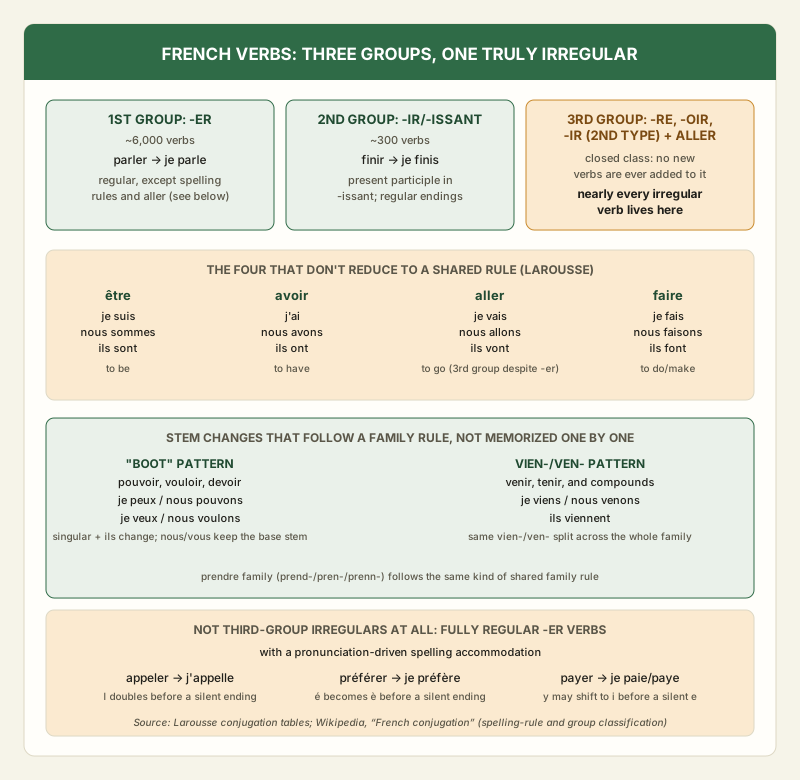
The only four that do not reduce to a rule: être, avoir, aller, faire
Être and avoir are the two verbs every French sentence in a compound tense eventually leans on, since they are also the auxiliaries behind passé composé and every other compound form. Per Larousse's conjugation tables, être runs je suis, tu es, il/elle est, nous sommes, vous êtes, ils/elles sont: six forms that share almost nothing with each other in sound or spelling, which is exactly what "truly irregular" means here. Avoir runs j'ai, tu as, il/elle a, nous avons, vous avez, ils/elles ont, a different but equally scattered set of stems.
Aller and faire round out the four. Aller, confirmed above as a third-group verb despite its -er ending, conjugates je vais, tu vas, il/elle va, nous allons, vous allez, ils/elles vont: none of those six forms share a stem, and none of them resemble a regular -er verb's endings either. Faire runs je fais, tu fais, il/elle fait, nous faisons, vous faites, ils/elles font. Vous faites belongs to a small, well-known exception: per Larousse, être (vous êtes) and dire (vous dites) take that same -tes ending instead of the -ez most other verbs use in the vous form. These four verbs are also among the handful that carry an irregular subjunctive stem, a different irregularity covered in full in the French subjunctive breakdown, where avoir and être turn out to be the only two verbs in the language that also swap their subjunctive endings, not just their stem. Être also sits behind a separate irregularity pattern with nothing to do with its own conjugation: it's the auxiliary a closed list of French reflexive verbs always takes instead of avoir, where the real complication isn't the auxiliary choice but when the past participle agrees with the subject and when it doesn't.
Most other "irregular" verbs are family patterns, not one-offs
Pouvoir, vouloir, and devoir share a stem-change shape old grammar guides nicknamed the "boot" or "shoe" pattern, because circling the changed forms on a conjugation chart traces that outline. Per Larousse, pouvoir runs je peux, tu peux, il/elle peut, nous pouvons, vous pouvez, ils/elles peuvent; vouloir runs je veux, tu veux, il/elle veut, nous voulons, vous voulez, ils/elles veulent; devoir runs je dois, tu dois, il/elle doit, nous devons, vous devez, ils/elles doivent. In all three, the je/tu/il/ils forms share one stem and nous/vous share a separate, more infinitive-like stem. Learn that split once and it applies to the whole family, not just to whichever one verb happened to come up in a textbook exercise.
Venir and tenir run a parallel two-stem split of their own. Per Larousse, venir conjugates je viens, tu viens, il/elle vient, nous venons, vous venez, ils/elles viennent: a vien- stem for je/tu/il/ils, a ven- stem for nous/vous. Tenir follows the identical pattern (je tiens, nous tenons), and so does every compound built on either verb: revenir, devenir, tenir's own compounds like obtenir and retenir. Learning venir well effectively means learning a dozen other verbs at the same time.
Prendre works the same way on a third stem shape: je prends, tu prends, il/elle prend, nous prenons, vous prenez, ils/elles prennent, per Larousse, with apprendre, comprendre, and reprendre inheriting the identical prend-/pren-/prenn- split. Across all three families, the useful unit to memorize is the family's stem-change rule, not each individual compound verb. A flat alphabetized list of "top 100 irregular verbs" hides that relationship entirely, presenting reprendre and prendre as two unrelated entries to learn from scratch.
Verbs people call "irregular" that are actually fully regular
A separate category gets lumped in with irregular verbs by habit, even though it belongs entirely to the regular first group. Per Wikipedia's spelling-rule summary for -er verbs, appeler and similar -eler/-eter verbs double their l or t before an ending that starts with a silent e (appeler → j'appelle), a purely orthographic fix: French spelling needs a doubled consonant to signal that the preceding e is pronounced as in "elle" rather than swallowed. Préférer and other -é[consonant]er verbs shift é to è under the same silent-ending condition: je préfère, nous préférons. Payer and other -ayer verbs may shift y to i before a silent e (je paie, alongside the still-standard je paye).
These verbs stay inside the regular -er pattern; a spelling adjustment sits on top of it purely to keep the written form matching the spoken one, and the same adjustment applies identically to every verb in that spelling class. Wikipedia notes one irregularity inside this group that is not just spelling, and it is narrower still: envoyer (and renvoyer) takes an irregular stem specifically in the future and conditional (j'enverrai, not the expected "envoierai"), a real, isolated exception rather than a spelling rule, and the only place a first-group verb crosses into the kind of irregularity the third group is built from.
Where the same irregular stems resurface: participles and the subjunctive
Irregularity in one tense does not automatically predict irregularity in another, but for these particular verbs it usually travels along. Être, avoir, faire, and aller all take irregular past participles (été, eu, fait, allé), and so do most of the family-pattern verbs from the previous sections: venir gives venu, tenir gives tenu, prendre gives pris (with apprendre and comprendre inheriting appris and compris the same way prend- carried across their present tense). The full set of irregular past participle families, grouped by ending rather than memorized verb by verb, covers this in more depth than fits here.
Several of the same high-frequency verbs, être, avoir, aller, and faire among them, also take an irregular stem in the present subjunctive, a distinct irregularity from anything covered above since the subjunctive is a different mood built on its own stem rules entirely. Que je sois, que j'aie, que j'aille, and que je fasse do not derive from any of the present-tense forms given earlier; the full account of which verbs break the subjunctive's otherwise uniform ending pattern, and which two break the endings themselves, lives in the site's dedicated subjunctive guide.
How to actually learn these verbs
Start with être and avoir: they are also the auxiliaries every compound tense in French is built on, so getting those two stem sets solid turns half of the compound-tense system into a matter of adding a participle rather than learning a new conjugation. Add aller and faire next; between the four of them, that covers the verbs that show up in nearly every conversation.
After that, the more efficient move is learning stem-change families rather than individual verbs: once venir is solid, tenir and their combined dozen-plus compounds are most of the way learned already; once pouvoir is solid, vouloir and devoir follow the identical shape. Spend the least effort on spelling-change -er verbs like appeler or préférer: treating them like third-group irregulars wastes effort on something already fully predictable from a spelling rule.