Six cases, and nowhere for an article to carry them
Russian marks a noun's role in a sentence with six cases: nominative, genitive, dative, accusative, instrumental, and prepositional, across two numbers (singular and plural) and three genders. It groups nouns into three declension patterns rather than one: feminine (and a few masculine) nouns ending in -a/-ya, most masculine and neuter nouns, and feminine nouns ending in a soft sign (mya'gkiy znak). Every noun in every one of those patterns changes its own ending across the six cases.
That last point is the real structural difference from a language like German. Russian has no definite or indefinite articles at all, nothing corresponding to "the" or "a." The German Cases guide on this site covers how German case marking lands almost entirely on der/die/das rather than the noun, with the bare noun changing in only a few predictable spots. Russian never developed that helper word, so it never had anywhere else to put the marking. All six cases show up on the noun itself, and on whatever adjective or pronoun modifies it.
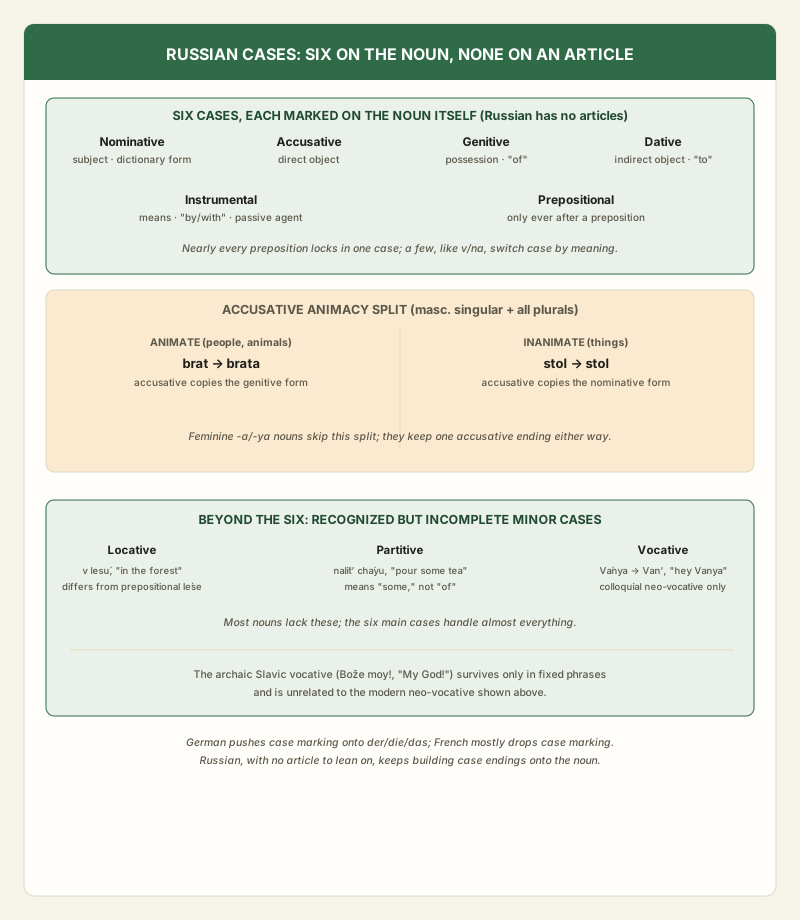
What each of the six actually marks
Nominative names the subject and doubles as the default citation form, the one a dictionary entry or a street sign uses. Accusative marks the direct object, and shows up after prepositions of motion such as v ("into"), na ("onto"), and za ("behind, after") when the phrase describes movement toward something rather than a fixed location. Genitive covers possession ("of"), attaches to numerals and quantifiers, and replaces the accusative on a negated direct object specifically to signal that the object is indefinite or entirely absent: ya ne vizhu knigi ("I don't see a book," or "any books at all") versus ya ne vizhu knigu ("I don't see the book," a specific one).
Dative marks the indirect object ("to"), and also drives a set of impersonal constructions English handles with a different subject entirely: mne kholodno, literally "to-me (is) cold," means "I am cold," and mne dvadtsat' let, literally "to-me twenty years," means "I am 20 years old." Instrumental marks the means or instrument of an action ("by/with"), doubles as the logical subject of a passive clause (pis'mo napisano Ivanom, "the letter was written by Ivan"), and is required by connective verbs describing what something is or becomes, byt' ("be"), stat' ("become"), ostat'sya ("remain"). Prepositional is the one case whose name states its own restriction: it exists only after a preposition, chiefly v/na for location and o/pri for "about, concerning."
Almost every Russian preposition locks in exactly one of these cases, the way durch or für always take the accusative in German (per the German Cases guide's rundown of that system). Russian pushes the idea further: the same preposition can require a different case depending on what it means. V and na take the accusative when they describe motion toward a destination (v shkolu, "into the school") and the prepositional when they describe a fixed location (v shkole, "in the school"), the exact split German marks with its own separate set of two-way prepositions. Not every language solves this problem with case endings on the noun at all: Japanese marks the same subject/object/destination roles with a small set of particles glued after the noun instead, wa, ga, wo, and ni doing a version of the job Russian's six-case system and German's four-case system split between endings and prepositions.
The accusative depends on whether the noun is alive
For masculine singular nouns in the largest declension class, and for every plural noun regardless of gender, Russian doesn't have one accusative ending of its own; the accusative borrows a different case's form depending on whether the noun refers to something animate. Animate referents, people and animals, take the genitive form in the accusative: brat ("brother," nominative) becomes brata in both the genitive and the accusative, so ya vizhu brata ("I see my brother") uses the genitive-shaped ending, not a distinct accusative one. Inanimate referents keep the nominative form instead: stol ("table") stays stol in the accusative, so ya vizhu stol ("I see the table") is spelled identically to the nominative.
That split doesn't touch feminine nouns ending in -a/-ya, the largest first-declension class, which have their own distinct accusative ending (-u/-yu) regardless of whether the noun is animate: kniga ("book") becomes knigu in the accusative whether the object is a book or, in a different sentence, a person's name that happens to take the same declension pattern. The animacy rule is specifically a workaround for the declension classes that would otherwise have no way to distinguish the accusative from another case, not a general feature that touches every noun in the language.
Six is the count in a grammar textbook, not the full list
Some analyses of Russian identify additional case-like forms beyond the six taught to learners, though nearly all of them are described as incomplete, applying to only a handful of nouns, or degenerate, identical in shape to one of the six main cases for most words. The three most commonly cited are locative, partitive, and vocative. Per Cornell University's Russian grammar reference (Leed, Nakhimovsky & Nakhimovsky), most Russian nouns have exactly six case forms, but some carry one or two more, a locative meaning "in/at/on" for use only after v/na, and a partitive meaning "some" rather than "of." Wikipedia's account of the same two minor cases supplies the specific nouns that show the contrast: the locative, for the nouns that have one, differs from the regular prepositional form and is always stressed on its own ending, so v lesu ("in the forest," from les) is the locative, distinct from the regular prepositional le'se; and the partitive shows up after verbs like nalit' ("to pour"), nalit' chayu, "to pour some tea," not the whole pot, versus nalit' chay, "to pour the tea."
Vocative has two unrelated forms in modern Russian. The original Common Slavic vocative case is archaic and now survives only in a small set of fixed, mostly religious phrases: Bozhe moy! ("My God!"), Gospodi! ("Good Lord!"), and the opening line of the Lord's Prayer, Otche nash. A separate, much more recent colloquial pattern, sometimes called the neo-vocative, gets used informally for names and close family terms and is made simply by dropping the noun's final vowel: Vanya (a nickname) becomes Van', Masha becomes Mash, mama becomes mam. It shows up in sentences like mam, ty menya slyshish'? ("mom, can you hear me?"), and it's limited to affectionate, informal address, not a revival of the older Slavic form it happens to share a name with.
Seen next to the French Articles guide on this site, which covers a language that leans on the article and word order instead of case, or the German Cases guide, which keeps four cases but pushes most of the marking onto der/die/das, Russian reads as the language that took the opposite route: no article to lean on, so the case system kept growing outward on the noun itself instead of settling onto one.