Formation: haber, conjugated, plus an unchanging participle
The present perfect pairs a present-tense form of haber (he, has, ha, hemos, habéis, han) with the past participle of the main verb. Regular participles swap -ar for -ado and -er/-ir for -ido: hablar → hablado, comer → comido, vivir → vivido. He hablado con ella. (I've spoken with her.) Hemos comido ya. (We've already eaten.) Questions and negatives keep the exact same word order as any other Spanish verb: ¿Has comido? (Have you eaten?), No he comido (I haven't eaten), with nothing inserted between haber and the participle in either case.
The participle inside this construction is frozen: it never agrees in gender or number with the subject, unlike the same word used as an adjective. Ella ha escrito la carta and Ellos han escrito la carta both keep escrito, never escrita or escritos, even though the subject changes. That invariance is specific to the compound tense; the moment the same participle stands alone as an adjective (la carta escrita), it starts agreeing again, the same way a past participle regains full adjective behavior once it leaves a compound tense in French.
The irregular participles you actually have to memorize
A closed set of verbs takes a "strong" participle inherited from Latin instead of the regular -ado/-ido pattern, stressed on the root rather than the ending. The RAE's reference on the participle lists: abierto (abrir), cubierto (cubrir), dicho (decir), escrito (escribir), hecho (hacer), muerto (morir), puesto (poner), resuelto (resolver), roto (romper), satisfecho (satisfacer), visto (ver), and vuelto (volver). Derived verbs generally inherit the same irregularity: descubierto (descubrir), devuelto (devolver), previsto (prever).
One pair breaks the inheritance pattern in a way that trips up even advanced learners: bendecir and maldecir look like they should follow decir → dicho, but the Academia's own entry gives their true verb participles as the regular bendecido and maldecido (Su padre lo había maldecido). The old strong forms, bendito and maldito, still exist, but almost exclusively as adjectives (agua bendita, maldito perro), not as part of a compound verb tense. These irregular forms sit alongside a separate irregularity in the simple preterite, where a different closed set of verbs changes shape for an unrelated reason.
Haber and the participle can't be split
English lets an adverb sit between "have" and the participle: "I have already eaten," "She has never seen it." Spanish doesn't allow the equivalent split. Ya he comido (not he ya comido) and Nunca lo ha visto (not ha nunca visto lo) both keep haber locked directly against the participle, with the adverb pushed to one side of the whole unit instead of wedged inside it.
The same rule blocks object pronouns from breaking up the pair. Lo he visto (I've seen it) attaches the pronoun before haber, never between haber and the participle, and never after the participle either; there's no He visto lo or He lo visto in standard Spanish. Object pronouns work the same way with every compound tense built from haber, not just this one; the pronoun always lands in front of the whole haber + participle unit, whether the tense is present perfect, pluperfect, or future perfect. The future perfect follows that same no-splitting rule, though its most common real-world job isn't a forecast at all: habré llegado usually signals a guess about something that has probably already happened, not a prediction about what's still to come.
Present perfect vs. simple preterite: what actually decides it
Set the regional split aside for a moment, and the core distinction is about whether the past event still bears on the present. He perdido las llaves (I've lost my keys) reports a state that's still true right now, the keys are still missing. Perdí las llaves ayer, pero las encontré (I lost my keys yesterday, but I found them) reports a closed, finished episode with no bearing on the present moment. Swapping the tenses in either sentence would sound off to a fluent ear, independent of any regional preference.
Certain words tend to pull toward one tense or the other. Ya (already), todavía no (not yet), alguna vez (ever), and nunca (never) commonly pair with the present perfect, because they're inherently about a span reaching into now: ¿Has estado alguna vez en Perú? (Have you ever been to Peru?), Todavía no he terminado (I still haven't finished). A specific, closed past date, ayer, la semana pasada, en 2020, pulls toward the simple preterite instead, because it fixes the event in a segment of time that's already sealed off: Fui a Perú en 2020 (I went to Peru in 2020), La llamé la semana pasada (I called her last week). These tendencies hold everywhere; what shifts by region, covered next, is how much recency alone can pull an event toward the perfect even without one of these explicit markers.
The regional divide that actually matters
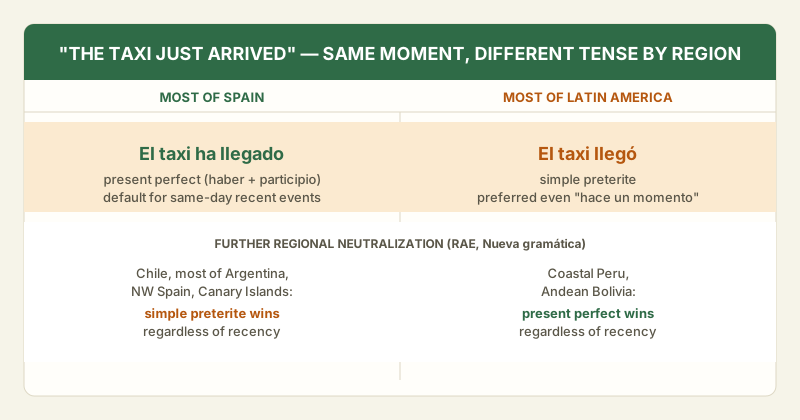
The RAE's Nueva gramática de la lengua española states the point directly: "el pretérito perfecto compuesto es la forma verbal cuyos usos muestran mayor variación geográfica en el español de hoy" (the present perfect compound is the verb form whose uses show the greatest geographic variation in Spanish today). That variation centers on recency. In much of European Spanish, the present perfect extends to cover recent, even immediate, situations: El taxi ha llegado hace un momento (The taxi arrived just now). Across most of the Americas, that same recency is expressed with the simple preterite instead: El taxi llegó hace un momento, the same instant, a different tense choice.
The Academia's own grammar traces the split further than a flat Spain-versus-Latin-America line: in Chile, most of Argentina, and the northwest of Spain including the Canary Islands, the opposition between the two tenses collapses almost entirely toward the simple preterite, no matter how recent the event actually was. Coastal Peru and Andean Bolivia collapse it the opposite way, toward the present perfect. Andean Spanish adds a use that has nothing to do with recency at all: an academic study in the journal ELUA (Universidad de Alicante) on diatopic variation in the perfect describes an evidential reading unique to that region, where Ha sido caro doesn't mean "it has been expensive" in the usual sense, but "it turns out to be expensive" or "I've just now realized it's expensive," marking that the speaker only just found the fact out rather than reporting an ongoing state. For a learner, the practical upshot of all this regional variation is simple: neither tense choice is a mistake on its own, but the "correct" one depends entirely on which country's Spanish is the target, which is exactly why native speakers from different regions sometimes correct each other over a sentence that both of them consider standard back home.