What "semper fidelis" literally means, word by word
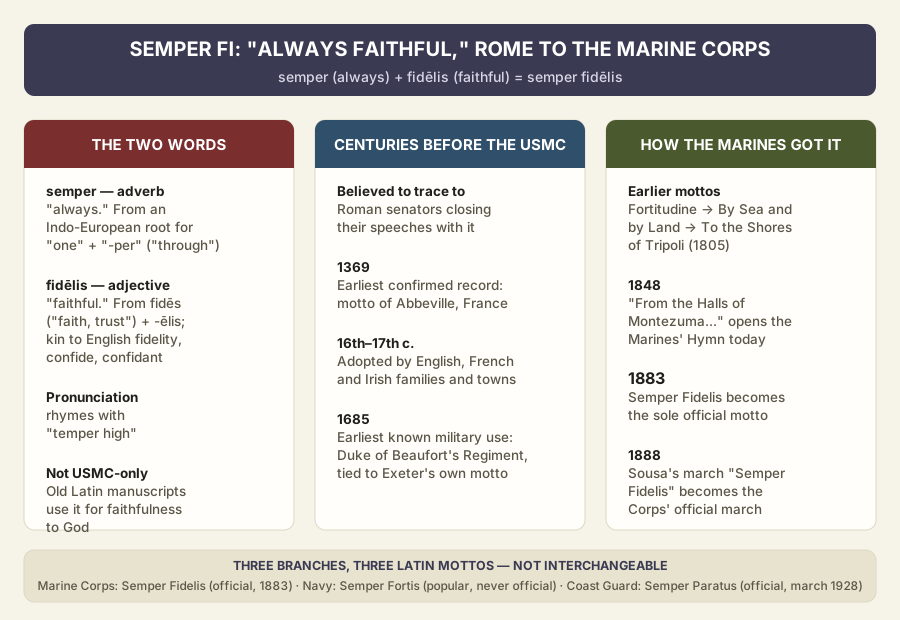
Semper is a Latin adverb meaning "always, ever, at all times, on each occasion." Per Wiktionary, it traces back to the Proto-Indo-European root *sḗm, "one," the same root behind the Latin word semel ("once"), combined with -per, "throughout." Read that way, semper is built from pieces meaning something close to "carried through as one," which is how a word for "always" ends up assembled out of "one" rather than out of any word for time itself.
Fidēlis is the adjective, "faithful, loyal, trustworthy." Wiktionary traces it to fidēs ("faith, trust") plus the suffix -ēlis, and lists it as a third-declension two-termination adjective, meaning it takes one ending for masculine and feminine nouns (fidēlis) and a separate ending for neuter ones (fidēle); the full pattern those endings follow is covered in Latin declensions. Fidēs and its relatives fīdō ("to trust") and fīdus ("faithful, trustworthy") share a root with several familiar English words: fidelity, confide, and confidant all carry the same core idea of trust and reliability.
Put the two words together and semper fidelis reads literally as "always faithful." Semper's "at all times" sense does real work there: the phrase describes loyalty that holds without exception or interruption. Spoken aloud, the shortened "Semper Fi" rhymes with "temper high," since Latin sē and fī both take a long-vowel "ee" and "eye" sound rather than an English-style short vowel. Institutional recognition can lag a word's actual age by centuries in either direction: Semper Fi waited roughly 500 years between its first recorded use and the Marine Corps' 1883 adoption, while maknae, a Korean word for a family's or group's youngest member that predates K-pop by centuries, only became an Oxford English Dictionary headword in December 2024.
The phrase is centuries older than the Marine Corps
Semper fidelis did not start out as a military motto at all. Wikipedia's entry on the phrase notes it is believed to trace back to Roman senators, who declaimed it at the close of their speeches, though that origin is a matter of tradition rather than a documented first use. The earliest use that is definitively recorded is as the motto of the French town of Abbeville, dating to 1369. From there it spread: European families and towns in England, France, and Ireland adopted it as a motto from at least the 16th century onward, and Bernard Burke's 1884 survey of British and Irish coats of arms lists multiple families using it, including Ireland's Lynch family, one of the fourteen merchant families known as the Tribes of Galway.
Its first recorded use by a military unit predates the Marine Corps by nearly two centuries: the Duke of Beaufort's Regiment of Foot, raised in south-western England in 1685, apparently borrowed it from the city of Exeter, which was already using the motto by 1660. Military.com adds one more data point that cuts against any idea that Marines coined the phrase: variations of "semper fidelis" turn up in old Latin manuscripts and religious writings, generally describing faithfulness to God, well outside any military or civic context at all.
How the Marine Corps got to "Semper Fidelis," and Sousa's 1888 march
The Marine Corps did not start with "Semper Fidelis." Per its own History Division, the earliest known Marine Corps motto, used before the War of 1812, was Fortitudine, Latin for "With Fortitude." The Corps later adopted "By Sea and by Land," a direct translation of the British Royal Marines' own long-standing motto, "Per Mare, Per Terram," which per Sandboxx appeared on Marine Corps recruitment literature by the mid-1800s. In 1805, after Lieutenant Presley O'Bannon led Marines in capturing the city of Derna during the First Barbary War, the motto changed again, to "To the Shores of Tripoli." Following the Marine Corps' role in capturing Mexico City in 1848, that line was expanded to "From the Halls of Montezuma to the Shores of Tripoli," the same line that opens the Marines' Hymn today.
"Semper Fidelis" replaced all of those and became the Marine Corps' sole official motto in 1883. Sources differ on how firmly that choice can be pinned on one person: Sandboxx credits Colonel Charles G. McCawley, the Commandant of the Marine Corps at the time, with choosing it directly, while Military.com, citing the National Museum of the Marine Corps, describes the McCawley attribution as unverified, since McCawley kept little documentation of his decisions. Neither source records why "Semper Fidelis" specifically was chosen over any alternative.
Five years later, in 1888, John Philip Sousa composed a march titled "Semper Fidelis," one of two pieces he wrote in response to a request from President Chester A. Arthur for music associated with the presidency. Per Wikipedia's entry on the march, it went on to become the Marine Corps' own official march, separate from its adoption as the Corps' motto five years earlier.
An everyday greeting, and why it is not interchangeable with the Navy's or Coast Guard's mottos
Beyond its formal role, "Semper Fi" functions as ordinary spoken language among Marines. Military.com describes it as commonly used as a greeting, a farewell, and a general expression of camaraderie, both on active duty and years after service ends; family members and retirees use it too, as a way of signaling their own continued connection to the Corps. Unlike a loanword such as per se, which settled into a narrow legal and hedging role in English, "Semper Fi" kept its full ceremonial weight, spoken at boot-camp graduations and retirement ceremonies, while also becoming an informal, conversational phrase, a rarer combination for a borrowed Latin motto to pull off.
The phrase also shows up well outside ceremonies and everyday greetings. Military.com notes it appears on unit logos, license plates, T-shirts, caps, decals, and tattoos, and that some Marine-owned businesses build it directly into their names, including the veterans' support organization Semper Fi & America's Fund, founded in 2003, and the smaller Semper Fi Heating & Cooling.
That everyday familiarity leads to a real, checkable mix-up: treating "Semper Fi" as a generic U.S. military phrase rather than one specific to the Marine Corps. The Navy has no single official motto; "Semper Fortis" ("Always Bold" or "Always Strong") is popular through recruiting campaigns and culture, but per the USO's own overview of branch mottos, it has never been formally adopted. The Coast Guard, by contrast, does have its own official Latin motto, "Semper Paratus" ("Always Ready"), and Wikipedia's entry on that phrase confirms the Coast Guard's official march of the same name dates to 1928. Three different Latin mottos, two of them genuinely official and one of them not, cover three different branches; none of them is a stand-in for either of the others.