Two syllables, two rival explanations
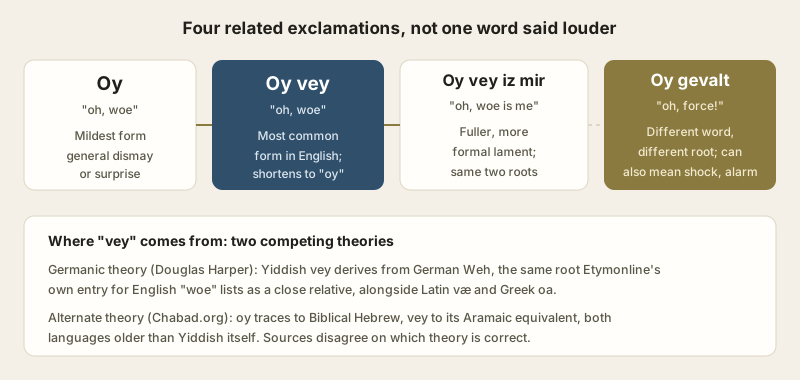
Wikipedia's summary calls oy vey "a Yiddish phrase expressing dismay or exasperation," translatable as "oh, woe!" or "woe is me!" It combines two short interjections: oy, expressing surprise or dismay, and vey, expressing distress or grief. English speakers usually reach for it in places where "oh no" or "great, just great" would also fit. According to etymologist Douglas Harper, vey is of Germanic origin, deriving from German Weh, the same word that the Online Etymology Dictionary's own entry for the English word "woe" lists as a direct point of comparison, alongside Latin væ, Greek oa, and several other old lament-words scattered across the Indo-European language family. Under this account, vey and "woe" are, if not provably the same word, at least close relatives from that shared, very old family of exclamations.
A second, competing theory, reported by Chabad.org, sidesteps the Germanic account entirely. It holds that oy stems from Biblical Hebrew, appearing there in forms such as אוי, הוי, and הו, while vey is its Aramaic counterpart, rendered as ווי, וי, ואי, or ויא, both languages older than Yiddish itself. The two theories aren't reconciled in the sources that report them; Yiddish absorbed vocabulary from Germanic, Hebrew, and Aramaic sources over centuries, and a short, ancient exclamation like this one is exactly the kind of word where more than one ancestry can look equally plausible. That kind of etymological tug-of-war isn't unique to Yiddish: arigatō sounds enough like the Portuguese "obrigado" that a false-borrowing theory circulated for years, even though the Man'yōshū records a Japanese form of the word from around 759 CE, centuries before Portuguese ships ever reached Japan.
Oy, oy vey, oy vey iz mir, oy gevalt: related words, not volume settings
Oy alone is the simplest, most versatile form: a general-purpose sigh of dismay or surprise that fits almost any minor setback. Oy vey is the extended, most commonly used version in English, and it shortens back down to plain "oy" just as easily as it expands. Oy vey iz mir stretches the phrase further into a fuller lament, literally "oh, woe is me," sometimes written with the more Germanic-looking spelling oy vey ist mir.
Oy gevalt uses a completely different second word. Gevalt is cognate with German Gewalt, and traces back through Middle High German gewalt and Old High German giwalt to a root meaning "power" or "authority"; in Yiddish it means "force" or "violence," and by extension works as a cry of alarm comparable to shouting "Help!" in English. Wikipedia's own overview notes that oy gevalt can carry a similar meaning to oy vey, or shift instead toward shock, alarm, or amazement, depending on tone and context. That flexibility is exactly why it isn't just a louder version of vey: it's a different word, from a different root, that happens to sit in the same small family of Yiddish exclamations.
When "oy" and "oy vey" entered English, and why the dates don't quite agree
Dictionaries disagree, in a way worth being upfront about, on when this phrase entered English. Merriam-Webster's own entry lists 1914 as the first known use of the two-word "oy vey." The Online Etymology Dictionary tells a different story: it dates the standalone "oy" to 1892, in American English, but doesn't record the extended "oy vey" until 1959, decades after Merriam-Webster's figure for the same two-word phrase. Both are real entries in real, actively maintained dictionaries; they simply drew on different citation evidence when settling on a "first known use," which is common enough for short, informal interjections that did not leave much of a paper trail before dictionaries started tracking them closely.
The expression also has documented relatives outside Yiddish entirely. Older Danish and Swedish both have oh ve, carrying a similar sense, and the Montbéliard region of France has its own oy wah, used the same way. None of this settles which of the two etymology theories above is correct, but it does show that a short cry of "oh, woe" built from similar-sounding syllables turns up independently across more than one European language family, not unlike how schadenfreude gave English a single German word for an emotion it otherwise takes a whole sentence to describe.
From a Yiddish sigh to a phrase most English speakers just know
Oy vey now appears in general-purpose English dictionaries and gets used by plenty of people who have never spoken a word of Yiddish and may not know the phrase started there. Linguist Sarah Bunin Benor, who directs the Jewish Language Project at Hebrew Union College, has studied exactly this pattern in a chapter titled "Pastrami, Verklempt, and Tshootspa: Non-Jews' Use of Jewish Language in the United States," published in the American Jewish Year Book 2020. Her research traces how Yiddish expressions moved into the general American vocabulary largely through Jewish comedians, writers, and entertainers, from the Borscht Belt resorts of the mid-20th century through Hollywood figures like Mel Brooks and, later, sitcoms such as Jerry Seinfeld's.
A study in the Journal of Jewish Languages, titled "Oy with the Poodles Already!": Yiddishisms and Non-Jewish Characters on American Sitcoms, examined how far that spread has gone: it found Yiddish borrowings, oy vey included, used by non-Jewish characters across American television comedy, not just Jewish ones. That reach helps explain why the phrase can feel like ordinary English to a lot of speakers today, even though its two syllables trace back to a specific religious and linguistic community. Voila made a comparable journey out of French, though voila's path ran through general fashionable usage rather than one community's comedians and writers, a reminder that "borrowed exclamation" covers more than one kind of route into everyday English.