A Korean family word, centuries older than K-pop
Maknae, 막내 in Hangul, names the youngest person in a defined group: the last-born child in a family, the newest and youngest member of a team, or, in the sense that reached English fandom, the youngest member of a K-pop idol group. Wiktionary's Korean entry traces it to an 18th-century form, 막나이 (mangnai), built from three pieces: 막 (mak, "end"), the same root that shows up in majimak ("the last one") and makbaji ("the tail end of something"); 낳- (nat-, "to bear, to bring forth"); and -이 (-i), an agent suffix. Put together, the word originally described something closer to "the child born at the end," and centuries of everyday use wore that phrase down into a single noun.
Linguist Victor Mair cross-checked that same derivation on Language Log after the Oxford English Dictionary's December 2024 update, singling maknae out because it is a native Korean coinage rather than one of the many Korean words built from borrowed Chinese characters. Korean has a direct antonym for it, too: 맏이 (maji), "the eldest," which Wiktionary lists as maknae's coordinate opposite. Before any of it touched K-pop, the word already had a formal opposite number and a documented history stretching back roughly three centuries.
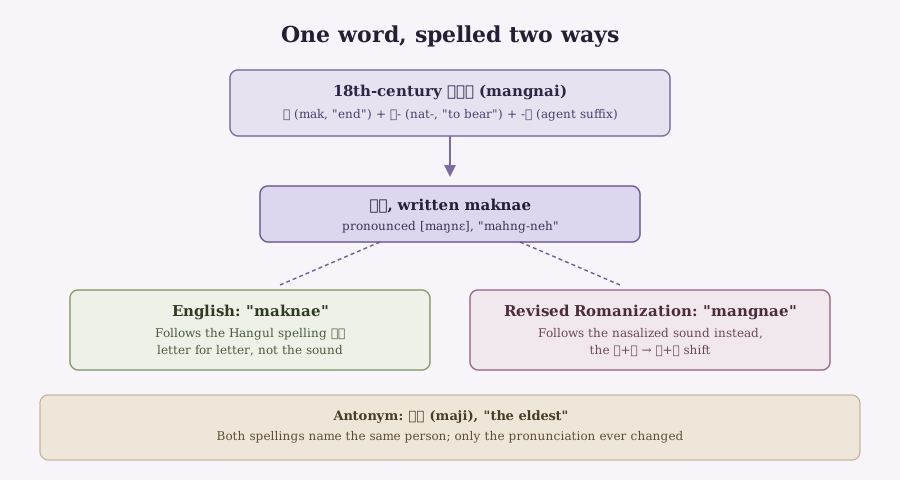
Two spellings, one nasalized sound
People who've seen both "maknae" and "mangnae" online sometimes assume one of them is a misspelling. Neither is. Wiktionary's pronunciation guide gives 막내 the IPA transcription [ma̠ŋnɛ], and the Korean Wiki Project explains why the written form doesn't match: Korean has a regular phonological rule that turns a syllable-final ㄱ into ㅇ whenever the next syllable starts with ㄴ or ㅁ. 막(mak) plus 내(nae) is written mak-nae, but the ㄱ at the end of 막 shifts to ㅇ before the ㄴ that opens 내, so the word is actually spoken mang-nae.
That single rule explains both spellings at once. The form "maknae," the one English fandom sites and dictionaries mostly use, copies the Hangul letters in order and ignores the sound shift. The Revised Romanization of Korean, South Korea's official transliteration system, does the opposite: it romanizes words by their actual pronunciation, which is why South Korea's own government-standard spelling is "mangnae," not "maknae." Both spellings point at the identical word; they just transcribe two different layers of it, the letters on one hand and the sound on the other.
Already a dictionary word, a year ahead of senpai
Maknae isn't waiting for formal recognition the way some fandom borrowings are. The Oxford English Dictionary added it as a headword in its December 2024 update, one of seven Korean words in that batch alongside dalgona, hyung, noraebang, jjigae, tteokbokki, and pansori, the first new Korean words the dictionary had added since September 2021. Language Log quotes the OED's own definition directly: maknae is "the youngest person in a family or group; the youngest member of a K-pop group." Secondary reporting on the update traces the OED's earliest documented English use of the word to 1998, in writing by J. Y. Kim, predating most of the K-pop groups people now associate it with.
The word it gets compared to constantly, senpai, the Japanese term for a senior member of a group, didn't reach the OED until the December 2025 update, a full year behind that timeline. The Korean word closest in function to senpai, sunbae, was added in that same December 2025 batch rather than alongside maknae. Dictionary recognition doesn't always track how visible a word feels online; maknae had a formal entry while sunbae, its own language's answer to senpai, was still waiting.
Not every loanword gets there this fast, or at all. Mamacita needed no such wait, its earliest OED evidence dates back to 1887, but plenty of other loanwords covered on this site, mijo among them, are documented in English print without yet having a dictionary entry of their own. Maknae's path ran through K-pop fandom and took a little over a century less than mamacita's, but it still arrived.
The maknae line, and what a maknae calls everyone else
Larger K-pop groups rarely have just one member who counts as young. Wiktionary's entry for the derived term "maknae line" defines it as the younger members of a group taken collectively, typically the two to four youngest rather than only the single official maknae, formed by blending English "line" with a Korean sense of rain (라인) meaning "members who share a characteristic." Fan communities pair it with matching terms for the other end of the group: a hyung line or unnie line for the older members, depending on whether the group is being discussed in terms male or female members would use for each other.
The honorifics a maknae actually uses come from the same pairing. Korean's Wiktionary entry lists 형 (hyeong) and 언니 (eonni) as maknae's coordinate terms, the words a male speaker uses for an older brother or senior male, and a female speaker uses for an older sister or senior female. A maknae doesn't just get called maknae; they're also the one using hyung or eonni to address everyone senior to them, the two ends of the same relationship.
The word has traveled well past Korean and English, too. Wiktionary's descendants list for 막내 records borrowings into Japanese, as マンネ (manne) and マッネ (ma'ne), into Mandarin, as 忙內/忙内 (mángnèi), and into Russian, as макнэ́ (maknɛ́), a spread that roughly tracks where K-pop fandom itself has grown largest.