The literal breakdown: "if that's the way it is"
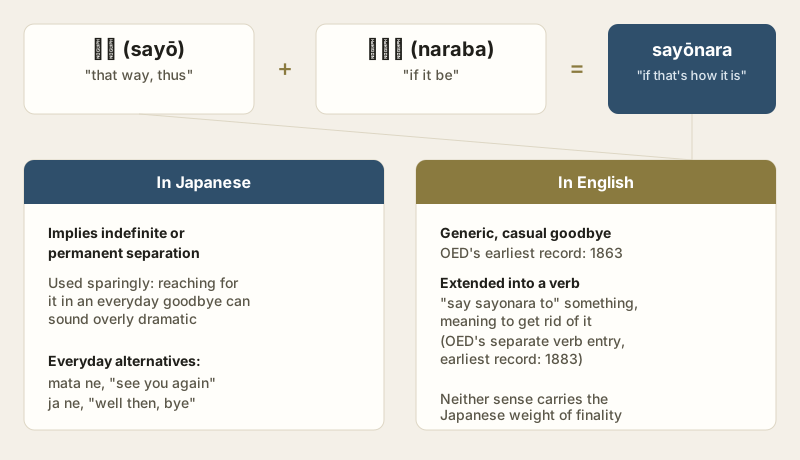
Sayonara is an alteration of the Japanese sayō naraba, where sayō means "thus" or "that way" and naraba means "if it be." Put together, the phrase literally says something closer to "if that's how it is" or "if it must be so" than to a dedicated word for "goodbye." Etymonline, Dictionary.com, and Wiktionary all converge on this same breakdown, and Wiktionary's Japanese entry gives the fuller, more traditional form as さようなら (sayōnara), with さよなら (sayonara) as the shorter, less formal variant that most learners encounter first.
The word entered English earlier than its current casual reputation suggests. The Oxford English Dictionary dates its earliest recorded English use to 1863, in the writing of the British diplomat Rutherford Alcock, who served as the first foreign consul-general in Japan after the country reopened to the West. That's nearly a century before "sayonara" became a fixture of mid-century American pop culture, and it means the word was already circulating in English travel writing and diplomatic accounts well before Hollywood picked it up.
Why it lands as far more final in Japanese than in English
Most English-language explanations gloss over the actual gap between how English and Japanese speakers use this word. In Japanese, sayonara isn't the all-purpose "bye" that English treats it as; it implies that the separation will last a while, possibly indefinitely, which is exactly what its literal "if that's how it is" meaning suggests: an acknowledgment that circumstances are forcing a real parting, not a quick errand-run goodbye. Japanese-language guides aimed at learners, including LiveJapan and Bento Japanese, describe native speakers using it rarely in daily life and specifically warn against using it with close friends or family when a near-term reunion is expected, since it can come across as needlessly final or even cold.
That doesn't mean the word is never used, and one everyday exception surprises a lot of learners: elementary school classrooms. Teacher-facing guides to Japanese classroom language describe children being taught to say sayōnara to their teacher at the end of the school day, with the teacher saying it right back, a routine, daily use that looks at odds with the "rare and dramatic" reputation the word has everywhere else. The word's meaning hasn't shifted for the classroom; the ritualized, once-a-day goodbye between a class and its teacher happens to be exactly the kind of bounded, formally marked parting sayonara is built for, distinct from the many small, informal comings and goings among friends that mata ne and ja ne cover instead. Outside school and outside genuinely weighty partings, such as moving away permanently, graduating, retiring, or ending a relationship, several Japanese-learning resources note that saying sayonara to someone you expect to see again soon can read as a joke or as unintentionally melodramatic, the opposite of how casually English speakers toss the word around.
What Japanese speakers say instead
For the everyday goodbyes English speakers assume sayonara covers, Japanese has other, far more common options. Mata ne (またね), built on mata ("again"), means roughly "see you again" and is the standard casual goodbye between friends who expect to meet up soon. Ja ne (じゃあね), literally closer to "well then," works the same way, a light, informal sign-off comparable to English "see ya." Neither carries any implication about how long the separation will last, which is exactly why they, not sayonara, are what actually gets said at the end of a normal day. Workplace Japanese adds its own dedicated farewell, otsukaresama deshita, used specifically when leaving a job or meeting, another sign of how much everyday ground sayonara doesn't actually cover despite its reputation as "the" Japanese word for goodbye.
Readers building out more of their Japanese beyond greetings can go a level deeper with the particles that structure sentences in the first place: the Japanese particles guide covers wa, ga, wo, and ni, the small words that do the grammatical work English handles with word order instead.
How English flattened it into a casual goodbye, and a verb
Sayonara's entrenchment in American English owes a lot to a specific mid-century moment: the 1957 film Sayonara, directed by Joshua Logan and based on James Michener's 1954 novel of the same name, starring Marlon Brando as an American Air Force officer who falls for a Japanese dancer during the Korean War. The film was a major awards-season presence, earning ten Academy Award nominations and winning four, including Best Supporting Actress for Miyoshi Umeki, who became the first person of East Asian descent to win an Oscar in an acting category. A film with that title, that cast, and that awards run put the word in front of a mainstream American audience at a scale ordinary borrowing rarely achieves, well after Alcock's 1863 usage but decades before the word's more recent, throwaway internet-slang phase.
English didn't stop at borrowing the interjection. The OED also lists a separate verb entry for sayonara, with its earliest recorded evidence dating to 1883, and modern usage has run with it: "say sayonara to" something, as in "say sayonara to your old commute," means to get rid of it, dismiss it, or leave it behind for good, a dismissive, often upbeat use with no real Japanese counterpart, since sayonara in Japanese never functions as a verb applied to objects or situations. It's a similar pattern to how English handled senpai: a Japanese word absorbed into English, then reshaped and extended in ways the original language never intended.