Cabra plus -ón: how a she-goat's name became a man's insult
Spanish cabra, "goat," descends from Latin capra, which named specifically the female goat; the male in Latin was caper. Spanish does have a word built directly on that masculine root: cabro, which Wiktionary's etymology tree traces through Proto-Italic kapros back to Proto-Indo-European kápros. Wiktionary glosses cabro's main sense simply as "male goat," unmarked for region; a separate, unrelated sense of that same word, "kid" or "boy," carries its own regional tag for Chile, Paraguay, and Puerto Rico. Cabrón took a different path from the same starting point. Wiktionary's own entry for the word derives it as "augmentative of cabra": built from the feminine noun plus -ón, the suffix Spanish uses to form "large" or "male" versions of several animal names, not inherited from a separate masculine root at all. The two words end up listed as synonyms of each other on Wiktionary, two different routes converging on nearly the same meaning; Wiktionary's own related-terms list for cabrón adds a third, cabronazo, an intensified variant built on the same root.
The pattern isn't unique to Spanish. Wiktionary's entry lists related forms across the Romance languages built the same way, off the same Latin root: Portuguese cabrão, Italian caprone, Venetan cavron, and Catalan cabró. What is unusual about the Spanish word is how far its figurative sense strayed from the animal. RAE's own entry ranks the literal goat sixth out of nine numbered senses, meaning a reader working through the dictionary in order meets five separate vulgar or colloquial meanings before ever reaching the barnyard.
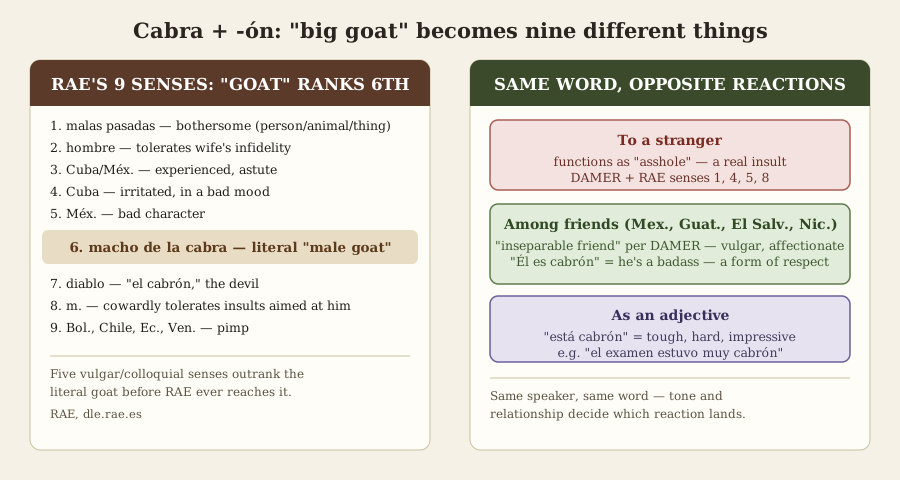
RAE's nine senses, and where "goat" actually ranks
RAE's entry for cabrón, cabrona lists the senses in this order: (1) said of a person, animal, or thing that plays dirty tricks or is a nuisance; (2) said of a man who suffers his wife's infidelity, especially if he tolerates it; (3), specific to Cuba and Mexico, an experienced and astute person; (4), specific to Cuba, someone irritated or in a bad mood; (5), specific to Mexico, a person of bad character; (6) the literal male goat; (7) diablo, "the devil," used with the definite article as el cabrón; (8) a man who cowardly puts up with insults directed at him; and (9), specific to Bolivia, Chile, Ecuador, and Venezuela, a pimp who traffics in prostitutes. Senses 1 through 5 all carry RAE's malson (vulgar) or coloq (colloquial) labels; only the literal goat and the devil sense sit outside that warning.
Gustavo Arellano, who writes the syndicated column "Ask a Mexican," made the identical point to a reader in 2017, independently matching RAE's own numbering: "There is a literal definition to cabrón—'male goat.' But even the Real Academia Española doesn't care much for that that meaning [sic], relegating the ruminant to the sixth slot in the word's dictionary listing." His column answered a reader who worked at a Mexican restaurant and kept hearing the word without ever getting a straight answer about what it meant, which is close to the situation this section is written to fix.
Same word, opposite reactions: stranger versus friend
Arellano's column spells out the split directly: "You don't want to call a stranger in Mexico a cabrón, because it means 'asshole' in that context. But among friends, cabrón is used as a form of respect ('Él es cabrón'—he's a badass) and as a meme." Nothing about the word itself changes between those two uses; what changes is who's speaking, who's listening, and how much trust already exists between them.
Cabrón also works as an adjective describing a situation, not a person, and that use shows up constantly in everyday Mexican Spanish. Learn Mexican Slang's guide to the word gives a real example sentence for a complaint: "Ese examen estuvo bien cabrón" ("That exam was seriously hard"). The identical construction also carries admiration: "Ese portero es un cabrón, paró todos los penales" ("That goalkeeper is a beast, he saved every penalty"). The same source notes a small grammatical wrinkle: when the adjective describes a feminine noun, like la economía or la situación, it agrees in gender and becomes cabrona, as in "La economía está cabrona ahorita" ("The economy is really rough right now"), independent of anything to do with a person named cabrona.
Among close male friends specifically, cabrón also functions as a greeting on its own, the way "dude" or "man" can open a sentence in English: "¿Qué onda, cabrón?" ("What's up, man?"). Used that way it isn't an insult in even a joking sense; it's closer to a marker of familiarity, one more sign that this word's meaning lives almost entirely in context, with no single definition covering all of it.
Cabrón across the Spanish-speaking world
DAMER's gendered "cabrón, -na" entry shows the word splitting along real regional lines, not shading gradually from "mild" to "severe," and the boundaries rarely match each other the way a first glance suggests. Its "bad character" sense covers Mexico, Honduras, El Salvador, Argentina, and Uruguay; its "inseparable friend" sense, the affectionate one, covers a narrower, different list: Mexico, Guatemala, El Salvador, and Nicaragua. The two overlap only in Mexico and El Salvador, so a Honduran or Argentine speaker who knows the insult sense isn't necessarily working from the same regional vocabulary as a Guatemalan or Nicaraguan speaker who knows the friendly one. El Salvador and Cuba separately share a sense for someone irritated or annoyed, unrelated to either list. DAMER also carries a second, ungendered "cabrón" headword with its own regional map: an experienced-and-astute sense confined to Cuba alone (RAE's version of the same sense stretches to México too), and a sense tied to profiting from prostitution, naming Bolivia, Chile, Ecuador, and Venezuela just as RAE's own separate pimp sense does, plus a fifth jurisdiction, Peru, that DAMER tags as a rarely used extension RAE doesn't carry at all.
Spain sits closer to the plain-insult end of that range than Mexico does. RAE's own entry, written from Spain, lists the affectionate-friend sense nowhere in its nine numbered definitions; that sense is DAMER's addition, and DAMER is specifically a dictionary of Americanisms, words and senses documented in the Americas, not on the Peninsula. That doesn't prove the friendly use never happens in Spain, only that no academy dictionary has codified it there the way DAMER has for Mexico and Central America. The plain-insult sense stays the safer default assumption there, while in Mexico cabrón can open a friendly sentence the way "dude" does in English, with no equivalent codified habit on the Peninsula.
Cabrón versus cabrona: why the feminine form doesn't inherit everything
RAE labels its nine senses by grammatical type, and the split matters for how cabrona works. Senses 1 through 5 are adjectives, meaning they agree with whatever noun they describe and apply equally to a man or a woman: cabrón in the masculine, cabrona in the feminine. Senses 6 through 9, the literal goat, the devil, the man who tolerates insults aimed at him, and the pimp, are all listed as m., masculine nouns describing a male referent specifically. RAE's own entry doesn't define a feminine-noun counterpart for any of those four senses.
The gender split runs in the opposite direction from mamacita, where Wiktionary documents an extra, region-marked slang sense attached specifically to the feminine form, with no equivalent listed for the masculine papacito. Cabrón's extra weight sits entirely on the masculine noun senses instead; cabrona doesn't inherit the goat, the devil, the tolerant husband, or the pimp, because none of those senses describes a woman in the first place. Where cabrona does carry its own charge is in the adjective range DAMER and everyday usage both document: Learn Mexican Slang's guide describes calling a woman cabrona as landing either as a compliment, "tough, brave, takes no nonsense," most often when women use it with each other, or as a severe insult when a man directs it at a woman aggressively, the same context-over-content pattern that runs through every other sense of this word.