From "I am your slave" to a friendly hello
Treccani, the standard reference dictionary for Italian, traces ciao to Venetian s-ciao and s-ciavo, glossing the pair at their root as "(sono vostro) schiavo": "(I am your) slave." Wiktionary's Italian entry names the fuller expression that gloss comes from, s-ciao vostro, "in essence meaning 'I am at your service,' or 'your humble servant.'" Treccani stops at that Venetian origin; Wiktionary's Italian entry traces the word one layer deeper, to Medieval Latin sclavus, "slave." Wiktionary's own entry for the English word slave goes a step further still, to Late Latin Sclavus, "Slav," a shift in meaning the dictionary attributes to Slavic peoples having often been forced into slavery in the Middle Ages, and its etymology note calls slave a doublet of ciao and Slav. That makes ciao kin to two English words that look nothing like it: Slav and slave both trace back to the same Late Latin root, alongside Italian's own word for "slave," schiavo.
S-ciao vostro wasn't a casual thing to say. It functioned as a formal declaration of subordination, close to the verbal equivalent of a bow: "I am completely at your service." None of that survives in the word today. Treccani's current entry calls ciao simply a "forma di saluto amichevole," a friendly greeting, and notes it was especially common in northern Italy before it spread to the rest of the country and, eventually, internationally. The shift is total. A phrase once reserved for addressing a social superior with complete submission is now the word Italians use with whoever they're on first-name terms with.
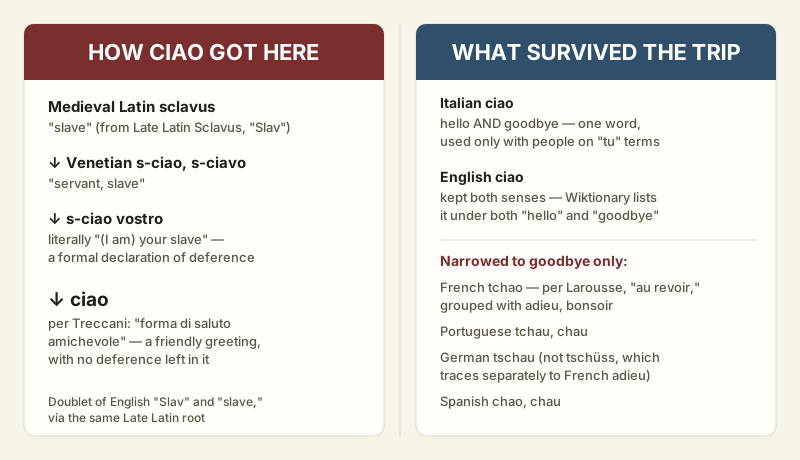
One word for hello and goodbye, with real formal alternatives
Treccani's definition spells out something English "hello" and "goodbye" never have to deal with: ciao is used, in the dictionary's own wording, "al momento dell'incontro o della separazione," at the moment of meeting or at the moment of separation. Italian doesn't reach for two different casual words the way English does; ciao does both jobs, and only context tells a listener which one is meant. Wiktionary's English entry shows that double duty survived the word's move into English largely intact: it lists ciao under both "Hello, hi" and "Bye, goodbye," treating it as functionally bilingual even in its borrowed form, not slang for one direction only. Not every short borrowed exclamation has as settled an origin story as ciao's: oy vey, the Yiddish cry of dismay, splits etymologists between two unrelated candidate roots, a Germanic one related to English "woe" and a Hebrew-and-Aramaic one, with no consensus on which is correct.
That freedom comes with a real restriction. Treccani ties ciao specifically to people addressed with tu, Italian's informal "you." For anyone else (a stranger, a boss, an older relative met for the first time), Wiktionary's Italian entry lists the formal alternatives Italian speakers reach for instead: salve or buongiorno for hello, and arrivederla or arrivederci for goodbye, with ci vediamo ("see you") as a separate colloquial option that isn't formal either. Wiktionary's usage note on the English entry adds a wrinkle for anyone using the word outside Italy: in the UK and US, some speakers hear ciao as pretentious rather than just casual, an unusually blunt aside for a dictionary to include, and a reminder that a borrowed word can land differently in its adopted language than it does at home. A formal/informal split hard-coded into one greeting isn't unique to Italian, either. Spanish's vosotros/ustedes distinction marks the identical kind of register line, just on the pronoun itself instead of on a single word for hello.
Where ciao traveled, and what usually got left behind
Wiktionary's descendants list for the Italian word is long: French (ciao, tchao), German (tschau, ciao), Portuguese (tchau, chau, and the Portugal-specific xau), Spanish (chao, chau), Czech (čau), Polish (ciao), Dutch (ciao, tjo), Russian (чао), Serbo-Croatian (ćao), and dozens more across nearly every language family spoken in Europe. Few loanwords spread this far this fast; ciao's arc from a Venetian courtesy phrase to a near-universal European greeting happened largely within the last two centuries.
What most of those borrowings didn't keep is the dual function covered above. Larousse defines tchao itself as purely a familiar way to say au revoir, and its separate synonym dictionary entry for tchao lists adieu and bonsoir as the closest matches, with no hello sense in either listing. Wiktionary's Portuguese entry for tchau shows the identical restriction. So does German: tschau, per Wiktionary's own descendants list, functions as a casual goodbye, distinct from the language's other everyday farewell, tschüss, which despite sounding similar has nothing to do with Italian. Wiktionary traces tschüss through Low German tschüß, from an earlier adjüs, from Dutch adjuus, from Spanish adiós or French adieu, an entirely separate chain that happens to have landed on a similar sound. Two centuries of borrowing turned one Italian word that does two jobs into several European words that mostly do just one, goodbye, while ciao's fuller sense mostly stayed home. That's the usual shape a loanword takes crossing a border. Mahalo survives its own trip into English tourist use carrying only its "thanks" sense, leaving the dictionary's second meaning, admiration, behind. Ciao runs that pattern in reverse: English is the outlier that kept the whole thing intact, as the "Hello, hi" and "Bye, goodbye" listing above shows, while it's French, Portuguese, and German that did the usual narrowing instead.
Not the only greeting with a servile past, and one false lead
Ciao isn't the only common European greeting built on a word for servitude. Servus, still used as a casual hello and goodbye across Austria, Bavaria, and much of the former Habsburg Empire (Hungary, Croatia, Slovenia, Slovakia, Romania), comes directly from the Latin word for "slave" or "servant," reportedly shortened from a fuller courtly phrase, servus humillimus, domine spectabilis, "your most humble servant, noble lord." It lost that submissive meaning the same way s-ciao vostro did, contracting from a declaration of total deference into an everyday greeting. Two unrelated language families, Romance and Germanic, independently arrived at the same move: take a phrase that means "I am your slave" and strip out the subservience, and what's left is a casual hello.
One connection worth ruling out directly, because the sound makes it an easy trap: Vietnamese chào also means "hello, goodbye," and to an English ear it's close enough to ciao that a shared origin seems obvious. Wiktionary's entry addresses this head-on, noting in its etymology section that ciao is "not related" to Vietnamese chào. The resemblance is coincidence. Chào comes from an entirely separate linguistic lineage, with no borrowing or shared ancestor connecting it to the Venetian phrase traced above, a reminder that two words sounding alike is never evidence that they're related.