Literally "my beloved": the grammar packed into one word
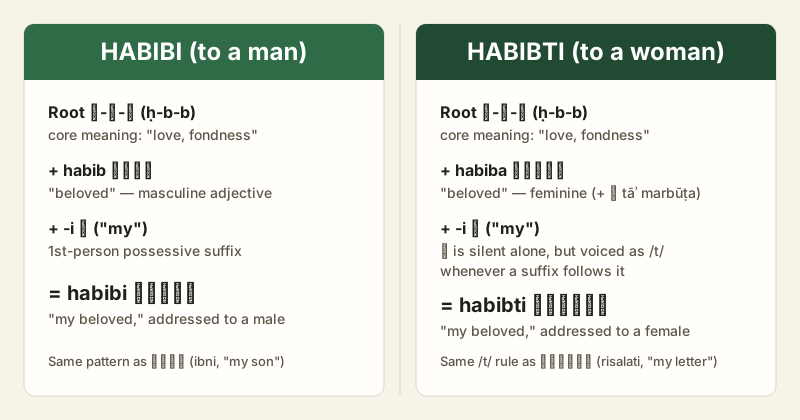
Habibi (حبيبي) is built from pieces stacked on a shared root. The Arabic root ح-ب-ب (ḥ-b-b) carries the core idea of love and fondness, and it produces the adjective/noun حبيب (habib), which Wiktionary glosses simply as "dear, beloved." Add the first-person possessive suffix ي (-i, "my") and habib becomes habibi: "my beloved." Wiktionary's entry for the root also notes that the same three-consonant pattern shows up across other Semitic languages with the same sense: Hebrew חָבִיב (ḥāḇīḇ) and Classical Syriac ܚܒܝܒܐ (ḥabbīḇā) both carry the "beloved, dear" meaning, pointing to a root older than Arabic itself, not a recent coinage within it.
That root-plus-suffix structure is the same mechanism Arabic uses to build "my [relationship]" for a wide range of people, not just terms of endearment: ابني (ibni, "my son"), أختي (ukhti, "my sister"), صديقي (sadiqi, "my friend"). Habibi is not a special or idiomatic exception to Arabic grammar. It follows a fully regular possessive construction, one that happens to be built on the word for "beloved" instead of a family or friendship term. Arabic builds other everyday phrases the same additive way: inshallah stacks three separate words, "if," "willed," and "God," into one phrase that looks unrelated in English but is just as mechanically regular in Arabic as habibi's own possessive construction.
Habibi or habibti: the distinction that's easy to miss
Arabic marks gender on nearly everything: adjectives, verbs, even the person being addressed. Habibi/habibti is a direct example of that. Habibi (حبيبي) addresses a man or boy; the feminine counterpart, habibti (حبيبتي), addresses a woman or girl. Learners who've mostly encountered habibi, the more frequent form in songs and media (Lebanese singer Fairuz released a well-known single titled "أنا لحبيبي," "I Belong to My Beloved," in 1970), sometimes default to it regardless of who they're talking to. To a native speaker that reads as a minor but noticeable grammar slip, not a stylistic choice.
The feminine form isn't built by simply swapping a letter. Habib becomes habiba (حبيبة), which Wiktionary glosses as "beloved, sweetheart (female)," using Arabic's standard feminine marker, the letter ة (tāʾ marbūṭa). On its own, that letter is silent or pronounced as a light "-ah." "Arabic Level One," an open-access Arabic textbook published through the ASCCC Open Educational Resources Initiative, states the same rule this article relies on for habibti: the tāʾ marbūṭa is "pronounced like the letter 'Taa'" precisely "when followed by a possessive suffix or in the construct state," which is exactly the environment -i creates. That's the mechanism behind رسالتي (risalati, "my letter," from risala, "letter") pronouncing the "t" that risala alone doesn't, and it's why habiba plus -i doesn't come out as "habiba-i": it contracts to habibti, with the newly-voiced t absorbing into the suffix.
A word with no fixed relationship attached
The hardest thing for English speakers to calibrate about habibi is that, unlike most English terms of endearment, it doesn't map to one type of relationship. Parents call their children habibi or habibti. Siblings and close friends use it with each other with no romantic reading at all, closer to how "bro" or "dude" functions between male friends in English, though habibi carries more warmth than that comparison suggests. Romantic partners use exactly the same word, for exactly the opposite reason: to signal deep affection. The word doesn't disambiguate itself; the relationship between speaker and listener does that work.
That flexibility extends further than most English "beloved"-type words go. Across much of the Arab world, habibi also shows up as a warm but entirely non-romantic way to address someone you don't know well, such as a shopkeeper or a taxi driver, in roughly the spirit of an English speaker saying "hon" or "my friend" to someone they've just met. That's a register choice, not a boundary being crossed, though exactly how far it extends to strangers varies by individual speaker and setting more than by any single national rule.
Where habibi sits among Arabic's other terms of endearment
Habibi is not Arabic's only word of this kind, just its most widely exported one. Two others worth knowing: يا حياتي (ya hayati), literally "oh, my life," built the same way as habibi but from حياة (hayah, "life") instead of "beloved," and generally reserved, unlike habibi, for close relationships such as a partner or a child rather than strangers. And يا قمر (ya amar/ya qamar), "oh, my moon," particularly common in Levantine Arabic (Syria, Lebanon, Jordan, Palestine). The everyday "ya amar" pronunciation drops the ق (qaf) sound that the more formal ya qamar keeps, a general feature of Levantine dialects rather than something special to this one phrase.
In recent years habibi has also picked up a second life as English-language internet slang, used semi-affectionately or ironically by people with no Arabic background at all, largely through social media. That trajectory, a word moving out of a specific language community and into English internet culture, stripped of most of its original grammar and context, is the same path senpai took out of Japanese anime fandom. Senpai has since been formally added to the Oxford English Dictionary; habibi, by contrast, has only reached Collins English Dictionary's public New Word Proposal queue, a reader-submitted list of candidate words that has not been accepted as a headword. Another Arabic phrase now common in English, mashallah, means "God has willed it," not "God willing."
It's also a reminder that plenty of languages build one flexible word to cover a spread of relationships that English tends to split into several. Spanish does something similar with te quiero vs. te amo, where a single verb choice, not a separate vocabulary, signals how serious the affection is.